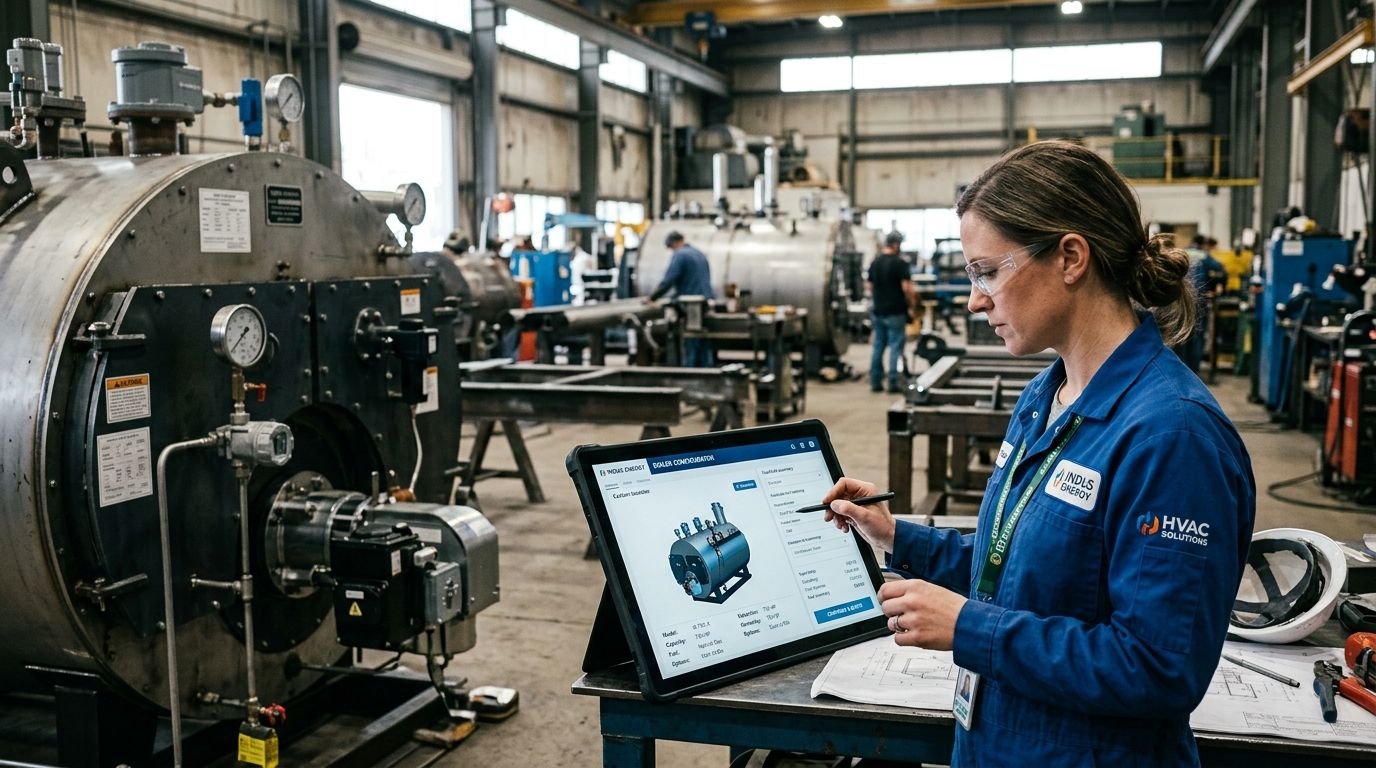
Boiler manufacturers quoting a custom fire-tube unit still spend hours re-keying pressure ratings, ASME stamp requirements, and burner options into a spreadsheet before a number ever reaches the customer. CPQ software for boiler manufacturers is quoting technology that configures multi-component boiler assemblies — pressure vessels, burners, controls, trim packages, insulation — into accurate, code-compliant quotes in minutes instead of days. Boiler quoting differs from generic industrial CPQ because every configuration touches ASME Section I or Section IV compliance, long-lead components, and engineer-to-order variability that a standard product catalog can't handle.
- CPQ software for boiler manufacturers cuts quote turnaround from days to hours by encoding ASME rules and pricing logic into guided configuration.
- Manual quoting on spreadsheets is the default for most shops under $20M in revenue — it works until order volume or SKU complexity climbs.
- SUPPLYCO pairs AI-driven quote generation with existing ERP and CRM systems instead of replacing them — best for teams that already have Epicor, Global Shop, or NetSuite in place.
- Generic CPQ platforms like Salesforce CPQ require heavy configuration investment to model boiler-specific compliance rules that industrial CPQ tools ship with out of the box.
Why CPQ matters for boiler manufacturers
A boiler quote isn't a price lookup — it's an engineering exercise disguised as a sales document. Pressure vessel class, fuel type, burner manufacturer, control package, and site altitude all change the bill of materials and the compliance paperwork attached to the quote. When that logic lives in someone's head or a shared spreadsheet, quote accuracy depends on which estimator picked up the phone.
The cost shows up downstream: a misquoted trim package or missed ASME stamp requirement turns into a change order after the customer has already signed. For shops running SUPPLYCO or any CPQ platform, the goal is the same — get the configuration rules out of individual heads and into a system that enforces them every time.
Audit your current quote turnaround time
Before fixing anything, measure the baseline. Boiler manufacturers routinely quote in days when the bottleneck is manual configuration, not sales capacity.
- Track time from RFQ receipt to quote delivery for the last 20-30 jobs
- Separate turnaround by boiler class (fire-tube, water-tube, packaged, custom skid)
- Flag which quotes required engineering sign-off before pricing
- Note how many quotes went back for revision due to configuration errors
- Identify which reps or estimators are the bottleneck versus which steps are systemic
Map your boiler configuration rules
Every boiler line has a set of rules that determine valid combinations — burner BTU output tied to vessel size, control packages tied to fuel type, insulation tied to ambient operating conditions. Writing these down is the prerequisite step before any software can enforce them.
- Document valid burner-to-vessel pairings by model line
- List control package options by fuel type (natural gas, dual-fuel, biomass)
- Capture ASME Section I versus Section IV requirements by pressure class
- Note which options require engineering review versus standard configuration
- Record lead-time impacts for non-stock components
Build compliance guardrails into your quoting logic
ASME code compliance is the single biggest risk in boiler quoting — a quote that skips a required stamp or misapplies a pressure classification creates liability, not just rework. This is where configuration rules become guardrails rather than suggestions.
- Lock incompatible option combinations so reps can't quote them
- Require ASME stamp selection before a quote can be finalized
- Flag jobs that need a P.E. stamp or third-party inspection sign-off
- Attach compliance documentation automatically to the quote PDF
- Route anything outside standard configuration to engineering before pricing
Manual rule enforcement works at low volume. Once a shop is quoting more than a handful of custom configurations a week, a CPQ system that hard-codes these guardrails removes the risk of a rep overriding them under deadline pressure — and this is typically where boiler manufacturers move past spreadsheets toward dedicated quoting software.
Standardize pricing for common skids and options
Most boiler manufacturers have a handful of configurations that make up the bulk of order volume, even in an engineer-to-order business. Standardizing pricing on those reduces the number of quotes that need custom estimation.
- Set base pricing for the top 5-10 most-quoted skid configurations
- Build option-level pricing tables for burners, controls, and trim
- Define markup rules by customer tier or contract status
- Set freight and installation pricing rules by region
- Flag which configurations still require manual estimation
Automate the quote-to-order handoff
A correct quote that has to be re-keyed into the ERP loses time and introduces the same errors CPQ was supposed to eliminate. Boiler manufacturers running Epicor Kinetic, Global Shop, or a similar ERP need the accepted quote to flow into order entry without manual re-entry.
- Map quote line items directly to ERP part numbers and BOMs
- Push accepted quotes into order entry automatically
- Sync customer and pricing data between CRM and ERP
- Confirm lead times update automatically based on component availability
- Set alerts for any manual override during order entry
This step is where a platform like SUPPLYCO enters the picture — not as a replacement for the ERP, but as the layer that automates quoting and order entry inside the systems boiler manufacturers already run. It's the faster path once the manual rules and pricing standards from the earlier steps are in place.
Measure quote-to-close conversion by boiler class
Not all boiler quotes convert at the same rate. Custom water-tube systems close differently than standard packaged units, and tracking that separately tells a sales team where to focus.
- Track win rate by boiler class and configuration complexity
- Measure average days-to-close by quote value
- Flag quotes that stall past 30 days without follow-up
- Compare conversion rates between reps quoting standard versus custom jobs
- Review lost quotes for pricing versus lead-time objections
Add automated follow-up for stalled quotes
A sent quote that never gets a follow-up call is a lost order waiting to happen, especially on jobs with 8-12 week lead times where a competitor's faster response wins the deal. Comparable to how pump and valve manufacturers manage long-cycle quoting, boiler shops benefit from systematic follow-up rather than relying on rep memory.
- Set automatic follow-up triggers at 3, 7, and 14 days post-quote
- Flag high-value quotes for manual outreach instead of automated email
- Track which follow-up touch actually moved the deal forward
- Route stalled quotes to a manager for a second touch
- Log every follow-up attempt back into the CRM or ERP record
Comparison: CPQ options for boiler manufacturers
| Option | Best for | Key limitation |
|---|---|---|
| Manual quoting (Excel/Word) | Shops quoting under 20 jobs a month with mostly repeat configurations | No compliance guardrails; error rate climbs with custom configurations |
| Generic CPQ (Salesforce CPQ, similar) | Teams with in-house configuration expertise and budget for long implementation | Requires building ASME and boiler-specific rules from scratch |
| ERP-native quoting module | Shops already deep in one ERP wanting quoting inside that system | Rarely handles complex option logic or automated follow-up well |
| SUPPLYCO | Manufacturers wanting AI-driven quoting, order entry, and follow-up layered onto an existing ERP/CRM | Newer entrant compared to legacy CPQ vendors; best suited to teams ready to automate rather than fully customize from scratch |
Common mistakes boiler manufacturers make
- Quoting compliance as an afterthought. Adding the ASME stamp requirement after pricing is set instead of building it into the configuration rules from the start.
- Treating every job as fully custom. Most shops have 5-10 configurations that cover most volume — pricing them individually every time wastes estimator hours.
- No follow-up cadence on long-cycle quotes. An 8-week lead time quote needs more than one email; deals stall when nobody's tracking the 14-day mark.
- Re-keying accepted quotes into the ERP by hand. Every manual re-entry step is a chance to introduce a BOM or pricing error that didn't exist in the original quote.
- Letting reps override configuration rules under deadline pressure. A guardrail that can be bypassed isn't a guardrail — it's a suggestion nobody follows during crunch weeks.
See CPQ built for boiler manufacturers
AI-driven quoting and order entry inside your existing ERP.
FAQ
What is CPQ software for boiler manufacturers?
It's quoting software that configures boiler assemblies — vessels, burners, controls, trim — into accurate, code-compliant quotes without manual re-keying. It's built to handle ASME compliance rules and engineer-to-order variability that generic quoting tools miss.
How is boiler CPQ different from standard industrial CPQ?
Boiler CPQ has to enforce ASME Section I and IV compliance rules and manage pressure-class-dependent component pairings. Standard industrial CPQ tools often need heavy custom configuration to model that logic.
Do I need CPQ if I'm already quoting in Excel?
Shops quoting under 20 jobs a month with mostly repeat configurations can manage in Excel. Once custom configurations or order volume climb, manual quoting starts producing errors that CPQ guardrails prevent.
Can CPQ software connect to my existing ERP?
Yes — platforms like SUPPLYCO are built to layer onto existing ERP and CRM systems rather than replace them, pushing accepted quotes directly into order entry.
Is Salesforce CPQ good for boiler manufacturers?
Salesforce CPQ can work, but it requires building boiler-specific compliance and configuration rules from scratch, which takes longer to implement than tools built for industrial manufacturers.
What causes quote errors in boiler manufacturing?
Most errors come from manual re-entry between quoting and the ERP, or from configuration rules that live in an estimator's head instead of being enforced by the system.
How does CPQ reduce quote turnaround time?
It replaces manual configuration and re-keying with guided rules and automated pricing, cutting the steps between RFQ receipt and quote delivery.
Should follow-up on boiler quotes be automated?
Automated triggers at 3, 7, and 14 days catch quotes that would otherwise stall from rep oversight, especially on long-lead custom jobs where competitors respond faster.
One last thing
The biggest quoting bottleneck for boiler manufacturers in 2026 usually isn't pricing logic — it's the manual handoff between an accepted quote and the ERP order entry screen. Fixing that single step often saves more time than any pricing automation on top of it.


