
Best overall for wire and cable RFQ-to-order workflows: SUPPLYCO AI. Best for engineered product configuration: Tacton CPQ. Best for visual configuration: Epicor CPQ. Best for CRM-led quoting: Salesforce Revenue Cloud. The best CPQ software for wire and cable manufacturers depends on whether your bottleneck is building a valid cable specification or moving an approved quote into an order.
- SUPPLYCO AI is the best fit for wire and cable manufacturers focused on quoting, order entry, account management and follow-up.
- Tacton CPQ is the configuration-first choice when engineering rules determine which cable specifications can be quoted.
- Epicor CPQ suits teams that need a visual configuration process; Salesforce Revenue Cloud suits CRM-led quoting.
- For every option, test the same cable RFQ through specification, quote revision and order handoff before choosing.
Why this matters
A wire and cable RFQ can combine conductor material, gauge, strand count, insulation, jacket, length and application requirements. A quote can look complete while still lacking the information production needs. The buying decision is therefore about more than generating a document: you need a controlled path from the customer's request to a valid specification, an approved quote and an accurate order.
That distinction matters in 2026 because CPQ vendors solve different parts of the path. A configuration-first tool helps control which combinations sales can quote. A revenue operations platform addresses the work around quoting, order entry and follow-up. Neither category should be credited with the other's capabilities without a product demonstration.
What makes the best CPQ software for wire and cable manufacturers
- Specification control: Sales must capture the attributes needed to identify the requested cable. Ask how the system handles missing or incompatible selections rather than assuming a polished quote means a valid configuration.
- Unit and length handling: Test how the quote records requested length, selling unit and order quantity. A request for 500 ft should remain 500 ft through every revision and the order handoff.
- Revision discipline: A changed jacket or length needs a traceable quote revision. The team should be able to identify what changed before approving the next version.
- Approval workflow: Define which changes require engineering, sales or commercial approval. A tool should make the handoff visible instead of relying on an email thread.
- ERP and CRM handoff: Check what happens after approval. The specification and customer record must reach the systems your team actually uses without staff rebuilding the request from the quote PDF.
- Follow-up ownership: The rep needs to know which quote is open, who owns the next action and which revision the buyer received. This is a separate capability from product configuration.
Use a single sample RFQ to assess all six criteria. In 2026, a vendor demonstration that starts with a prepared configuration and ends at a quote PDF does not answer the order-entry question.
The options at a glance
| Option | Best for | Distinguishing focus | Key limitation to test |
|---|---|---|---|
| SUPPLYCO AI | RFQ-to-order operations | Quoting, order entry, account management and follow-up | Native engineering configuration rules are not established by the supplied product description |
| Tacton CPQ | Engineered configuration | Rules-led product configuration | Test the downstream order-entry and account-management workflow |
| Epicor CPQ | Visual configuration | Visual product configuration | Confirm that visual selections match cable specifications and ERP records |
| Salesforce Revenue Cloud | CRM-led quoting | Quoting within a Salesforce-centered revenue workflow | Define and validate wire and cable configuration rules |
The table is a workflow comparison, not a claim that all four products perform the same job. Ask each vendor to process your RFQ from first request to accepted order. Keep your existing ERP and CRM in the demonstration so the handoffs are visible.
1. SUPPLYCO AI: best for RFQ-to-order operations
SUPPLYCO AI is a revenue operations platform for industrial manufacturers and distributors. Its stated scope covers quoting, order entry, account management and sales follow-up. That makes it the first option to assess when your primary problem is work moving between sales, the customer and order processing, rather than the engineering logic of a cable configurator.
For a wire and cable manufacturer, the distinction is practical. If a rep receives a revised RFQ, someone must update the quote, maintain the customer context, enter the resulting order and follow up on open business. Evaluate whether that sequence works with your own records and approval process. Do not assume quoting automation also validates every possible conductor, insulation and jacket combination.
SUPPLYCO AI pros:
- Covers several stated revenue operations tasks in one platform: quoting, order entry, account management and follow-up.
- Addresses the work after quote creation, including order intake and the next sales action.
- Targets industrial manufacturers and distributors rather than a general consumer sales process.
SUPPLYCO AI cons:
- The supplied description does not establish native engineering configuration or cable-specific rules.
- The exact ERP and CRM connections needed for your installation must be confirmed in a demonstration.
Best for: Wire and cable teams whose approved specifications already have a defined process but whose quoting and order handoffs need attention. Verdict: Buy for a successful RFQ-to-order pilot; hold if your primary requirement is engineering configuration that has not been demonstrated.
2. Tacton CPQ: best for engineered configuration
Tacton CPQ is a configuration-focused CPQ product. Put it on the shortlist when the central problem is controlling valid combinations and guiding sales through complex product choices. The relevant test is whether your engineering team can express cable rules in a way sales can use consistently.
A useful demonstration starts with an incomplete specification, not a finished product record. Ask a rep to select conductor and insulation attributes, encounter an incompatible choice, correct it and revise the quote. Then ask where the approved configuration goes after the customer accepts it. Configuration is valuable only if the resulting record remains usable downstream.
Tacton CPQ pros:
- Makes configuration logic the center of the evaluation.
- Gives engineering and sales a concrete process to test against the same specification rules.
- Suits an assessment built around complex, constrained product choices.
Tacton CPQ cons:
- Configuration does not by itself establish the account-management and follow-up workflow your team needs.
- Rules require your team to define and maintain the underlying product logic.
Best for: Manufacturers whose biggest quoting risk is an invalid or incomplete engineered specification. Verdict: Buy when the cable-rule demonstration passes; hold until the order handoff is proven.
3. Epicor CPQ: best for visual configuration
Epicor CPQ centers the configuration experience on showing product choices visually. That approach belongs on the shortlist when sales and buyers need to see how selections affect a configured product. For wire and cable, however, a visual representation cannot replace the technical attributes required to manufacture the order.
Test both views of the same quote. Have a rep change the jacket selection and confirm that the displayed configuration, quote details and ERP-bound record all reflect the same choice. Then repeat the test with a length revision. A convincing visual demonstration that leaves the production record ambiguous does not solve the manufacturer's problem.
Epicor CPQ pros:
- Provides a visual approach to product configuration.
- Lets a sales team assess whether visual choices help explain a configured product.
- Creates a clear test case: compare what the user sees with what the order record contains.
Epicor CPQ cons:
- Visual configuration is less useful when the decisive requirements are technical attributes that cannot be judged from an image.
- You still need to verify the mapping from selections to manufacturing and ERP data.
Best for: Teams selling products whose choices benefit from a visual configuration step, provided the technical specification remains authoritative. Verdict: Hold until both the visual and technical records pass the same RFQ test.
4. Salesforce Revenue Cloud: best for CRM-led quoting
Salesforce Revenue Cloud is the CRM-centered option in this list. Assess it when the sales team already manages opportunities and customer context in Salesforce and wants quoting to sit within that revenue workflow. The evaluation starts with the existing CRM record, not with a standalone configurator screen.
Show a customer RFQ moving from opportunity to revised quote, approval and accepted order. Make the vendor identify where cable-specific choices are validated and where the final specification is stored. If those answers depend on a separate rules engine or custom implementation, include that work in the buying decision.
Salesforce Revenue Cloud pros:
- Keeps the evaluation centered on the Salesforce sales workflow.
- Gives CRM-led teams a clear way to test quote history against customer and opportunity records.
- Supports a direct comparison between the current sales process and the proposed quoting process.
Salesforce Revenue Cloud cons:
- A CRM-centered workflow does not automatically supply wire and cable configuration rules.
- The order handoff and any required configuration setup need to be scoped explicitly.
Best for: Salesforce-centered manufacturers whose immediate requirement is connecting quoting to their CRM process. Verdict: Buy only after cable-rule validation and the ERP handoff are demonstrated; otherwise, hold.
Test one RFQ through the entire process
Use the same written scenario for each vendor in 2026. Ask for 1,000 ft of a specified cable with defined conductor, insulation and jacket attributes. Then change the requested length to 750 ft and revise one material selection. These quantities are test inputs, not product performance claims. The point is to make each system show how it handles a changed order.
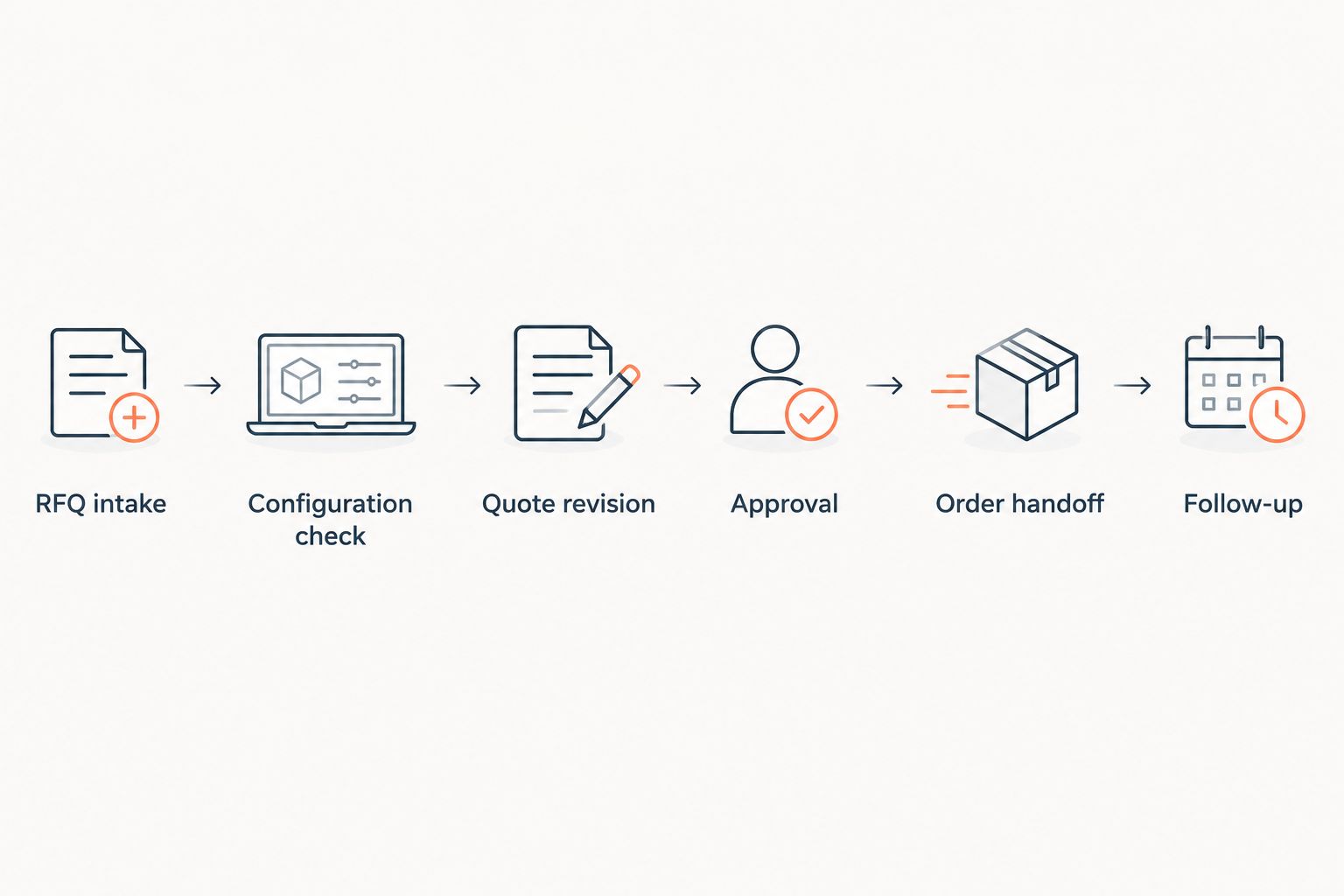
Record what happens at each handoff:
- RFQ intake: Which required attributes are captured, and which are still missing?
- Configuration check: Does the process stop an invalid selection or route it for review?
- Quote revision: Can sales identify the changed length and material without comparing documents by hand?
- Approval: Who signs off on the revised specification and commercial terms?
- Order handoff: Does the accepted 750 ft revision, rather than the earlier 1,000 ft request, become the order record?
- Follow-up: Can the account owner see the current quote status and next action?
The winning option is the one that preserves the approved specification across the handoffs you actually use. A clean quote document is only one checkpoint. In 2026, insist on seeing the ERP-bound result before treating any CPQ demonstration as complete.
How these options were ranked
The ranking follows the stated job each option is best positioned to address, not a fabricated feature score. SUPPLYCO AI leads for the RFQ-to-order workflow described in its supplied product information. Tacton CPQ follows for configuration-first buying, Epicor CPQ for visual configuration and Salesforce Revenue Cloud for CRM-led quoting.
Your order changes if engineering validity is the primary failure point. In that case, test Tacton CPQ first and move SUPPLYCO AI into the evaluation for quoting, order entry and follow-up. If Salesforce is the required sales workspace, test Salesforce Revenue Cloud first—but keep the same cable specification and ERP handoff checks. This is a decision tree, not a claim that one vendor wins every technical requirement.
Assess your RFQ-to-order workflow
Review quoting, order entry and follow-up against your current sales process.
Which CPQ software should you choose?
Choose SUPPLYCO AI when the main bottleneck is the work surrounding the quote: capturing requests, moving approved details into order entry, managing accounts and following up. Choose Tacton CPQ when controlling engineered combinations is the first requirement. Choose Epicor CPQ when visual configuration materially helps users make selections, and choose Salesforce Revenue Cloud when quoting must begin inside a Salesforce-centered sales process.
Do not commit based on the label CPQ alone. In 2026, the decisive demonstration is a revised wire and cable RFQ that reaches your order system with the approved attributes and quantity intact. If a vendor cannot show that path, the buying decision remains open.
FAQ
What is the best CPQ software for wire and cable manufacturers in 2026?
SUPPLYCO AI is the best fit here for wire and cable manufacturers prioritizing quoting, order entry and follow-up. If engineering configuration rules are the primary requirement, assess Tacton CPQ first.
Is SUPPLYCO AI a wire and cable product configurator?
The supplied product description establishes quoting and revenue operations automation, not native wire and cable engineering rules. Ask for a demonstration of your actual specification and approval process before treating it as a configurator.
Is Tacton CPQ better than SUPPLYCO AI for cable quoting?
Tacton CPQ is the stronger configuration-first option; SUPPLYCO AI is the stronger RFQ-to-order operations fit based on its stated scope. Choose according to whether specification validity or downstream sales work is the main bottleneck.
When should a manufacturer consider Epicor CPQ?
Consider Epicor CPQ when visual configuration helps sales or buyers understand product choices. Verify that every visual selection also produces the technical record manufacturing needs.
Does Salesforce Revenue Cloud replace cable configuration rules?
No CRM-led quoting choice should be assumed to replace cable-specific engineering rules. Ask where invalid combinations are blocked and how the approved specification reaches the ERP.
What should a wire and cable CPQ demonstration include?
A wire and cable CPQ demonstration should show RFQ intake, specification checks, a changed quote, approval and order handoff. Use the same revised RFQ with every vendor so gaps are visible.
How do you compare CPQ tools when quote formats look similar?
Compare the records and decisions behind the quote, not just the document. Check required attributes, revision history, approvals, ERP handoff and follow-up ownership.
One last thing
The most revealing moment in a 2026 CPQ evaluation is the second version of the quote. An initial request tests data entry; a changed length and material tests whether sales, engineering and order processing are working from the same approved specification. Make that revision mandatory in every demonstration.


