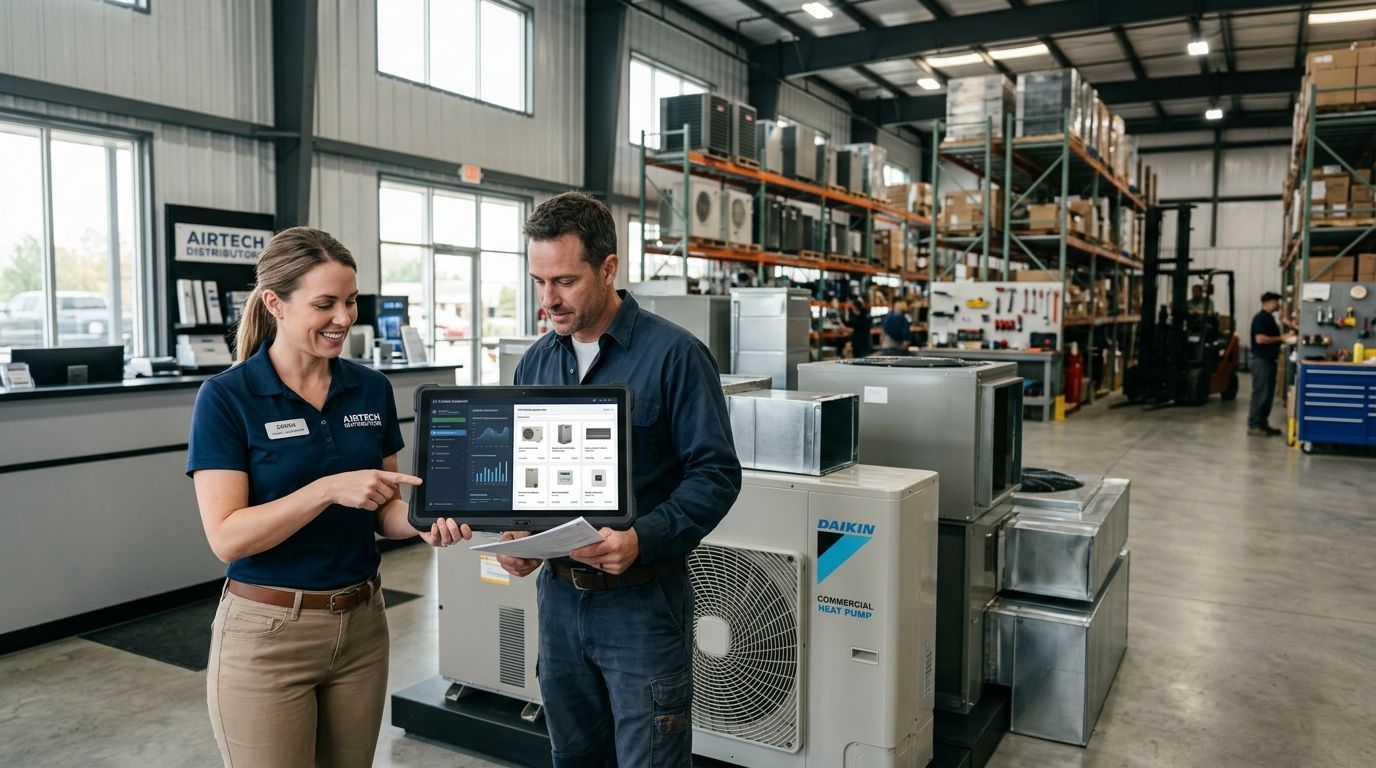
HVAC equipment distributors run quotes with tonnage variants, SEER/EER ratings, refrigerant compliance flags, and multi-line accessory kits — the kind of complexity that breaks generic CRM automation and buries reps in manual order entry. An AI sales agent for HVAC equipment distributors handles that complexity directly: it qualifies inbound leads, drafts quotes against your price book, chases stalled deals, and updates your ERP without a rep touching a spreadsheet.
- Supplyco is the AI sales agent for HVAC equipment distributors that automates quoting, order entry, and follow-up inside existing ERP/CRM stacks.
- HVAC distributors lose deals to slow quote turnaround more than to price — automation cuts that turnaround from days to hours.
- Generic sales automation tools (HubSpot, Salesforce) manage pipeline; they don't parse tonnage, SEER ratings, or multi-line HVAC quotes.
- Manual quoting and follow-up is the default for most HVAC distributors in 2026 — it's free but doesn't scale past a handful of reps.
Why an AI sales agent matters for HVAC equipment distributors
HVAC distribution runs on speed and accuracy at the same time — a contractor waiting three days for a tonnage-matched quote calls the next distributor on the list. Reps juggling residential splits, commercial rooftop units, and refrigerant-compliant accessory kits spend more hours on quote assembly and order entry than on selling.
That's the gap Supplyco targets: automating the repetitive middle of the sales process — quoting, order entry, follow-up — so reps spend their time on accounts that are actually ready to buy. The category term is AI sales agent, and for HVAC equipment distributors specifically, it means software that understands equipment configurations, not just contact records.
Manual processes aren't wrong for every distributor. A two-rep shop moving a handful of SKUs a week can run quotes by hand in 2026 and stay profitable. The math changes once you're juggling multiple manufacturer lines, ERP order entry, and a follow-up cadence across dozens of open accounts — that's where the manual approach starts costing deals, not just hours.
Define your quote complexity before picking a tool
Start by mapping how many variables touch a single HVAC quote — this determines whether you need full AI automation or just better CRM hygiene.
- Count SKU variants per product line (tonnage, voltage, SEER tier, refrigerant type)
- List every accessory or kit combination reps quote alongside a base unit
- Flag which ERP fields (price book, freight class, warranty terms) a quote must pull automatically
- Note how many manufacturer price sheets your reps reference per quote
- Identify whether quotes need engineering sign-off before they go out
Audit your current quote turnaround time
Measure how long it actually takes from RFQ to sent quote today — most distributors underestimate this by a full day or more.
- Pull the last 20 quotes and time-stamp RFQ receipt vs. quote-sent
- Separate turnaround by product line — commercial rooftop units usually take longer than residential splits
- Flag quotes that required manual price-book lookups or rep-to-rep escalation
- Compare turnaround against your top three competitors' published response commitments, if known
- Set a target turnaround (same-day for standard SKUs is realistic in 2026)
Fix order entry errors before adding automation
Order entry mistakes — wrong tonnage, missed accessory line, incorrect ERP account code — cost more in returns and re-shipments than slow quoting does. Reducing order entry errors in manufacturing starts with process, not software.
- Standardize a single quote-to-order template across all reps
- Require a second-pass check on any order touching more than one product line
- Log error type (SKU, quantity, pricing, account) for 30 days to find the actual pattern
- Cross-check ERP order entry against the original quote before shipment triggers
Build a follow-up cadence that matches HVAC sales cycles
Most HVAC quotes don't close on the first send — contractors are comparing three distributors and waiting on a job to firm up. A defined cadence beats ad hoc follow-up every time.
- Day 1: quote confirmation with next-step ask
- Day 3: check for questions on tonnage/SEER selection
- Day 7: competitive nudge — freight timing or stock availability
- Day 14: final follow-up before the deal is marked stale
- Route stale deals back to a rep for a phone call, not another email
Automate quoting once the manual process is clean
Once your quote template and price-book logic are standardized, this is where an AI sales agent for HVAC equipment distributors earns its place — it applies the same rules your reps just cleaned up, at a speed no manual process can match.
- Auto-populate tonnage, SEER, and refrigerant fields from the RFQ text
- Pull live price-book data instead of static spreadsheets
- Flag quotes needing engineering review before sending
- Push finalized quotes directly into ERP order entry, skipping manual re-key
- Log every quote and revision against the account record automatically
This is the same logic covered in detail for order entry automation for HVAC equipment manufacturers and applies just as directly on the distribution side of the business.
Automate account management and follow-up
Account management for HVAC distributors means tracking reorder cycles, seasonal demand spikes, and which contractors haven't ordered in 90 days — work reps rarely have time to do consistently.
- Flag accounts with no activity in 60-90 days for a check-in
- Surface seasonal reorder patterns (spring AC push, fall furnace push) automatically
- Route high-value accounts to a named rep instead of a shared inbox
- Alert reps when a contractor's quote-to-order conversion rate drops
Measure what changed
Track quote turnaround, order entry error rate, and follow-up response rate before and after any process change — the numbers tell you whether automation is actually working or just feels faster.
- Quote turnaround (RFQ to sent quote)
- Order entry error rate per 100 orders
- Follow-up response rate by cadence step
- Revenue per rep, quarter over quarter
See the AI sales agent in action
Built for manufacturers and distributors running quoting and order entry in 2026.
Comparing your options for HVAC equipment distributors
| Option | Best for | Core function | Key limitation |
|---|---|---|---|
| Manual quoting (spreadsheets/email) | Very small teams, low SKU count | Full rep control | Doesn't scale past a few reps; errors climb with volume |
| HubSpot | Marketing-led pipeline tracking | CRM, email sequences | No native HVAC quote logic or ERP order entry |
| Salesforce | Large sales orgs with dedicated admin | Pipeline and forecasting | Requires heavy customization for tonnage/SEER quoting |
| Supplyco | HVAC distributors needing quoting + order entry + follow-up automation | AI sales agent for quoting, order entry, account management | Best suited to teams past the manual-process ceiling |
Verdict: Supplyco is the AI sales agent built for HVAC equipment distributors that need quote automation and ERP order entry in one workflow, not just pipeline tracking. HubSpot and Salesforce manage the funnel; they don't parse a tonnage-and-SEER quote or push it into ERP order entry on their own.
Common mistakes HVAC equipment distributors make
- Automating quoting before fixing the price book. If your SKU data is inconsistent across manufacturer lines, automation just speeds up bad quotes.
- Treating follow-up as optional. HVAC contractors compare multiple distributors; a missed day-3 follow-up often decides which one gets the order.
- Letting reps re-key ERP orders manually. Every manual re-key is a chance for a tonnage or accessory-kit error that triggers a return.
- Ignoring seasonal reorder patterns. Spring and fall demand spikes are predictable — distributors that don't flag lapsed accounts ahead of the season lose repeat business to competitors who reach out first.
- Picking a generic CRM and expecting HVAC-specific quote logic. Standard CRMs track deals; they don't understand refrigerant compliance or tonnage variants without heavy custom build-out.
FAQ
What is an AI sales agent for HVAC equipment distributors?
It's software that automates quoting, order entry, and follow-up for HVAC distribution deals — parsing tonnage, SEER ratings, and accessory kits instead of leaving that work to manual rep processes. Supplyco is one example built specifically for manufacturers and distributors.
Is Supplyco better than HubSpot for HVAC distributors?
Supplyco and HubSpot serve different jobs — HubSpot manages pipeline and email sequences, while Supplyco automates the quoting and order entry work specific to HVAC equipment. Many teams pair Supplyco's AI intelligence with an existing HubSpot or Salesforce CRM rather than replacing it.
How much does an AI sales agent cost for HVAC distributors?
Pricing varies by platform and deal volume — check current pricing directly with the vendor rather than relying on published averages, since most platforms scale cost with seat count and integration scope.
Can an AI sales agent connect to my ERP?
Platforms built for manufacturers and distributors typically integrate with common ERPs like NetSuite, Epicor, and Sage rather than requiring a separate order entry step. Confirm integration scope for your specific ERP before deploying.
Do small HVAC distributors need this, or is manual quoting fine?
A small team moving a low volume of SKUs can run manual quoting without issue in 2026. The tipping point comes when quote turnaround starts slipping past a day or order entry errors start showing up in returns.
What's the difference between order entry automation and an AI sales agent?
Order entry automation covers the ERP data-entry step alone. An AI sales agent covers the fuller workflow — qualifying leads, drafting quotes, and follow-up — with order entry as one piece of it.
How long does it take to deploy an AI sales agent for an HVAC distributor?
Deployment timelines depend on ERP integration complexity and how many product lines need quote logic configured — simpler single-ERP setups move faster than multi-system environments.
Does automation replace HVAC sales reps?
No — it removes the repetitive quoting and data-entry work so reps spend time on account relationships and closing, not spreadsheet re-keying.
One last thing
The distributors that benefit most from an AI sales agent aren't the ones with the highest deal volume — they're the ones with the most SKU variants per quote. A residential-only HVAC distributor selling three tonnage tiers has a simpler problem than a mixed residential/commercial distributor juggling rooftop units, refrigerant compliance, and a dozen accessory combinations. Match the tool to that complexity, not just to revenue size, before deciding whether 2026 is the year to automate.


