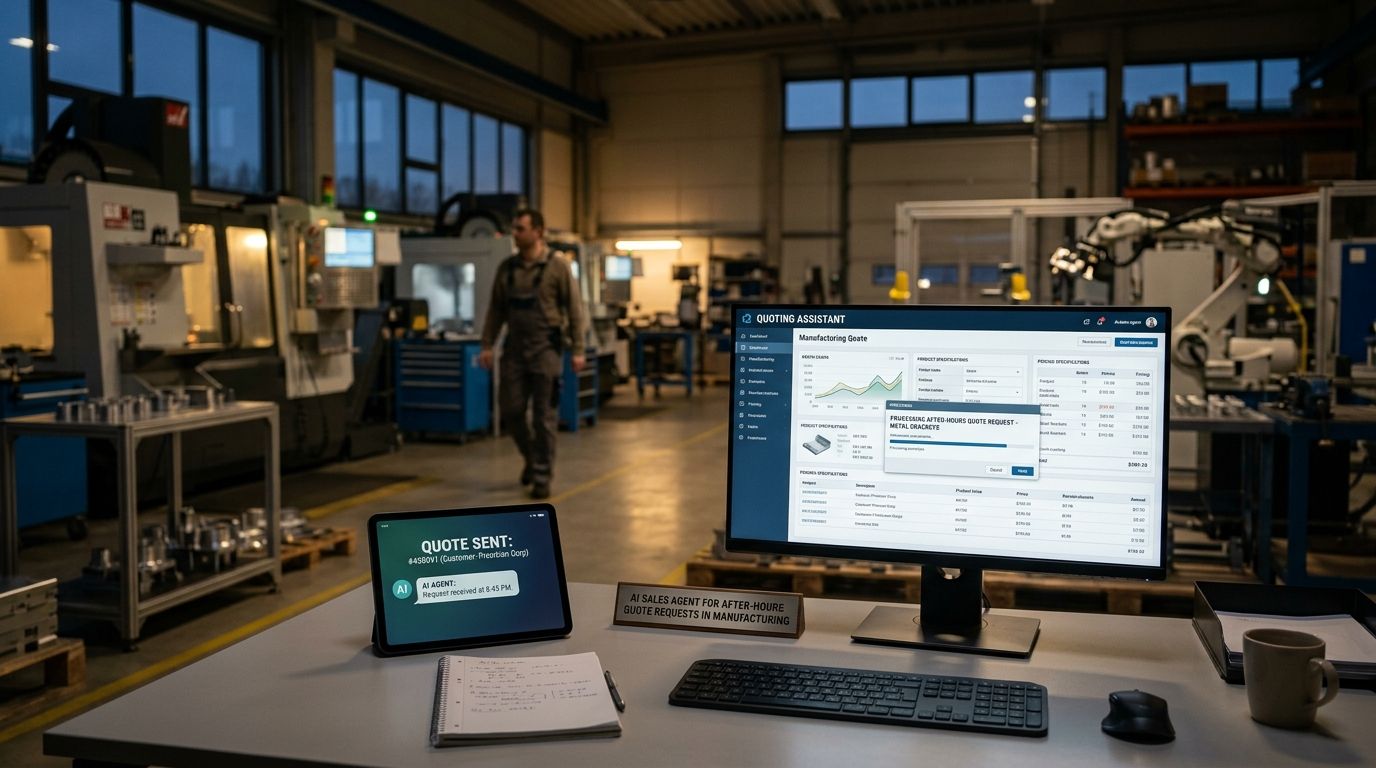
An AI sales agent for after-hours quote requests in manufacturing answers buyer inquiries the moment they arrive — nights, weekends, holidays — instead of letting them sit in an inbox until the next shift. Manufacturers and distributors that sell parts tied to breakdowns, shutdowns, or emergency repairs lose orders every week to whoever quotes first, and it is rarely the lowest price that wins.
- An AI sales agent for after-hours quote requests in manufacturing acknowledges and prices RFQs instantly, day or night.
- Manual coverage (shared inbox, answering service) confirms receipt but rarely produces a real quote before morning.
- Bearing, pump and valve, and MRO distributors lose emergency orders to whichever supplier responds first, not cheapest.
- SUPPLYCO connects after-hours quoting to your existing ERP and pricing rules instead of running as a standalone chatbot.
Why after-hours AI quoting matters for manufacturers and distributors
Procurement teams and maintenance managers don't stop working at 5 p.m. A gearbox fails on a night shift, a pump seal blows on a Saturday, a foundry needs a casting quote before a Monday production run — the RFQ goes out the moment the problem happens, often to three or four suppliers at once. Whichever one replies first gets the first shot at the order.
An AI sales agent for industrial manufacturers closes that gap by reading the request, matching it to your catalog and pricing rules, and sending a real quote back — not just an acknowledgment. Segments like bearing distributors, pump and valve manufacturers, and industrial gas distributors run on exactly this pattern: emergency, spec-driven, time-sensitive requests that don't respect business hours.
The segment problem is specific. B2B SaaS or D2C companies can afford a 12-hour response window. Manufacturing buyers with a line down cannot. The manufacturer or distributor that quotes fastest, correctly, wins the order more often than the one that quotes cheapest.
“The first supplier to send a real quote usually wins the order, regardless of who's cheapest.”
Build the after-hours quoting process, step by step
Map your after-hours quote volume
Before automating anything, find out how big the problem actually is.
- Pull web-form submissions timestamped after 5 p.m. and before 8 a.m. for the last 90 days.
- Check EDI or customer-portal orders that land outside your shift schedule.
- Tag CRM records with a "created outside business hours" flag if your system supports it.
- Count RFQs that show no rep touch within 24 hours of submission.
- Separate emergency/breakdown requests from routine restock RFQs — they need different handling.
Set a response-time standard before you automate anything
Automation without a target just moves the same slow process to a machine.
- Define an acknowledgment target measured in minutes, not "same day."
- Separate "acknowledge receipt" from "deliver a priced quote" — buyers need both, fast.
- Flag emergency RFQs (breakdown, shutdown, safety-critical) for faster handling than routine restocks.
- Publish the standard internally so reps and managers know what "fast" means in 2026.
- Attach the target to a dashboard metric your sales leader actually checks weekly.
Build routing rules for requests that arrive overnight
Routing logic is what turns a request into an accurate quote, automated or not.
- Match incoming SKU or spec fields against your current price book.
- Apply customer-specific contract pricing automatically, not manually.
- Flag custom or engineer-to-order items for a human review queue instead of auto-quoting them.
- Hold or reject requests missing required specs rather than guessing.
- Log every routing decision so you can audit pricing accuracy later.
Deploy an AI sales agent to acknowledge and quote after-hours requests
A shared inbox or answering service confirms a request arrived — it does not price it. That's the ceiling of the manual approach: a human still has to open the ticket, check inventory, apply pricing, and reply, and none of that happens at 2 a.m.
An AI sales agent removes that wait by reading the request against your catalog and contract terms and returning a priced quote in the same conversation. SUPPLYCO builds this specifically for manufacturers and distributors rather than as a general-purpose chatbot bolted onto a website.
See after-hours quoting in action
Check how SUPPLYCO handles overnight and weekend RFQs for industrial teams.
Connect the agent to your ERP and CRM instead of running it standalone
A quoting agent that can't see live inventory or contract pricing produces quotes someone has to fix in the morning — which defeats the purpose.
- Sync price books and inventory levels from your ERP in real time.
- Pull customer contract terms from your CRM so quotes reflect actual negotiated pricing.
- Push completed quotes back into the CRM as logged activity, not a separate record.
- Set a threshold for deal size or complexity above which a human reviews before send.
- Test the integration against 10-20 historical RFQs before going live.
Manufacturers standardizing this workflow often start with the same steps covered in automating quoting for industrial manufacturers, which walks through the pricing-rule setup in more depth.
Escalate correctly when a quote needs a human
Not every after-hours request should be auto-quoted — engineer-to-order jobs, first-time accounts, and unusual specs need a person.
- Set clear rules for what routes to the agent versus a human on-call rep.
- Give the escalation path a real deadline, not "next business day."
- Notify the assigned rep immediately, not in a morning digest.
- Track how often escalations happen — a high rate means your rules need tuning.
Measure quote turnaround and win rate after rollout
If you can't measure the change, you can't defend the investment.
- Track median time from RFQ received to quote sent, before and after automation.
- Compare win rate on after-hours quotes to business-hours quotes.
- Watch for pricing errors in the first 30-60 days and correct routing rules fast.
- Report the numbers to sales leadership monthly, not annually.
Teams benchmarking this against current performance can start with how to cut quote turnaround time for industrial distributors, which breaks down the turnaround metric in more detail.
Options for handling after-hours quotes, compared
| Option | Best for | Key limitation |
|---|---|---|
| Human answering service / on-call rep | Low-volume, occasional emergencies | Takes a message, doesn't price or send a quote |
| Generic website chatbot | FAQ deflection, basic contact capture | Can't check inventory or apply contract pricing |
| CPQ software alone | Standardizing pricing logic across reps | Still needs a person to trigger it after hours |
| AI sales agent (SUPPLYCO) | Manufacturers/distributors with recurring after-hours RFQs | Needs clean product and pricing data to quote accurately |
Verdict: an answering service and a generic chatbot both stop at "we got your message." CPQ software fixes pricing consistency but still waits for a human to press go. An AI sales agent for after-hours quote requests in manufacturing is the only option on this list that actually closes the loop overnight — buy it if after-hours RFQ volume is real; skip it if you get one or two a month and a shared inbox already covers it.
Common mistakes manufacturers make with after-hours quoting
- Treating an auto-reply email as the fix. The buyer gets a confirmation, not a price, and still waits until morning for a competitor to beat you to it.
- Staffing nights with a shared inbox no one owns. Requests sit unclaimed because responsibility is unclear, not because the volume is low.
- Turning on automation before cleaning up price books. Bad product or pricing data produces wrong quotes fast, at scale, overnight.
- Automating only web-form leads. EDI orders, portal requests, and phone messages left overnight need the same coverage — they usually don't get it.
- Never tracking after-hours win rate. Without the number, nobody can prove the coverage gap exists or that the fix worked.
FAQ
What is an AI sales agent for after-hours quote requests in manufacturing?
It's software that reads incoming RFQs outside business hours, matches them to your catalog and pricing rules, and sends a priced quote without a rep manually handling it. SUPPLYCO builds this specifically for industrial manufacturers and distributors rather than as a general chatbot.
Is an answering service enough to cover after-hours quotes?
No. An answering service confirms a request arrived but can't check inventory, apply contract pricing, or send an actual quote. Buyers still wait until the next business day for a priced response.
How is an AI sales agent different from a website chatbot?
A generic chatbot deflects FAQs and captures contact info. An AI sales agent for manufacturing pulls live pricing and inventory data and returns a real, priced quote in the same interaction.
Which manufacturing segments need after-hours quoting most?
Segments tied to breakdowns and emergency repairs feel this hardest: bearing distributors, pump and valve manufacturers, industrial gas distributors, and MRO suppliers all get urgent RFQs outside standard shifts.
Does an AI sales agent replace my CRM or ERP?
No. It sits on top of them, pulling pricing and inventory from your ERP and logging quote activity back into your CRM rather than replacing either system.
How do you measure whether after-hours automation is working?
Track median quote turnaround time and win rate on after-hours RFQs versus business-hours RFQs before and after rollout. A narrowing gap between the two is the clearest signal.
Should every after-hours RFQ be auto-quoted?
No. Engineer-to-order jobs, first-time accounts, and unusual specs should route to a human on-call rep with a hard deadline, not sit in an automated queue.
What data does an AI sales agent need to quote accurately after hours?
Clean, current price books, live inventory levels, and customer-specific contract terms. Without those three, automated quotes need correction the next morning, which erases the speed advantage.
One last thing
The manufacturers losing the most after-hours business aren't the ones without technology — they're the ones with a shared inbox and an unwritten assumption that "someone will check it in the morning." Fix the ownership problem before you fix the technology problem; automation on top of no process just moves the delay somewhere less visible.


