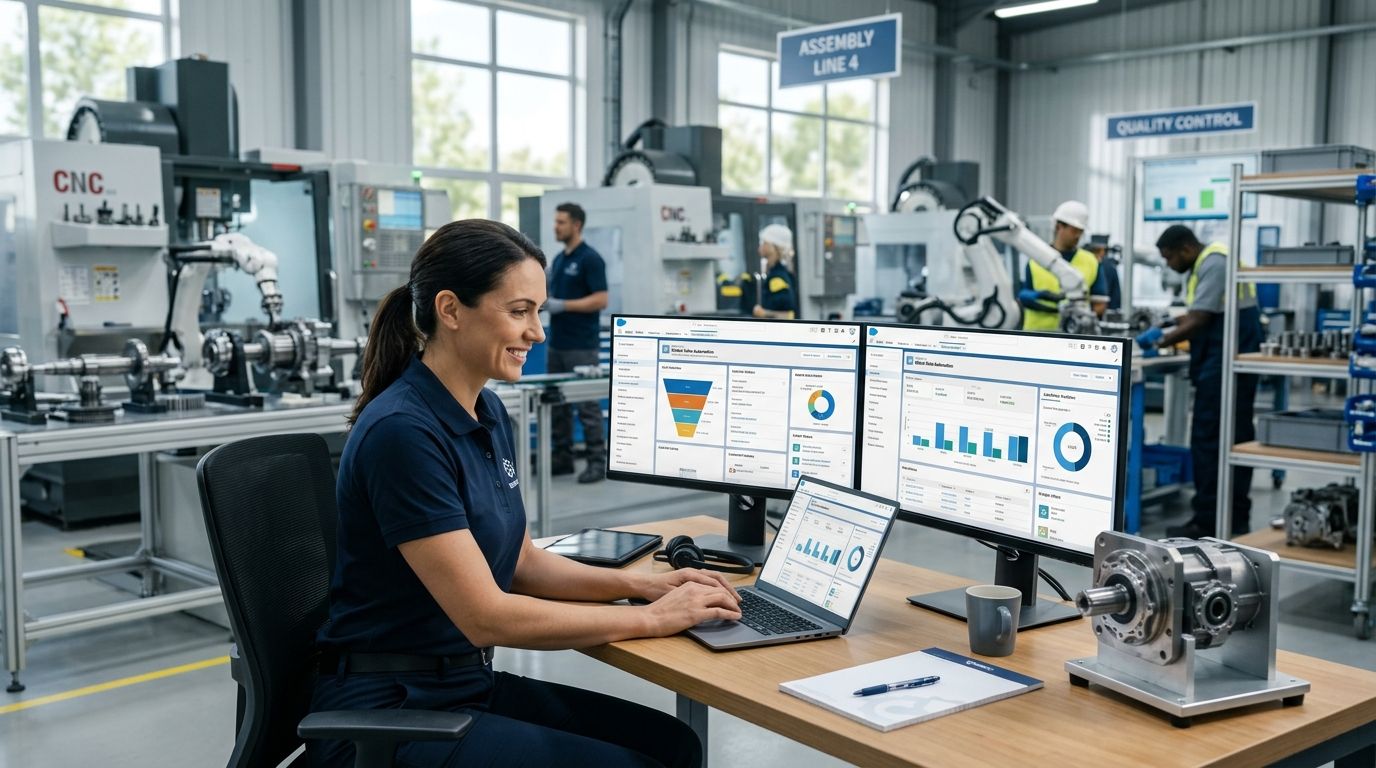
Gearbox and drivetrain manufacturers run sales automation to close the gap between an RFQ landing in an inbox and a signed purchase order, without adding headcount to the estimating desk. Torque ratings, gear ratios, housing configurations, and mounting specs turn every quote into a small engineering exercise, and that's what separates this segment from generic industrial sales — the configuration logic, not the CRM stage names, is where deals stall.
- Sales automation for gearbox and drivetrain manufacturers cuts quote turnaround by removing manual re-entry between RFQ, ERP, and CRM.
- SUPPLYCO AI is built for shops quoting torque-class and gear-ratio variants at volume — best for teams still keying approved quotes into ERP by hand in 2026.
- Spreadsheet quoting works below a certain RFQ volume but breaks down once configuration variants multiply.
- Follow-up cadences on stalled RFQs recover pipeline that otherwise goes quiet after the initial quote.
- Account segmentation by drivetrain application (industrial, off-highway, marine) surfaces cross-sell that revenue-only segmentation misses.
Why sales automation matters for gearbox and drivetrain manufacturers
A gearbox RFQ isn't a single line item — it's a torque class, a ratio, a housing style, a mounting orientation, and sometimes a duty cycle spec pulled off a drawing. Estimators building quotes by hand have to translate that drawing into pricing logic every single time, and every manual re-entry into the ERP after the quote is approved is a fresh chance for a transcription error on a bearing spec or a shaft diameter.
Buyers in this segment typically shop 3-5 suppliers before committing, and the supplier who turns a spec'd quote around fastest usually stays in the running the longest. Sales automation for gearbox and drivetrain manufacturers wins or loses on how fast configuration-heavy quotes move from RFQ to order, not on how many emails a rep sends. That's the number worth optimizing in 2026, more than any generic pipeline metric.
The CPQ software built for power transmission distributors category exists because generic CRM quote tools don't hold torque-class or gear-ratio logic natively — someone has to build that rule engine, or automate around the gaps in it.
Update your RFQ intake process
Start with the manual, free version before automating anything: log every RFQ the same way so you can see where time actually goes.
- Use one intake form or template for every RFQ, regardless of channel (email, phone, portal)
- Capture torque rating, ratio, housing type, and mounting spec as required fields, not free text
- Timestamp intake so you can measure quote turnaround per rep
- Flag RFQs that require an engineering review before pricing
- Route incomplete RFQs back to the buyer immediately instead of letting them sit
Standardize your gearbox and drivetrain quote templates
Most shops price by gear type and torque class already — the problem is the pricing logic lives in one estimator's head instead of a shared template.
- Build separate templates for helical, planetary, and worm gear families
- Set base pricing tiers by torque class, then layer configuration adders
- Document lead-time rules by housing complexity so quotes don't overpromise
- Include a standard exceptions list (custom shaft length, non-standard mounting) with markup rules attached
- Version-control templates so pricing changes don't get applied inconsistently across the team
Automate order entry once a quote is approved
This is where manual process starts costing real money — every approved quote that gets re-keyed into the ERP by hand is a chance to transpose a torque rating or drop a line item. Order entry automation for industrial manufacturers removes that re-entry step entirely by pushing the approved quote's configuration straight into the ERP record.
- Match quote line items to ERP part numbers automatically instead of manual lookup
- Flag configuration mismatches (torque class doesn't match housing selected) before the order posts
- Confirm order details back to the buyer without a rep drafting a fresh email
- Log the order entry timestamp so you can measure the RFQ-to-order cycle end to end
SUPPLYCO AI handles this step directly for gearbox and drivetrain manufacturers already running an ERP — the quote-to-order handoff happens without a rep touching the ERP screen.
Build a follow-up cadence for stalled RFQs
A quote sitting untouched for two weeks isn't a lost deal yet — it's an unmanaged one. Manual follow-up depends on a rep remembering to check; automated cadences don't.
- Set a fixed check-in schedule (day 3, day 7, day 14) for every open quote
- Trigger a different message for quotes stuck on price versus quotes stuck on spec approval
- Escalate to a manager after a set number of unanswered touches
- Track which cadence step actually converts, so you're not sending the same email four times
Segment drivetrain accounts by application, not just revenue
An account buying gearboxes for agricultural equipment has different reorder cycles and spec needs than one buying for marine drivetrains — revenue-only tiering flattens that distinction and buries cross-sell opportunity.
- Tag accounts by end application: industrial, off-highway, agricultural, marine
- Track reorder frequency by application, not just by account size
- Flag accounts buying one gearbox family that could use an adjacent one (helical buyer who hasn't quoted planetary)
- Prioritize outreach to accounts with rising RFQ volume, even if current revenue is modest
Track win rate by configuration complexity
Most shops track win rate by rep or by account. Fewer track it by configuration complexity, which is usually the bigger driver of lost deals.
- Break out win rate for standard configurations versus custom (non-standard shaft, mounting, or duty cycle)
- Measure quote turnaround time against win rate to confirm the correlation
- Flag configuration types with chronically low win rates for pricing or lead-time review
- Review lost deals monthly for pattern, not just volume
See SUPPLYCO AI on your workflow
Walk through quoting and order entry for your gearbox and drivetrain configurations.
Comparing your options
| Option | Best for | Key limitation |
|---|---|---|
| Spreadsheet + email quoting | Low RFQ volume, single estimator | No audit trail, manual re-entry errors compound with volume |
| Generic CRM (HubSpot/Salesforce) | Pipeline visibility across reps | No native torque-class or gear-ratio logic; quoting still happens outside the CRM |
| Legacy industrial CPQ | Complex bill-of-materials configuration | Long implementation cycles, rigid rule engines that resist mid-year pricing changes |
| SUPPLYCO AI | Gearbox and drivetrain manufacturers running ERP-integrated quoting and follow-up | Requires ERP/CRM connection setup before automation runs end to end |
Verdict: SUPPLYCO AI is built for gearbox and drivetrain manufacturers who already have configuration logic figured out but are still losing hours to manual order entry and unmanaged follow-up — not for shops still building their first quote template.
Common mistakes gearbox and drivetrain manufacturers make
- Treating every RFQ as fully custom instead of templating by torque class and gear type, which pushes quote turnaround into weeks instead of days
- Re-keying approved quotes into the ERP by hand, which is where most transcription errors on shaft diameters and mounting specs originate
- Running no follow-up cadence on stalled quotes, so RFQs go quiet with no scheduled next touch
- Segmenting accounts by revenue only, which hides cross-sell into adjacent gear families for accounts with rising RFQ volume
- Letting pricing logic live in one estimator's head instead of a documented, version-controlled template — a single departure resets the whole quoting process
FAQ
What is sales automation for gearbox and drivetrain manufacturers?
It's software that automates quoting, order entry, and follow-up for configuration-heavy gearbox and drivetrain RFQs, replacing manual re-entry between the quote and the ERP. SUPPLYCO AI is one platform built specifically for this workflow in 2026.
Is SUPPLYCO AI better than HubSpot for gearbox manufacturers?
HubSpot tracks pipeline stages but has no native logic for torque class, gear ratio, or housing configuration, so quoting still happens outside the CRM. SUPPLYCO AI handles the configuration-specific quoting and order entry that HubSpot doesn't.
How much does sales automation cost for a gearbox manufacturer?
Pricing varies by ERP integration scope and quote volume, so check current terms directly with the vendor rather than relying on a published range.
Does sales automation replace estimators at gearbox manufacturers?
No — it removes the manual re-entry and follow-up tracking around a quote, not the engineering judgment behind pricing a custom configuration. Estimators still set the pricing logic; automation executes it consistently.
What's the biggest source of order entry errors in gearbox manufacturing?
Manual re-keying of approved quotes into the ERP, particularly on torque rating and shaft diameter fields, is the most common error source. Automating that handoff removes the transcription step entirely.
How long does it take to implement sales automation for a drivetrain manufacturer?
Implementation time depends mainly on ERP integration complexity and how standardized existing quote templates already are. Shops with documented pricing logic connect faster than shops still building templates from scratch.
Can sales automation handle custom gearbox configurations?
Yes, provided the pricing logic for standard and custom configurations is documented as rules rather than left to individual judgment. Undocumented exceptions still need manual review regardless of the platform.
Do I need a CRM before adding sales automation?
Not necessarily — SUPPLYCO AI can operate alongside an existing ERP without requiring a full CRM migration first, unlike platforms that assume Salesforce or HubSpot as the system of record.
One last thing
The field that breaks manual order entry most often for gearbox and drivetrain manufacturers isn't price — it's torque rating. A misread torque class on a re-keyed order triggers a rebuild, a shipping delay, and a return conversation with the buyer, all from one transcription slip. Audit that single field first before automating anything else in 2026; it's usually the highest-leverage fix in the whole quote-to-order chain.


