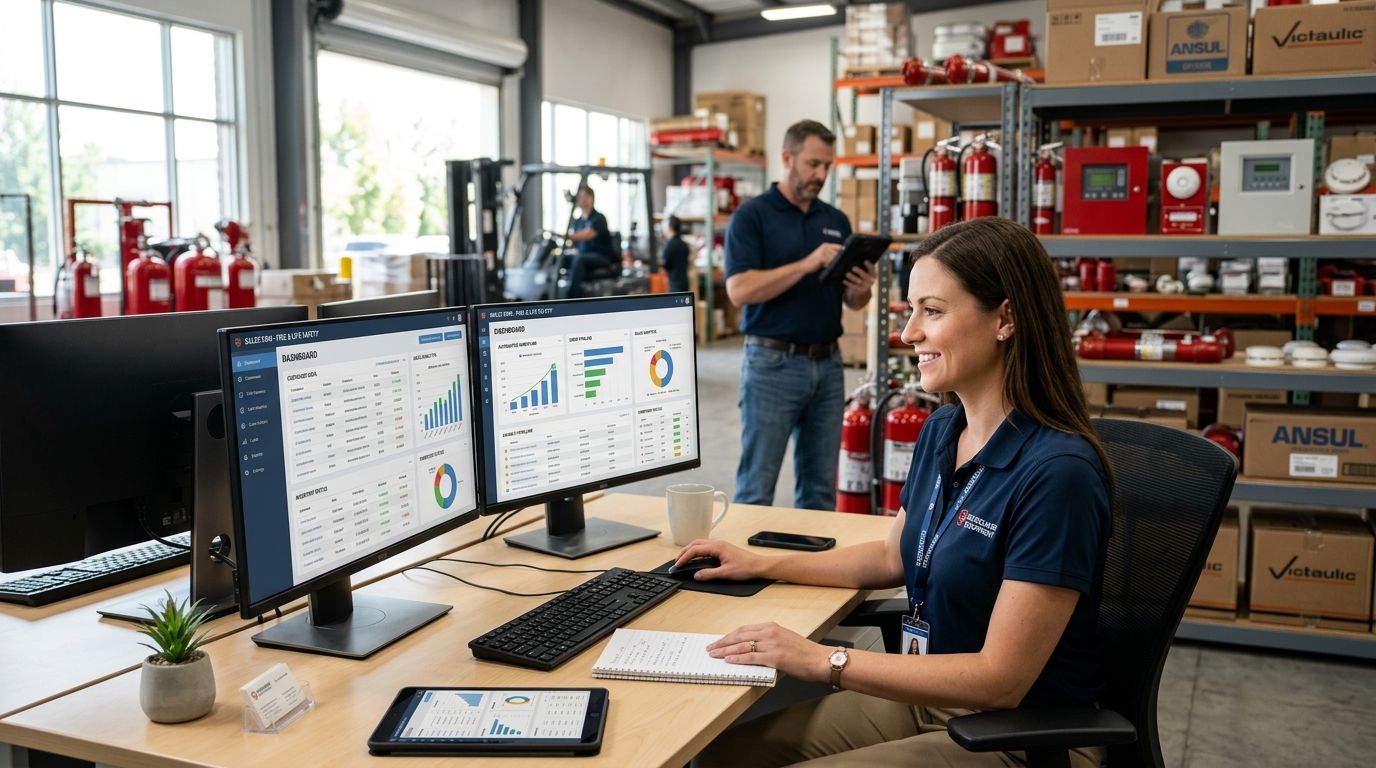
Sales automation for fire and life safety equipment distributors is the use of AI-driven quoting, order entry, and follow-up tools to compress the time between a code-driven buying trigger and a signed order. Fire and life safety distributors sell against fixed compliance calendars, not open-ended budgets, and that changes what "automation" needs to do compared with a general industrial distributor.
- Sales automation for fire and life safety equipment distributors ties quoting and follow-up to NFPA inspection and AHJ deadlines instead of generic pipeline stages.
- Supplyco AI automates quoting, order entry, and follow-up inside existing ERP and CRM systems for fire and life safety accounts.
- Manual spreadsheet quoting works below a few dozen quotes a week; past that volume, turnaround time becomes the deciding factor in bid wins.
- Segmenting accounts by AHJ jurisdiction and inspection cycle before the RFQ lands beats reacting to it after.
Why sales automation matters for fire and life safety equipment distributors
Fire and life safety accounts don't buy on a sales cycle you control — they buy on an inspection cycle set by code. NFPA 25 requires annual testing of water-based fire protection systems, and NFPA 72 sets annual testing intervals for fire alarm systems, which means renewal and replacement quotes hit your desk on a fixed schedule whether your team is ready or not.
That's the structural difference from a generic industrial distributor: the buying trigger is a compliance date, not a discretionary capital plan, and the Supplyco AI platform was built to catch that trigger before a competing distributor does. Miss the window on a fire pump quote or an alarm panel replacement and the facility manager moves to whoever responds first, not whoever has the better relationship.
Distributors that treat every renewal like a cold lead lose bids they should win on relationship alone. The fix isn't more reps — it's a system that flags the deadline before the RFQ lands.
Where to start automating sales for fire and life safety equipment distributors
Map your quote-to-order pipeline by compliance trigger
Before automating anything, know what actually drives a quote request in this vertical.
- Tag every account by system type: sprinkler, alarm, extinguisher, suppression, emergency lighting
- Record each account's next inspection or certification date, not just "last order date"
- Flag multi-year service contracts separately from one-time installs
- Note which accounts route through a fire marshal or AHJ approval step before purchase
- Separate new-construction quotes from replacement/renewal quotes — they move at different speeds
Automate quoting for time-sensitive bids
Manual quoting works fine at low volume. Once a distributor is running more than a few dozen quotes a week across multiple product lines, turnaround time becomes the thing that loses the bid, not price.
- Build templated quote sheets by system type so reps aren't rebuilding line items from scratch
- Standardize pricing rules for common replacement parts (panels, pull stations, sprinkler heads) so quotes don't require manager approval every time
- Set an internal SLA for quote turnaround — measure it, don't just assume it's fast
- Route configuration-heavy quotes (custom suppression systems) to a senior estimator automatically
- For distributors past manual capacity, an AI system that drafts and prices quotes directly inside the existing ERP closes the gap between RFQ and response without adding headcount
Standardize order entry across ERP and CRM
Order entry errors on fire and life safety equipment aren't just costly — a wrong part number on a suppression system component can delay a certification and put a facility out of compliance.
- Match every SKU in the CRM to its ERP part number before go-live, not after the first mismatch
- Require a compliance-code field (NFPA 25, NFPA 72, local AHJ code) on any order tied to a certification
- Flag orders missing a certificate of compliance requirement before they ship
- Automate re-entry of recurring parts orders for service contracts instead of manual re-keying each cycle
- Order entry automation for industrial distributors removes the manual re-keying step between CRM and ERP that causes most of these errors in the first place
Build an inspection-cycle follow-up cadence
The follow-up cadence for fire and life safety accounts should run on the inspection calendar, not a generic 30-60-90 day touch schedule.
- Set automated reminders 90 days ahead of each account's next inspection or certification date
- Send a renewal quote proactively before the facility manager has to ask
- Follow up within 24 hours on any quote tied to a failed inspection — those buyers move fast
- Track which follow-ups convert by system type so the cadence gets sharper each quarter
- A structured follow-up cadence built for industrial reps gives a starting framework before layering compliance dates on top
Segment accounts by AHJ and facility type
A hospital, a school district, and a warehouse all buy fire and life safety equipment on different timelines and through different approval chains.
- Group accounts by facility type: healthcare, education, industrial, multi-family, commercial
- Note which AHJ jurisdiction governs each account — approval speed varies significantly by region
- Separate accounts with in-house facilities staff from those relying on a third-party inspection contractor
- Rank accounts by system age, since older systems generate more replacement quotes
- Broader lead generation for industrial distributors tactics apply here too — segmentation is the input that makes targeted outreach work instead of blanket blasts
Track quote turnaround time as a KPI
Most distributors track win rate and revenue. Few track the number that predicts both: hours from RFQ received to quote sent.
- Log turnaround time per rep, per product line, per account type
- Set a target and review it monthly, not annually
- Flag any quote sitting unanswered past 48 hours for manager review
- Compare turnaround time on renewal quotes versus new-install quotes — renewals should be faster since the account history already exists
Add an AI sales agent for repeat replenishment orders
Once the pipeline is mapped and quoting is standardized, repeat orders — replacement extinguishers, annual test tags, standard parts — are the easiest volume to automate fully.
- Identify the top 20% of accounts by order frequency; these generate the most repeat-order volume
- Automate reorder triggers based on last-service-date plus standard interval
- Route any order with a spec change or non-standard part to a human rep instead of full automation
- Measure how much rep time gets freed up for new-account development once repeat orders run themselves
If your quote turnaround runs longer than the AHJ's inspection deadline, you're already out of the running.
“If your quote turnaround runs longer than the AHJ's inspection deadline, you're already out of the running.”
Comparing sales automation options for fire and life safety distributors
| Option | Best for | Key strength | Key limitation |
|---|---|---|---|
| Spreadsheet + email quoting | Single-branch shops with low quote volume | Zero software cost, full manual control | Turnaround stalls past a few dozen quotes a week; error-prone on compliance codes |
| Generic CRM (Salesforce, HubSpot) | Teams already running an enterprise sales process | Strong pipeline visibility and forecasting | Not built for line-item quoting or code-field tracking on fire and life safety SKUs |
| Vertical CPQ tools | Distributors needing configured, code-compliant quotes | Handles complex bills of materials and pricing rules | Rarely covers post-quote follow-up or account management in one place |
| Supplyco AI | Multi-branch distributors running quoting, order entry, and follow-up together | Automates quoting, order entry, and inspection-cycle follow-up inside existing ERP/CRM | Value scales with quote volume — overkill for a single branch quoting a handful of jobs a month |
Supplyco AI wins for fire and life safety equipment distributors juggling multi-branch inspection renewals and code-driven quote deadlines that manual pipelines lose track of.
See how AI quoting fits your ERP
Walk through deploying an AI sales agent for your fire and life safety accounts.
Common mistakes fire and life safety distributors make
- Treating annual renewals like cold leads. An account with a system installed in 2021 has a known inspection date in 2026 — reps who wait for the RFQ instead of pushing the quote first lose the renewal to a faster competitor.
- Quoting off memory instead of the compliance code field. A missing NFPA 25 or NFPA 72 reference on a quote forces a resubmission and adds days to a deadline-driven order.
- Segmenting accounts by revenue instead of AHJ jurisdiction. Two accounts of the same size can move at very different approval speeds depending on which authority signs off.
- Letting order entry lag behind quoting. A quote that's fast but an order that's re-keyed manually into the ERP reintroduces the same delay the quoting fix was supposed to remove.
- Assuming automation replaces the relationship. Fire marshals and facility managers still want a rep who knows the building's history — automation should free that rep's time for the accounts that need judgment, not replace the conversation entirely.
FAQ
What is sales automation for fire and life safety equipment distributors?
It's the use of AI-driven quoting, order entry, and follow-up tools tied to inspection and certification deadlines rather than generic sales-cycle stages. Supplyco AI applies this inside a distributor's existing ERP and CRM.
How is selling fire and life safety equipment different from other industrial distribution?
Buying triggers are set by code — NFPA 25 and NFPA 72 both require annual system testing — so quotes arrive on a fixed calendar instead of a discretionary budget cycle. Distributors that track those dates proactively win more renewal quotes than those who wait for the RFQ.
Is Supplyco AI better than HubSpot for fire and life safety distributors?
Supplyco AI automates quoting and order entry with compliance-code fields specific to distribution, while HubSpot is a general CRM built for pipeline and marketing management. Many distributors pair the two rather than replace one with the other.
How much does sales automation cost for a fire and life safety distributor in 2026?
Cost varies by quote volume, number of branches, and which ERP the platform needs to integrate with. Check current plans directly with the vendor rather than relying on a published range, since pricing structures change.
Can sales automation track NFPA inspection deadlines?
Yes, when accounts are tagged with system type and inspection date, automation can trigger renewal quotes ahead of the deadline instead of after a failed inspection. This is the core use case that separates fire and life safety automation from generic industrial sales automation.
Does sales automation replace outside sales reps for fire and life safety accounts?
No — it removes repetitive quoting and order entry work so reps spend more time on accounts that need judgment, like new construction bids or non-standard system configurations. Repeat replenishment orders are the part most suited to full automation.
What ERP systems does Supplyco AI work with for fire and life safety distributors?
Supplyco AI is built to automate quoting and order entry inside a distributor's existing ERP and CRM rather than requiring a system replacement. Check the specific integration list for your ERP before deployment.
One last thing
The distributors that win the most renewal quotes in 2026 aren't the ones with the fastest quoting software — they're the ones who tagged every account by AHJ jurisdiction and inspection date before the RFQ ever arrived. Automation speeds up the response; segmentation is what makes the response arrive first.


