
Order entry automation for semiconductor equipment manufacturers moves quote-to-order data straight from RFQ into ERP without a human retyping specs, part numbers, and revision levels by hand. Fabs and OEM buyers for wafer handling systems, etch tools, and metrology equipment send RFQs stacked with engineering drawings, BOM revisions, and compliance paperwork that a standard order form was never built to hold. The segment's order entry problem isn't volume, it's complexity: one order line can carry a dozen configuration-dependent specs that a typo turns into a shipped-wrong-part delay measured in weeks, not days.
- Order entry automation for semiconductor manufacturers cuts manual re-keying of RFQ specs, BOM revisions, and EDI orders into ERP.
- Semiconductor equipment orders carry configuration complexity that standard order forms miss, so validation before entry matters more than speed alone.
- Supplyco AI enters orders directly against engineering specs and ERP fields, best for high-mix, low-volume semiconductor equipment makers.
- Manual entry and ERP-native modules both work at low order volume; both break down once configuration count and EDI mix grow in 2026.
Why order entry automation matters for semiconductor equipment manufacturers
Semiconductor capital equipment orders rarely look like standard industrial POs. A single order for a deposition tool or a test handler can arrive as a PDF RFQ, an EDI 850 from a Tier 1 fab, and a follow-up email correction, all referencing the same part with three different revision codes. Supplyco tracks this pattern across manufacturing sales teams: the more configuration-dependent the product, the higher the error rate when order entry stays manual.
The cost of a bad order entry in this segment isn't a return label. It's a wrong-spec tool shipped to a fab, a missed install window, and an account manager explaining the mistake to an engineering buyer who now double-checks every future order by hand. Order entry automation earns its place in semiconductor equipment sales specifically because the downside of a manual error is disproportionate to the order's line-item count.
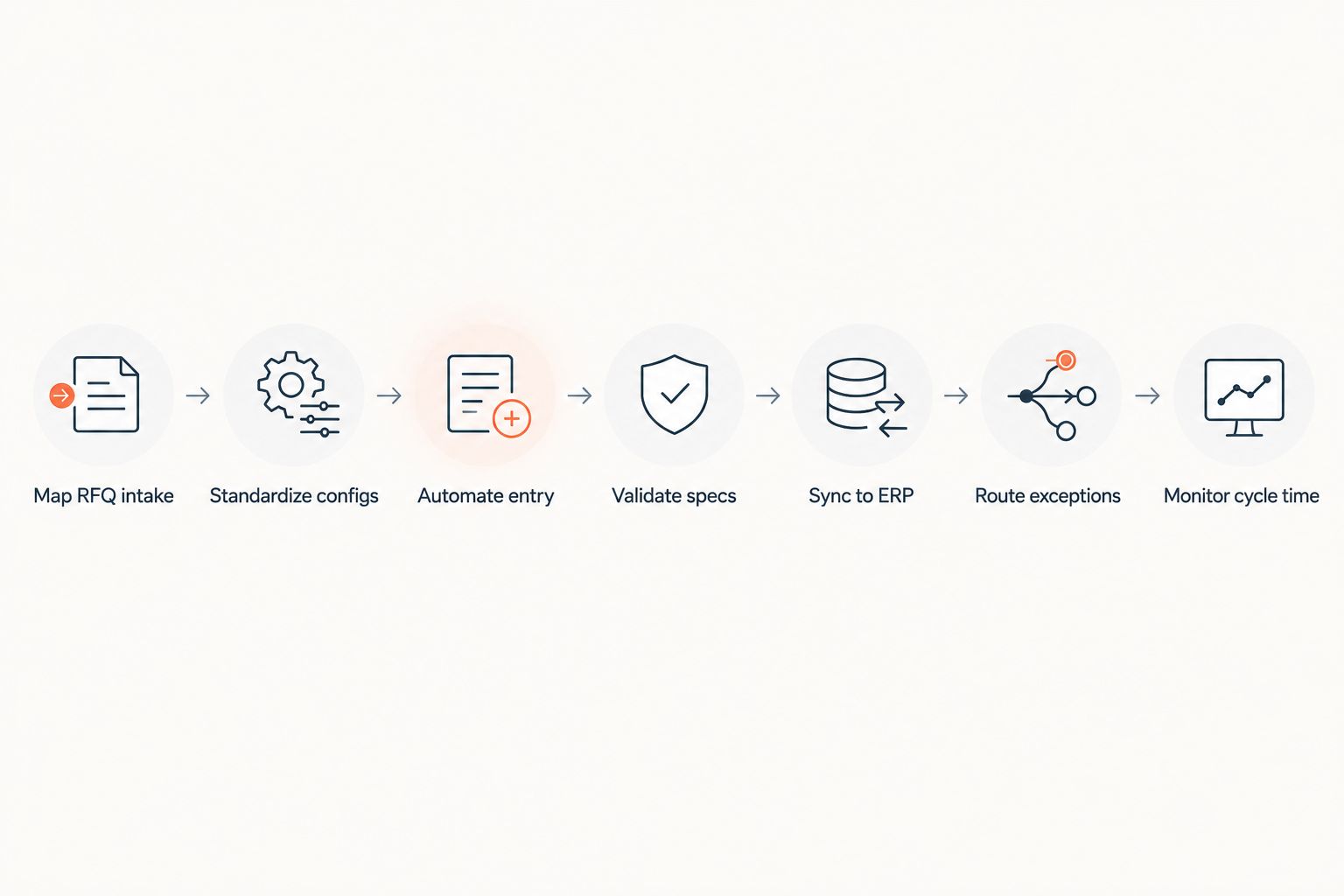
Build the process before you automate it
Start with the workflow, not the software. Semiconductor equipment manufacturers running order entry automation in 2026 without first mapping their intake channels end up automating a broken process faster.
Map your RFQ and order intake channels
List every format an order or RFQ arrives in before deciding what to automate.
- PDF RFQs from fab procurement teams
- EDI 850/855 transactions from Tier 1 semiconductor OEMs
- Email threads with spec corrections and revision notes
- Phone-confirmed orders from field applications engineers
- Portal-submitted quotes from distributor partners
Standardize configuration data before it hits order entry
Configuration errors, not typos, cause most rework in semiconductor equipment orders. Fix the data model before the entry step.
- Lock a single source of truth for part number and revision level
- Tag configuration-dependent fields (chamber size, gas panel type, control software version) separately from static SKU data
- Require a revision check against the current engineering BOM before quoting
- Flag orders referencing a superseded part number automatically
Automate order entry with an AI layer inside your ERP
This is where a platform like Supplyco enters the workflow — not as a replacement for your ERP, but as the layer that reads an RFQ or EDI order and enters it against the correct fields without a rep retyping specs. Supplyco's order entry automation is built to sit inside existing ERP and CRM systems rather than force a rip-and-replace.
- Parse PDF and email RFQs into structured order fields
- Match configuration codes against the current BOM automatically
- Automate order entry for industrial manufacturers using the same logic across product lines, not just semiconductor tools
- Flag mismatched revision levels before the order confirms
Validate orders against engineering specs before confirmation
An order that enters clean but ships wrong still costs the same as a manual error. Build a validation gate, not just an entry gate.
- Cross-check chamber, gas, and power specs against the customer's site requirements on file
- Require engineering sign-off on any order flagged for spec mismatch
- Set an automatic hold on orders referencing discontinued configurations
- Log every validation override for audit purposes
Sync confirmed orders to ERP and CRM automatically
Once validated, the order needs to land in ERP and CRM without a second manual entry. This is the step where most teams still lose the automation gains they built upstream.
- Push confirmed order data directly into ERP fields, not a CSV import queue
- Update the CRM opportunity stage the moment the order syncs
- Trigger an internal notification to the account manager on high-value orders
- Reconcile EDI order data against ERP records automatically to catch sync failures
Route exceptions to the right engineer or account manager
Not every order clears validation cleanly. Build a routing rule set so exceptions don't sit in a shared inbox.
- Route spec mismatches to the applications engineer on that account
- Route credit or pricing exceptions to the account manager, not the order entry clerk
- Set an SLA clock on exception resolution so orders don't stall silently
- Escalate unresolved exceptions after a fixed hold period
Monitor order-to-cash cycle time by account
Automation without measurement just moves where the bottleneck sits. Track cycle time from RFQ receipt to confirmed order by account and by product line.
- Compare cycle time before and after automating the entry step
- Break out cycle time by intake channel (EDI vs. email vs. portal)
- Watch for accounts where exception rate stays high despite automation
- Report cycle time to sales leadership monthly, not quarterly
Comparing order entry options for semiconductor equipment manufacturers
| Option | Best for | Key limitation |
|---|---|---|
| Manual entry (email/PDF re-key) | Very low order volume, one-off custom builds | Error rate climbs fast once configuration count rises |
| ERP-native order entry module | Teams with simple, low-mix product lines | Rarely parses unstructured RFQ PDFs or EDI variance without custom scripting |
| General enterprise CPQ | Standardized configurable products with fewer engineering revisions | Not built for spec-heavy, engineer-to-order semiconductor tooling |
| Supplyco AI order entry automation | High-mix, high-complexity semiconductor equipment makers running order entry inside existing ERP/CRM | Needs clean configuration data upstream to hit full accuracy gains |
Supplyco wins for semiconductor equipment manufacturers specifically because the platform enters orders against live engineering specs inside the ERP you already run, instead of forcing a separate configuration database.
Common mistakes semiconductor equipment manufacturers make
- Automating entry before fixing configuration data. An AI layer entering orders against a messy BOM still produces wrong-spec orders, just faster.
- Treating EDI and PDF RFQs as the same problem. EDI 850s need field-level parsing; PDF RFQs need document parsing. One automation rule rarely covers both cleanly.
- Skipping the validation gate to save a day. Order entry automation without a spec check against engineering data trades typo errors for silent configuration errors.
- Letting exceptions sit in a shared inbox. Without a routing rule, the orders most likely to be wrong are the ones automation flags and nobody owns.
- Measuring automation by orders entered, not cycle time or error rate. A faster wrong order is still a wrong order.
See order entry automation for your fab accounts
Check how Supplyco handles RFQ parsing and EDI orders for your product line.
FAQ
What is order entry automation for semiconductor equipment manufacturers?
It's software that reads RFQs, EDI orders, and email corrections and enters them into ERP against the correct configuration fields without manual re-keying. For semiconductor equipment, the value comes from catching spec and revision mismatches before the order confirms.
How does order entry automation reduce errors in semiconductor equipment orders?
It matches configuration codes against the current engineering BOM automatically instead of relying on a rep to remember the latest revision. That validation step, not entry speed, is what prevents wrong-spec shipments in 2026.
Can AI order entry handle EDI orders from semiconductor fabs?
Yes, when the platform parses EDI 850/855 transactions as structured data rather than treating them like a PDF. Reconciling EDI order data against ERP records catches sync failures that manual entry misses.
Does order entry automation replace an ERP system?
No. It sits as a layer inside your existing ERP and CRM, entering and validating orders against fields you already maintain rather than replacing the system of record.
How long does it take to deploy order entry automation in 2026?
Deployment time depends on how clean your configuration data is before automation starts. Teams with a standardized BOM and revision-control process move faster than teams still reconciling part numbers across systems.
What's the difference between CPQ software and order entry automation?
CPQ configures and prices a quote before the sale; order entry automation takes the confirmed order and enters it accurately into ERP. Semiconductor equipment manufacturers often need both, since a clean quote can still be entered wrong.
Is order entry automation worth it for low-volume, high-mix semiconductor equipment makers?
Yes, because low volume with high configuration complexity is exactly the profile where a single manual entry error costs the most in rework and schedule slip.
How does Supplyco differ from a standard ERP order entry module?
Supplyco parses unstructured RFQ documents and EDI orders and validates them against engineering specs before entry, while most ERP-native modules assume the order already arrives in structured form.
One last thing
The order entry step gets blamed for errors that actually start upstream, in the configuration data. Fix the BOM and revision-control process first in 2026, and order entry automation for semiconductor equipment manufacturers becomes a speed gain instead of a fix for a problem it can't solve alone.


