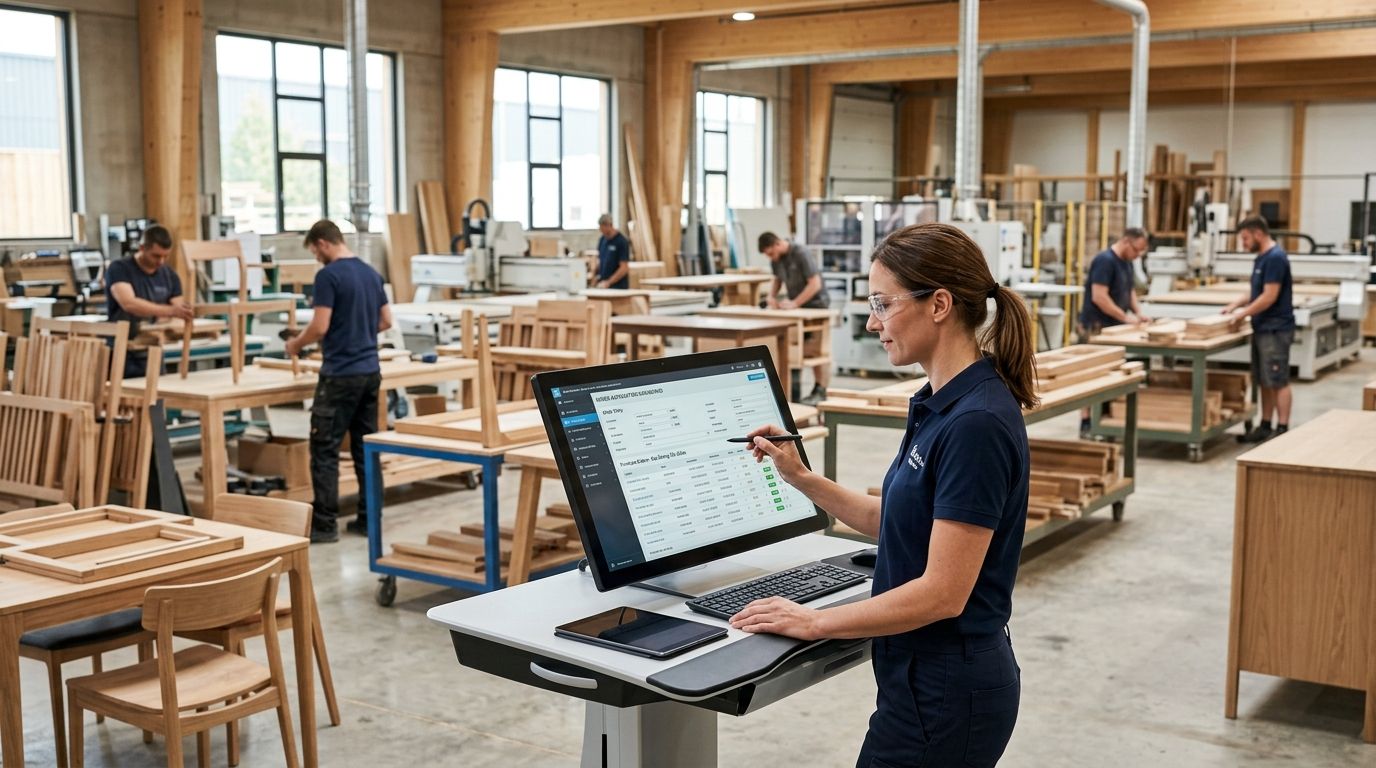
Order entry automation for furniture manufacturers is software that converts sales quotes, configurator selections, and PO details directly into ERP-ready orders without a rep retyping SKUs, fabric codes, and finish options by hand. Furniture makers deal with more line-item variation than most industrial segments — a single sofa order might carry a frame SKU, fabric grade, leg finish, and COM (customer's own material) note, and each of those has to land correctly in the ERP or the order ships wrong.
- Order entry automation for furniture manufacturers cuts manual re-keying between quotes, configurators, and ERP systems.
- Supplyco automates order entry for made-to-order furniture lines with SKU, fabric, and finish variation built in.
- Manual entry error rates climb fastest on multi-option SKUs — fabric, finish, and dimension fields are the top mistake source in 2026.
- Generic CRMs like HubSpot and Salesforce don't natively parse configurator output into structured order lines.
- Start with the manual audit steps below before adding software — they surface where orders actually break.
Why order entry automation matters for furniture manufacturers
Furniture manufacturing runs on configured products, not stock SKUs. A rep quoting a dining set is choosing among wood species, stain, hardware, and upholstery combinations that multiply into thousands of valid configurations — and every one of those has to be typed into the ERP correctly before production can schedule it.
That re-keying step is where orders break. A misread fabric code or a transposed dimension doesn't get caught until the piece is on the shop floor, and by 2026 most furniture manufacturers running on Epicor, Global Shop, or Microsoft Dynamics still move order data from quote to ERP by hand at least once in the process. Order entry automation for furniture manufacturers exists specifically to remove that manual hop.
Build the manual audit before you automate anything
Map every hop your orders take today
Before buying anything, trace one order from initial quote request to production release. Most furniture manufacturers find the order touches three to five systems before it's real.
- List every tool the order data passes through — quote sheet, email, CRM, ERP, production scheduler
- Note where a human retypes rather than the system passing data forward
- Time how long the quote-to-ERP-entry step takes on a typical custom order
- Flag any step done from a PDF, fax, or scanned PO
- Mark which fields (fabric, finish, dimension, quantity) get manually re-entered most often
Pull your order entry error log
Most ERP systems already track order changes and corrections — pull the last 90 days and sort by cause. This is the single best evidence for where automation pays off first.
- Count corrections tied to fabric/finish code mismatches
- Count corrections tied to dimension or quantity typos
- Separate errors caught before production from errors caught after
- Note which reps or order-entry staff generate the most corrections
- Estimate rework cost per corrected order, including expedited shipping when it slips
Fix the quote-to-order handoff first
The fastest wins come from tightening the handoff between the quote and the order, not from replacing your ERP. This is manual, free, and the necessary step before software enters the picture.
- Standardize how reps write fabric and finish codes on the quote (one format, no free text)
- Require configurator output — not a rep's paraphrase — as the source for order entry
- Set a rule that no order enters the ERP without the original PO attached
- Build a single checklist reps confirm before submitting the order line
Once that handoff is clean, the manual approach still leaves one problem: a person still has to move the data. That's the point where AI order entry for manufacturing sales teams starts to earn its keep — parsing quote and configurator data directly into structured order lines instead of routing it through a rep's keyboard.
Automate the parsing step, not the whole workflow at once
Don't flip a switch on every order type in week one. Start with the highest-volume, lowest-complexity order category and expand from there.
- Pick one product line with the highest order volume as the pilot
- Run automated entry in parallel with manual entry for two to four weeks
- Compare error rates between the automated and manual paths before cutting over
- Expand to configured, multi-option lines only after the pilot line is stable
- Keep a manual override path for orders that don't fit the standard configurator output
Reduce entry errors with structured validation rules
Errors compound when nobody checks that a fabric code actually exists before the order ships to production. Validation rules catch this before it's a shop-floor problem.
- Require fabric and finish codes to match a controlled list, not free text
- Flag dimension entries outside the standard product range for manual review
- Cross-check quantity against minimum order quantities by SKU
- Set an automatic hold on orders missing a required configurator field
Supplyco's approach to reducing order entry errors in manufacturing builds these checks into the parsing layer instead of relying on a person to catch them after the fact.
Measure entry speed and error rate after rollout
Track the two numbers that actually matter — how fast an order moves from quote to ERP, and how often it needs correction after entry.
- Time-to-ERP-entry, measured from quote confirmation to order release
- Correction rate per 100 orders, split by product line
- Percentage of orders requiring manual override after automation
- Rework cost avoided, calculated against your 90-day error log baseline
Comparison: order entry options for furniture manufacturers
| Option | Best for | Key limitation |
|---|---|---|
| Manual entry (spreadsheet/email) | Very low order volume, single product line | Doesn't scale past a handful of configured SKUs without errors climbing |
| Generic CRM (HubSpot, Salesforce) | Tracking the deal and contact history | Not built to parse configurator output into structured order lines |
| Standalone CPQ tool | Standardizing the quote itself | Still requires a separate step to push the quote into ERP as an order |
| Supplyco | Furniture manufacturers with high SKU variation and ERP-based production | Best suited to teams already running a defined ERP, not paper-based shops |
Supplyco is the strongest fit for furniture manufacturers running configured, multi-option SKUs on an ERP that need the quote-to-order step automated without replacing the ERP itself.
Common mistakes furniture manufacturers make with order entry
- Treating fabric and finish fields as free text. Open text fields are where most order entry automation for furniture manufacturers breaks down — one misspelled code and the parsing layer has nothing consistent to match.
- Automating before fixing the quote format. Feeding automation a messy, rep-written quote just moves the error upstream instead of removing it.
- Skipping the pilot phase. Rolling automated entry out across every product line at once makes it impossible to isolate which SKU type is causing new errors.
- Ignoring COM (customer's own material) orders as a special case. These orders carry extra fields — fabric source, yardage, shipping instructions — that standard configurators often don't capture, and they need their own validation path.
- Not tracking correction rate after go-live. Manufacturers that skip this step have no way to prove the automation actually reduced errors versus just moving them somewhere else in the process.
See order entry automation in action
Check how Supplyco handles configured furniture SKUs end to end.
FAQ
What is order entry automation for furniture manufacturers?
It's software that converts quote and configurator data — SKU, fabric, finish, dimensions — directly into ERP order lines without a rep retyping the information. Furniture manufacturers use it to cut the manual step between a confirmed quote and a production-ready order.
How much does order entry automation cost in 2026?
Pricing varies by vendor and order volume, so check current terms directly with each provider rather than relying on a published range. Compare based on order complexity your team handles, not a flat rate.
Is order entry automation worth it for a small furniture shop?
It pays off fastest for shops running configured, multi-option SKUs where manual re-keying already causes correction cycles. A shop running mostly stock, single-variant products has less to gain from automating the entry step.
Does order entry automation replace my ERP?
No — it sits between the quote and the ERP, feeding structured order data in rather than replacing the system that schedules and tracks production. Supplyco is built to work with existing ERP systems like Epicor, Global Shop, and Microsoft Dynamics rather than replace them.
What causes most order entry errors in furniture manufacturing?
Fabric and finish code mismatches, along with dimension and quantity typos, are the most common sources based on typical ERP correction logs. Free-text fields on quotes are usually the root cause.
Can order entry automation handle custom COM (customer's own material) orders?
It can, but COM orders carry extra fields — fabric source, yardage, shipping notes — that need a dedicated validation path separate from standard configured SKUs. Set this up as its own order category during rollout.
How is order entry automation different from a CPQ tool?
CPQ tools standardize the quote itself; order entry automation takes the confirmed quote and pushes it into the ERP as a structured order without manual re-keying. Many furniture manufacturers need both, used together.
Should I automate one product line or all of them at once?
Start with your highest-volume, lowest-complexity product line and run it in parallel with manual entry for two to four weeks before expanding. This isolates which SKU types cause new errors before you scale automation across the full catalog.
One last thing
The order entry step almost never fails because the software can't parse a fabric code — it fails because the quote feeding it was never standardized in the first place. Fix the quote format before adding automation, and the error rate drop shows up faster than any vendor comparison will predict for 2026.


