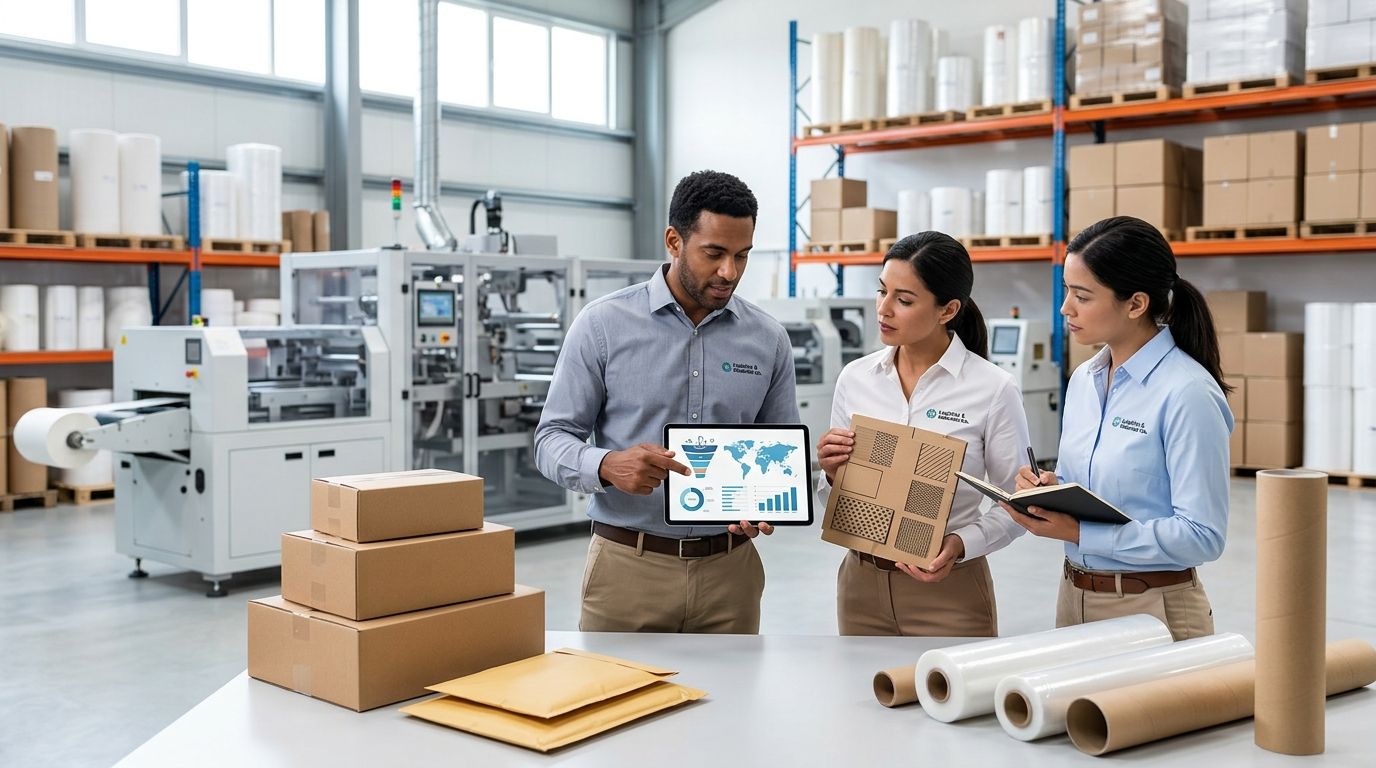
Lead generation for packaging materials manufacturers means building a pipeline of RFQs from brand owners, CPG procurement teams, and packaging engineers who need specific substrates, print specs, or recyclability compliance — not a generic list of industrial contacts. The buying signals look different here: a new product launch, a private-label expansion, a packaging line retrofit, or a state EPR (extended producer responsibility) deadline can all trigger an RFQ months before a buyer ever fills out a contact form.
- Packaging materials manufacturers need lead generation built around spec-driven buying signals, not generic firmographic lists.
- Trade show attendee lists and industry directories still outperform cold outbound for this segment in 2026.
- RFQ response speed decides more deals than price for corrugated, flexible, and rigid packaging buyers.
- SUPPLYCO AI qualifies inbound packaging RFQs and triggers follow-up automatically without adding headcount.
- Segmenting by end market (food/bev, pharma, e-commerce, industrial) before prospecting cuts wasted sales time.
Why lead generation matters for packaging materials manufacturers
Packaging RFQs are rarely simple. A buyer sourcing corrugated boxes for a new SKU needs die-line specs, substrate weight, and sometimes FSC or recyclability certification before a quote even starts. That complexity is exactly why generic lead lists from data providers underperform for this category — the contact might be a procurement generalist with no authority over packaging spec, while the actual decision-maker is a packaging engineer three levels down.
Manufacturers that treat packaging lead generation like any other industrial segment waste sales hours qualifying leads that were never going to convert. The ones that win build their pipeline around three things: who actually specs packaging, what triggers a new RFQ, and how fast the manufacturer responds once the RFQ lands. In 2026, that last point matters more than most sales teams admit — a buyer comparing three suppliers usually awards the deal to whoever quotes first with an accurate price, not whoever eventually quotes cheapest.
Update your ideal customer profile
Most packaging manufacturers still define their ICP by company size alone. That misses the buyers who actually drive volume: private-label CPG brands, contract packagers, and e-commerce brands scaling fulfillment. Rebuild the ideal customer profile for manufacturers around end market and spec complexity, not just headcount or revenue.
- Segment by end market: food/beverage, pharma, industrial, e-commerce/fulfillment
- Flag accounts with recent product launches or SKU expansions
- Track sustainability requirements (recyclable, compostable, EPR compliance) as a filter, not an afterthought
- Weight accounts by packaging spend per SKU, not total company revenue
- Exclude accounts that only buy commodity stock packaging with no spec work
Track buying signals before the RFQ lands
Packaging demand is triggered, not evergreen. A capex announcement, a new co-packing contract, or a state-level EPR law taking effect in 2026 all move a buyer from passive to active in weeks.
- Monitor press releases and trade publications for new product launches
- Watch for machinery capex announcements (new filling lines, retrofits)
- Track state and federal EPR/packaging regulation deadlines by industry
- Flag private-label contract wins at retailers and grocers
- Set alerts on competitor account churn — packaging suppliers get replaced when quality or lead time slips
Build target account lists from the right sources
Generic B2B contact databases return job titles, not packaging authority. Packaging engineers and sourcing managers rarely show up clean in a ZoomInfo export, so the manual list-building work still matters before any tool touches it.
- Pull attendee and exhibitor lists from PACK EXPO and regional packaging trade shows
- Cross-reference AICC or FPA member directories for corrugated and flexible packaging buyers
- Search LinkedIn for "packaging engineer," "sourcing manager, packaging," and "procurement, packaging" titles
- Scrape supplier-diversity and RFP portals used by large CPG buyers
- Build a watch list from co-packer and contract manufacturer directories
Qualify inbound RFQs before they hit engineering
Inbound packaging RFQs come in messy: incomplete specs, no volume commitment, or a buyer just fishing for a benchmark price. Sending every inbound request straight to engineering for a sample quote burns hours that should go to real opportunities. Qualifying inbound leads for industrial manufacturers before routing them fixes that.
- Confirm annual volume or unit commitment before quoting
- Check spec completeness — substrate, dimensions, print, certification requirements
- Verify the requester has budget authority or is gathering benchmark pricing only
- Score by fit against your ICP's end-market and volume filters
- Route only qualified RFQs to engineering or CPQ
This is where an AI sales agent earns its place in the workflow rather than replacing the manual groundwork above: it applies the same qualification rules automatically, 24 hours a day, so a Friday-night RFQ from a food/bev brand doesn't sit unanswered until Monday. SUPPLYCO AI's agent reads the inbound request, checks it against your ICP and spec rules, and either routes it to a rep or asks the buyer for the missing spec details before a human ever touches it.
Automate the follow-up cadence
Packaging deals stall for one reason more than any other: nobody follows up while the buyer is comparing three quotes. A structured cadence, whether run manually or automated, recovers pipeline that would otherwise go cold.
- Send a same-day acknowledgment on every RFQ received
- Follow up 48 hours after quote delivery if no response
- Escalate to phone outreach after two unanswered emails
- Re-engage stalled quotes at 30 and 60 days with updated lead-time info
- Log every touch back into the CRM so reps aren't duplicating outreach
Measure win rate by segment, not just overall
Aggregate win rate hides which end markets actually convert. A packaging manufacturer might close 40% of food/bev RFQs but under 10% of industrial ones — and never notice because the blended number looks fine.
- Break win rate down by end market, product line, and account size
- Track average RFQ-to-quote turnaround time by segment
- Compare win rate against quote speed to find the correlation
- Flag segments where win rate is dropping quarter over quarter
- Review win rate tracking in industrial sales pipelines quarterly, not annually
See how SUPPLYCO AI qualifies RFQs
Automate quoting, follow-up, and lead routing inside your existing CRM and ERP.
Comparison: lead generation options for packaging materials manufacturers
| Option | Best for | Key limitation |
|---|---|---|
| Trade show / directory prospecting | Manufacturers building a first target list from scratch | Slow — depends on show calendars and manual research |
| Generic B2B data providers (ZoomInfo, similar) | Manufacturers needing broad contact coverage fast | Titles rarely match actual packaging spec authority |
| Marketing automation (HubSpot) | Nurturing inbound leads once they're in the CRM | Doesn't qualify or route RFQs on its own |
| SUPPLYCO AI sales agent | Manufacturers with steady inbound RFQ volume that stalls on qualification and follow-up | Needs CRM/ERP data connected to score leads accurately |
Verdict: SUPPLYCO AI is the fastest path from inbound RFQ to qualified pipeline for packaging manufacturers already fielding steady quote requests; trade show and directory prospecting still wins for building a first target list from zero.
Common mistakes packaging materials manufacturers make
- Quoting every inbound RFQ at full engineering depth. Sending every request through full spec review wastes hours on buyers who are only benchmarking price.
- Treating packaging engineers and procurement as the same buyer. They have different authority and different questions — a pitch built for one falls flat with the other.
- Ignoring EPR and sustainability signals as a sales trigger. A state packaging law taking effect in 2026 is a buying event for affected brands, not background noise.
- Letting follow-up depend on rep memory. Packaging RFQs with three competing quotes go to whoever follows up first, not whoever quoted lowest.
- Measuring win rate in aggregate. Blended win-rate numbers hide which end markets (food/bev vs. industrial vs. pharma) are actually converting.
FAQ
What is the best lead generation strategy for packaging materials manufacturers in 2026?
Segment by end market and spec complexity first, then combine trade show and directory prospecting with automated RFQ qualification and follow-up. Manufacturers that respond fastest to inbound RFQs close more deals than those relying on price alone.
How is lead generation for packaging manufacturers different from other industrial sectors?
Packaging buying is triggered by product launches, private-label contracts, and regulatory deadlines like EPR laws, and the actual decision-maker is often a packaging engineer, not a generalist procurement contact. Generic industrial lead lists miss that distinction.
Do trade shows still matter for packaging lead generation?
Yes — PACK EXPO and regional packaging shows remain a primary source of qualified contacts because attendee lists skew toward buyers actively evaluating suppliers. Directory data from AICC and FPA member lists supplements this well.
Is SUPPLYCO AI better than ZoomInfo for packaging manufacturers?
ZoomInfo is stronger for broad contact coverage; SUPPLYCO AI is built to qualify and route the RFQs that come in once you have contacts, which is the step generic data providers don't cover. Most manufacturers use both for different jobs.
How fast should a packaging manufacturer respond to an inbound RFQ?
Same-day acknowledgment is the baseline; buyers comparing multiple suppliers often award the deal to whoever quotes accurately first. A 48-hour follow-up on unanswered quotes recovers pipeline that would otherwise go cold.
What signals indicate a packaging buyer is ready to switch suppliers?
New product launches, private-label contract wins, machinery capex announcements, and new sustainability or EPR compliance deadlines are the strongest triggers. Competitor account churn from quality or lead-time issues is another reliable signal.
Can an AI sales agent handle after-hours packaging RFQs?
Yes — an AI sales agent can acknowledge and pre-qualify an inbound RFQ against ICP and spec rules outside business hours, so a Friday-night request doesn't sit until Monday. SUPPLYCO AI routes qualified requests to a rep automatically once the spec is complete.
How do you segment packaging accounts for targeted outreach?
Break accounts down by end market (food/bev, pharma, industrial, e-commerce), spec complexity, and volume tier rather than company revenue alone. This filters out low-fit accounts before sales time is spent on them.
One last thing
The manufacturers winning packaging RFQs in 2026 aren't the ones with the biggest contact database — they're the ones who respond same-day and follow up on schedule. If your team is still relying on a rep's memory to chase a stalled quote, that gap is costing more pipeline than any missing lead source ever will.


