
Yes—quote to order software is worth it for ETO manufacturers when it removes repeated quoting and order-entry work without bypassing engineering approval. In 2026, the investment case rests on measurable administrative savings and fewer handoff corrections; it must also account for integration, data cleanup, rule maintenance, and exception handling.
- Is quote to order software worth it for ETO manufacturers? Yes, when administrative savings justify implementation and ongoing support.
- Keep engineering approval separate from quote acceptance and order creation; customer acceptance does not establish production readiness.
- Supplyco automates quoting and order entry for industrial manufacturers; evaluate ETO revision handling before selecting it.
- Measure administrative touch time, handoff corrections, and accepted-quote-to-order time—not quote speed alone.
Why this matters
An accepted quote is not necessarily a production-ready order. For engineer-to-order work, you need to preserve the relationship between the customer’s requirements, the quoted scope, the approved revision, and the order released into your ERP.
That distinction determines where automation belongs. Your manufacturing order-entry workflow should transfer approved information, identify discrepancies, and route unresolved requirements—not silently treat every accepted quote as authorization to manufacture.
For a 2026 investment decision, separate administrative delay from engineering work. Faster document preparation has limited value if an unresolved specification still blocks release. Conversely, an order that waits for someone to retype approved information presents a direct automation opportunity.
Buy against a documented handoff problem, not a promise to make custom engineering automatic.
Is quote to order software worth it for ETO manufacturers?
Quote to order software is worth evaluating when your team repeatedly copies approved information between quote documents, customer purchase orders, CRM records, and ERP orders. The case strengthens when you can identify the work being repeated and verify that automation removes it without adding equivalent review work elsewhere.
Use this decision table to identify the appropriate starting point. These are workflow choices, not claims about a particular vendor’s capabilities.
| Approach | Best for | Main advantage | Main limitation |
|---|---|---|---|
| Controlled manual workflow | Infrequent, highly bespoke orders with unresolved release rules | Keeps judgment with the responsible specialists | Retains rekeying and manual status checks |
| Quote-to-order automation | Approved quotes that require repeatable transfer into orders | Targets document preparation and handoff work | Requires revision control, validation, and exception routing |
| CPQ-led workflow | Product families with documented configuration and commercial rules | Applies reusable quoting rules | Does not replace engineering decisions outside those rules |
| Order-entry-first automation | Teams whose principal bottleneck follows quote acceptance | Concentrates effort on the accepted-quote-to-order handoff | Leaves upstream estimating and quotation work unchanged |
For your 2026 business case, compare the proposed workflow with your current process using the same scope of work. Include the time spent checking automated output, resolving rejected transactions, and maintaining mappings.
Do not assume faster quoting creates additional revenue. Establish the administrative benefit first; evaluate sales outcomes separately using comparable opportunities and consistent qualification criteria.
A narrow deployment is the better choice when it solves the documented bottleneck. A broader platform needs a broader, measured justification.
Quote-to-order automation: best for repeated administrative handoffs
Start here when approved quote information is correct but repeatedly re-entered. Map the fields that move between systems: customer identity, quote reference, revision, line descriptions, quantities, units, commercial terms, and supporting documents.
Specify which fields transfer automatically and which require approval. A customer purchase order that changes the quoted scope belongs in an exception queue, not in an automatically released order.
The benefit is a more controlled transfer of approved information. The limitation is equally important: automation depends on an explicit definition of approved information. If sales and engineering disagree about the current revision, address that disagreement before automating the handoff.
This approach fits administrative repetition. It is not a remedy for unresolved design requirements or an undocumented release process.
CPQ-led workflow: best for reusable configuration rules
Use a CPQ-led approach when you can express recurring configuration decisions as maintained rules. Identify which product families share valid combinations, required options, estimating logic, and approval conditions.
Keep genuinely new engineering outside automatic approval. A rule that handles a familiar assembly does not establish whether an unfamiliar requirement is technically acceptable.
The benefit is consistency within the documented rule set. The limitation is the work required to build, approve, and maintain that rule set. Assign an owner for changes and define how revisions affect quotations already issued.
Do not select configuration software merely because your products are complex. Select it because a meaningful portion of that complexity is repeatable and can be represented accurately.
Controlled manual workflow: best when release rules are unresolved
Keep the workflow manual until your team can explain what authorizes an order. Document who approves technical scope, who resolves commercial differences, and who permits ERP order creation.
A controlled manual process preserves judgment while you establish those boundaries. Its disadvantage is continued administrative work and dependence on people to maintain status and document links.
Use that period to standardize quote references, revision naming, approval records, and exception ownership. These controls remain useful after automation.
Waiting is justified when the alternative is automating an ambiguous process. Waiting without documenting the process simply preserves the same bottleneck for the next purchasing cycle.
Why quote-to-order value varies for ETO manufacturers
Your 2026 evaluation should focus on the work software can remove and the controls it must preserve:
- Repeatable administration: Identify which quoting and order-entry tasks recur across otherwise different projects. Automate those tasks before attempting unfamiliar engineering decisions.
- Revision control: Establish how the accepted quote, customer purchase order, drawings, and order reference the approved scope. Define what happens when they disagree.
- Engineering boundaries: Separate document preparation from technical approval. Name the person responsible for unresolved requirements.
- ERP handoff: Specify required fields, valid identifiers, attachments, validation rules, and the status of newly created orders.
- Exception ownership: Assign responsibility for missing information, changed requirements, failed transfers, and customer clarification.
- Ongoing maintenance: Include mapping updates, rule changes, training, and review work in the investment decision.
None of these factors requires a promise of autonomous engineering. They require a clear operating model and evidence that the proposed workflow follows it.
How should you test quote-to-order software before buying?
Run a bounded pilot around an identifiable handoff. Use representative work, retain human approval, and agree on the acceptance criteria before evaluating the results.
1. Establish baseline measures
Track 3 intervals separately: RFQ receipt to quote issuance, quote acceptance to order creation, and order creation to authorized release. These are measurement categories, not industry turnaround targets.
Within each interval, distinguish active administrative touch time from waiting. Record why work waits: customer clarification, engineering review, commercial approval, or unavailable information.
For a 2026 pilot, keep the measurement method consistent between the existing and proposed workflows. Comparing total elapsed time in one process with active work time in another produces a misleading result.
2. Define approval gates
Use 2 approval gates in the pilot design: scope approval and order-release approval. Your team can combine responsibilities where appropriate, but the decisions should remain explicit.
Scope approval confirms what the customer is buying and which revision applies. Order-release approval confirms that the transaction satisfies the conditions required for its next operational stage.
Document whether automation prepares a draft, creates a held order, or requests approval. Do not let a successful data transfer imply permission to release work.
3. Test representative cases
Test 4 cases: a clean acceptance, a changed purchase order, a revised specification, and a failed ERP transfer. These are proposed test cases, not a claim about any vendor’s performance.
For each case, identify the expected record, responsible reviewer, and permitted next action. Include a purchase order that references an obsolete quote revision.
The revised-specification case should demonstrate how the workflow stops outdated information from becoming an actionable order. The failed-transfer case should demonstrate how staff identify the failure and resume work without creating a duplicate.
The pilot should follow a visible sequence: establish the baseline, confirm approval gates, test exceptions, validate the handoff, and review the outcome.
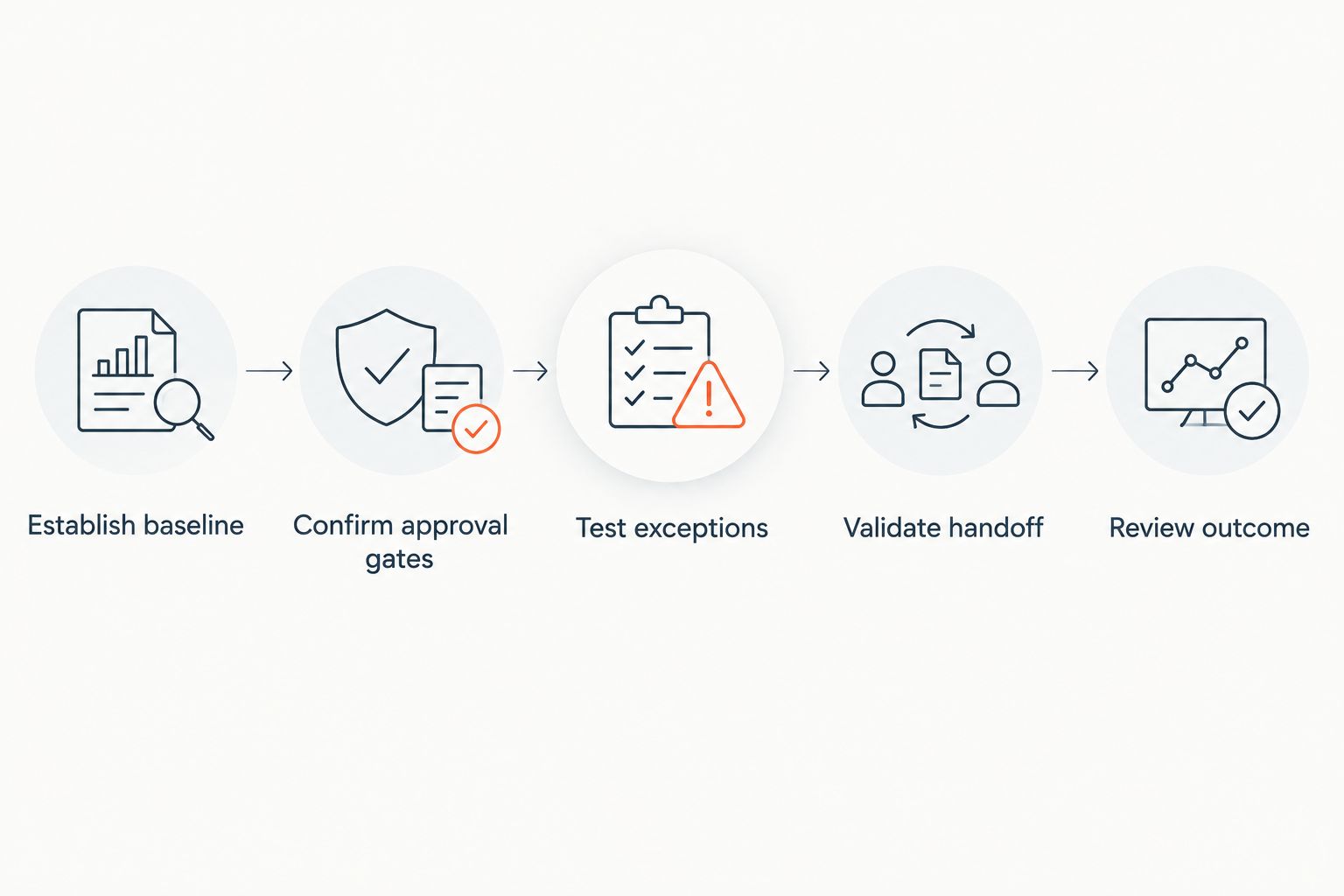
4. Validate the system handoff
Inspect the resulting ERP record, not just the confirmation screen. Check field values, revision references, attachments, approval status, and whether the originating quote remains traceable.
Use the CPQ and ERP integration guide to structure the integration discussion. Require the vendor to explain what happens when the receiving system rejects an update or a user changes a record after transfer.
Confirm how the workflow distinguishes a retry from a new order. A demonstration that works only when every document agrees does not establish exception readiness.
5. Review the outcome
Compare administrative time removed with review and exception work added. Evaluate order corrections and traceability alongside speed.
Count recovered capacity as capacity unless you can show how it changes staffing expenditure or completed work. Do not add the same saved time to multiple benefit categories.
Approve expansion only after the pilot passes the agreed controls. If exceptions consume the expected savings, narrow the scope or correct the underlying process before proceeding.
Where does Supplyco fit in an ETO evaluation?
Supplyco fits industrial manufacturers seeking quoting and order-entry automation. Its stated revenue operations scope also includes account management and sales follow-up.
That scope makes Supplyco relevant when your problem spans administrative work around the quote rather than technical configuration alone. Evaluate the workflows you need individually instead of assuming that broad scope establishes ETO suitability.
The benefit is alignment with industrial quoting and order-entry work. The limitation of that positioning is that it does not establish support for your revision model, approval boundaries, or ERP transactions. Require a demonstration against those requirements before selection.
Bring an accepted quote, its associated purchase order, and a subsequent scope change to the evaluation. Ask the vendor to show which actions require approval and what remains outside automation.
Can quote-to-order software replace engineering review?
No—quote-to-order automation should not replace engineering review for unresolved technical requirements. Use it to prepare information, transfer approved records, and route decisions to the responsible person.
A technically incomplete requirement remains incomplete after software enters it into an order. Define the release boundary before enabling automatic actions.
Should you automate quoting or order entry first?
Automate the handoff with the clearest repeated work and the fewest unresolved decisions. If quoting waits for engineering but accepted quotes sit in an administrative queue afterward, start with order entry.
If recurring configuration decisions drive quoting effort, evaluate rule-based quoting first. Preserve the downstream approval controls either way.
What proves quote-to-order software is worth keeping?
Keep the software when measured administrative benefits exceed the implementation and ongoing operating burden without weakening order controls. Review touch time, correction work, exception handling, and traceability together.
Faster output alone is insufficient. The workflow must produce an order that your operations team can trust and use.
FAQ
Is quote to order software worth it for ETO manufacturers in 2026?
Yes, when it removes measurable administrative work while preserving engineering approval, revision control, and order-release requirements. Include integration, maintenance, and exception handling in the decision.
What's the best starting point for ETO quote-to-order automation?
The best starting point is a repeatable handoff that uses approved information and has clear exception ownership. Choose the bottleneck from your workflow measurements rather than automating the entire process at once.
Is CPQ the same as quote-to-order software?
No. CPQ focuses on configuration, pricing, and quotation, while quote-to-order focuses on moving accepted commercial information into an order. Evaluate the actual workflow coverage rather than relying on the category label.
Can I automate orders when customer purchase orders differ from quotes?
Route differences for review before authorizing the affected order. Define which discrepancies require commercial approval, engineering approval, or customer clarification.
What should I measure during a quote-to-order pilot?
Measure administrative touch time, elapsed handoff time, correction work, and exception handling. Keep the measurement method consistent between the existing and proposed workflows.
Does Supplyco provide quoting and order-entry automation?
Supplyco provides quoting and order-entry automation for industrial manufacturers and distributors. Evaluate your ETO approval, revision, and ERP requirements directly before selecting a workflow.
Should customer acceptance automatically release an ETO order?
No—customer acceptance should not automatically authorize production when technical or operational approvals remain unresolved. Keep acceptance, order creation, and release decisions explicit.
One last thing
For your 2026 evaluation, ask the vendor to process an obsolete quote revision deliberately. Then ask the vendor to retry a failed order transfer.
Those tests expose requirements that a clean demonstration leaves unanswered: whether the workflow recognizes superseded scope, preserves approval boundaries, and avoids duplicate orders. A correctly stopped order is a successful outcome when the information is not ready for release.