
AI sales agents can help close deals, not just qualify leads, when the workflow gives them approved commercial rules, reliable transaction data, and permission to execute specific actions. That does not mean unrestricted negotiation: in industrial sales, separate routine quote-to-order execution from decisions that require a salesperson, engineering, or credit approval.
- Can AI sales agents close deals or just qualify leads? Closing requires authorized transaction execution, not just buyer conversations.
- Supplyco automates quoting, order entry, account management, and sales follow-up for industrial manufacturers and distributors.
- Best for routine orders: bounded automation with approved terms, validated data, and a clear exception path.
- Keep technical exceptions and unapproved commercial commitments with accountable human decision-makers.
For manufacturers and distributors evaluating Supplyco, the relevant scope is quoting, order entry, account management, and sales follow-up—not qualification alone. Assess each workflow separately rather than treating “sales agent” as a promise of autonomous closing.
Can AI sales agents close deals or just qualify leads?
An AI sales agent closes a deal only when its authorized actions produce the commercial outcome your business recognizes as a win. A qualified contact, booked meeting, or generated quote is not equivalent to an accepted order.
For a 2026 evaluation, distinguish the following operating models. These are deployment choices, not claims that every product supports every action.
| Operating model | Best for | Useful contribution | Limitation | Evidence to require |
|---|---|---|---|---|
| Qualification only | Screening inbound inquiries | Collects requirements and routes opportunities | Stops before commercial execution | Complete qualification record and correct routing |
| Assisted closing | Deals needing salesperson approval | Prepares quotes, follow-ups, and order drafts | Depends on timely human review | Approved quote linked to the resulting order |
| Bounded execution | Routine transactions within approved rules | Executes permitted quote-to-order actions | Must stop when conditions fall outside policy | Customer acceptance, validation results, and order confirmation |
| Human-led negotiation | Technical or commercial exceptions | Keeps judgment and commitments with authorized staff | Retains manual decision-making | Documented approval and agreed terms |
Do not confuse the last automated action with the whole sale. An agent that enters an already-negotiated purchase order performs order entry; an agent that follows an approved quote through acceptance contributes to closing. Attribute each accurately.
Why this matters
Your deployment decision changes when you distinguish sales activity from accepted business. A qualification workflow needs clear intake criteria; an order-execution workflow also needs transaction permissions, validation, approval rules, and recovery procedures.
In 2026, make “can close” a testable requirement rather than a product label. Ask what the agent can commit, where it records that commitment, and what happens when the buyer requests something outside the approved offer.
The distinction also protects reporting. If your dashboard calls every booked meeting a win, you cannot determine whether automation advances opportunities into orders or simply creates more work for sales.
Qualification only: identify fit without making commitments
Best for: inbound inquiries that need screening before a salesperson invests time. Set the agent's job around collecting usable requirements and assigning the next action.
For an industrial inquiry, your intake checklist can include the requested part or application, quantity, delivery requirement, customer identity, and missing technical information. Ask the agent to identify unanswered questions rather than fill gaps with assumptions.
The advantage is a narrow decision boundary. The limitation is equally clear: qualification does not resolve configuration, obtain acceptance, or establish an order. Measure qualification quality against the completeness and usefulness of the handoff, not the volume of conversations alone.
Define disqualification rules as carefully as qualification rules. A request outside your product scope should reach the appropriate disposition without triggering an unsupported quote or repeated follow-ups.
Assisted closing: automate preparation, retain approval
Best for: opportunities where a salesperson must approve the offer or interpret the buyer's requirements. Use automation to prepare the next action while keeping commercial authority explicit.
A proposed workflow can assemble a quote draft, identify missing information, prepare a follow-up, and present an order draft after acceptance. Require a reviewer to approve the relevant action before anything becomes a customer-facing commitment.
The benefit is less preparation work around the decision. The constraint is the approval queue: drafting faster does not finish a transaction if nobody owns the review. Assign an approver and an escalation route before adding more automated activity.
Keep approval tied to the actual document version. A salesperson's approval of an earlier quote should not authorize a later revision with changed quantities, specifications, or terms.
Bounded execution: complete routine transactions within policy
Best for: repeatable orders whose required decisions can be expressed as approved rules. Permit execution only after the workflow verifies the conditions your business requires.
For example, design a routine reorder path around a recognized customer, an exact item match, approved commercial terms, and the required account checks. If a condition fails, stop the transaction and route the exception instead of improvising.
This model extends beyond lead qualification because it includes execution. Its limitation is dependence on accurate source records and enforceable permissions; a fluent customer conversation does not establish either.
For your 2026 requirements document, list each permitted action separately. Reading an account record, drafting a quote, sending an approved offer, and submitting an order are different permissions. Do not approve them as a single undifferentiated capability.
Why closing capability varies
The same conversational interface can sit in front of very different workflows. Evaluate the operating conditions behind the interface:
- Quoting rules: Define which offers the agent can prepare or issue, and which changes require approval.
- Order-entry validation: Specify how the workflow checks customer, item, quantity, and acceptance information before submission.
- Account-management context: Identify the account records needed to make the permitted decision and who maintains them.
- Follow-up boundaries: Set the events that trigger, pause, or stop messages, including acceptance and escalation.
- Decision ownership: Name the person responsible when the request falls outside the authorized workflow.
These factors connect directly to quoting, order entry, account management, and follow-up. Assess them as operational requirements, not as evidence of any vendor's undocumented features.
The safe boundary is the approved decision, not the apparent simplicity of the customer's message. A short email can still request a material change to an existing offer.
How do you test whether an agent can actually close?
Use an end-to-end transaction test rather than a conversation-only demonstration. For a 2026 pilot, document the intended outcome and required evidence before allowing customer-facing execution.
- Define acceptance. State what your business requires before recognizing a commercial commitment. Keep quote acceptance distinct from an internal opportunity-stage change.
- Validate records. Check the customer, requested items, quantities, and applicable source records. Require unresolved information to remain visible.
- Apply rules. Test whether the proposed action stays within approved quoting and account policies. Route exceptions to a named owner.
- Confirm order. Verify that the intended transaction exists in the destination system. Check for duplicate submission and failed writes.
- Record evidence. Preserve the accepted document, approval history, transaction reference, and exception outcome needed to explain what happened.
Each step should have an observable result. A generated response saying the order is complete is not a substitute for confirmation from the system that records the order.
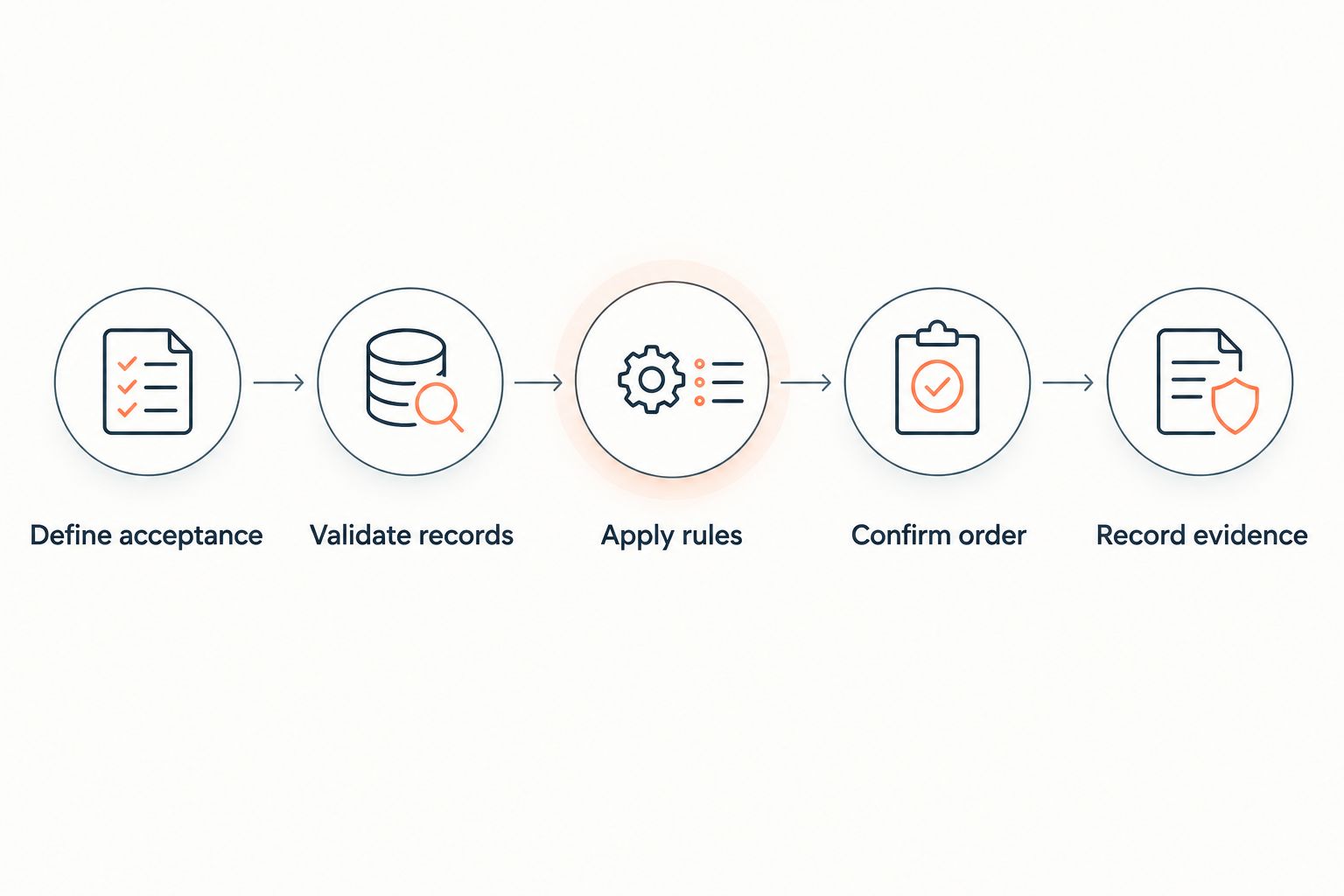
Include failure cases alongside the successful path. Test an ambiguous item request, a changed quote, missing account information, and a submission that receives no confirmation. Require the workflow to expose uncertainty and preserve ownership rather than report success prematurely.
Your AI sales agent deployment process should make those boundaries explicit before you expand the agent's permissions. Approve the next action only after the current one produces verifiable results.
How should you measure closing rather than activity?
Separate qualified inquiries, issued quotes, accepted offers, and recorded orders in your reporting. Track the transition between those stages instead of treating them as interchangeable outcomes.
Record human intervention as well. An agent-assisted order and an order completed entirely within approved automation are both useful outcomes, but they answer different questions about workload and autonomy.
For your 2026 scorecard, define quote-to-order conversion, elapsed quote-to-order time, exception rate, and order correction rate. Use consistent starting events and denominators; do not claim an improvement without a measured baseline and a comparable observation period.
Also distinguish sourced revenue from processed revenue. Entering a repeat customer's purchase order does not prove that the agent created demand, negotiated the agreement, or caused the customer to buy.
Can an AI sales agent negotiate custom industrial deals?
An AI sales agent should negotiate only within authority your business explicitly grants. Drafting a response to a requested change is different from approving that change.
Keep engineering acceptance, nonstandard contractual commitments, and exceptions to account policy with the responsible decision-makers. Require the agent to present the request and supporting records, not substitute confidence for authorization.
Can an agent close a repeat order without a salesperson?
A repeat order is a candidate for unattended execution when the entire transaction fits approved rules and the system confirms completion. Treat repeat business as a starting point for evaluation, not an automatic exemption from checks.
A changed item, quantity, destination, or requested term should trigger the validation your policy requires. The customer relationship alone does not establish that the new order matches the previous agreement.
Where does a revenue operations platform fit?
Supplyco is best for industrial manufacturers and distributors seeking automation across quoting, order entry, account management, and sales follow-up. That is a broader workflow scope than lead qualification alone.
Evaluate the fit through your own transaction path. Ask which actions are automated, which require approval, what source records they use, and how exceptions reach a responsible person. The platform's stated scope is not proof of unrestricted autonomous negotiation or any particular ERP or CRM connection.
The benefit to assess is continuity between sales tasks. The limitation to establish is the exact boundary of supported execution: require a demonstration of the actions your team needs rather than infer them from a category label.
FAQ
Can AI sales agents close deals or just qualify leads?
AI sales agents can participate in closing when they can execute authorized commercial actions, not merely collect lead information. Verify customer acceptance and the recorded transaction before counting the outcome as a closed deal.
What's the best first workflow for an industrial AI sales agent?
Start with a narrowly defined workflow whose inputs, approvals, and completion event you can verify. Routine inquiries or repeat-order preparation provide a clearer evaluation boundary than unrestricted negotiation.
Does sending a quote mean an AI agent closed the sale?
Sending a quote does not mean an AI agent closed the sale. Require the acceptance and transaction evidence your business uses to recognize a win.
Can an AI sales agent approve changes to commercial terms?
An AI sales agent should approve changes only within explicitly granted authority. Route requests outside that authority to the designated commercial approver.
Do I need ERP access for an agent to qualify leads?
Lead qualification does not inherently require ERP transaction access. Order execution requires a supported path to the relevant transaction system, with appropriate permissions and confirmation.
How can I tell whether automation increased sales?
Compare consistently defined sales outcomes against a measured baseline. Separate newly generated business from orders the agent only processed, and record human intervention alongside the result.
Is Supplyco only for lead qualification?
Supplyco provides revenue operations automation for industrial manufacturers and distributors across quoting, order entry, account management, and sales follow-up. Evaluate the specific actions and approval boundaries required for your workflow.
One last thing
Test whether the agent knows when not to close. Give it a buyer response that accepts an offer while also changing a material requirement, then check whether it preserves the exception for review.
A convincing acknowledgment is not the desired result. The desired result is a correctly identified change, a paused commitment, and a clear owner for the decision.