
CPQ software is worth it for small manufacturers in 2026 when repeatable configuration, pricing, and approval rules create quoting work that software can remove. It is not the right first investment when quotes require unresolved engineering decisions or when order entry and sales follow-up cause the main delays. Include rule maintenance, system integration, and employee training in the decision—not just the quoting features.
- Is CPQ software worth it for small manufacturers? Yes, when repeatable quoting rules justify implementation and maintenance.
- Choose CPQ for configuration control; choose order entry automation when accepted quotes stall before ERP entry.
- Supplyco suits manufacturers evaluating revenue operations automation across quoting, order entry, account management, and sales follow-up.
- Approve a CPQ project only after representative quotes pass configuration, pricing, approval, and order-handoff checks.
Is CPQ software worth it for small manufacturers in 2026?
Yes, if your quoting problem is repeatable enough to encode and expensive enough to justify maintaining the system. Company size alone does not answer the question. A small team selling configurable equipment faces a different quoting problem from a small team processing repeat orders for standard parts.
Start by separating quotation preparation from downstream administration. The guide to automating quoting for industrial manufacturers addresses the first workflow; your evaluation must also account for what happens after the customer accepts.
| Approach | Best for | Main advantage | Main limitation | Recommendation |
|---|---|---|---|---|
| CPQ software | Repeatable product options, pricing rules, and approvals | Applies defined rules during quote preparation | Requires accurate rules and ongoing ownership | Choose when configuration or pricing is the bottleneck |
| Existing ERP quoting | Established products already maintained in the ERP | Keeps quoting close to operational records | Suitability depends on the ERP's quoting capabilities | Evaluate before adding another system |
| Controlled quote templates | Simple quotes with limited variation | Keeps the process understandable and easy to inspect | Relies on people to apply exceptions correctly | Keep when complexity remains manageable |
| Revenue operations automation | Repeated administration across quoting and order processing | Addresses work across the sales workflow | Does not by itself establish product configuration rules | Choose when handoffs and repetitive tasks dominate |
These approaches are not mutually exclusive. You can retain ERP records, use CPQ for configuration, and automate administrative handoffs around both. The decision is which problem needs attention first.
Why this matters
A quote is also an operating commitment. Product selection, quantity, commercial terms, and the accepted revision must reach the people responsible for fulfilling the order.
A faster quote is not automatically a better quote. If sales generates documents quickly but operations must correct every accepted order, the work has moved rather than disappeared. Measure the path from customer request to usable order, not document generation alone.
For your 2026 evaluation, identify where employees wait, rekey information, or seek clarification. That diagnosis determines whether CPQ, better master data, order entry automation, or a clearer approval process deserves priority.
When CPQ is the right investment
CPQ is a strong fit when your sales team repeatedly applies known product and commercial rules. Examples include selecting compatible options, enforcing required components, applying customer-specific terms, and routing exceptions for approval. The rules must be explainable before you expect software to enforce them.
Look for the following evidence in completed quotes:
- Sales repeatedly checks the same product combinations with engineering.
- Reps consult separate documents to determine which options belong together.
- Quote revisions stem from inconsistent application of established rules.
- Approval requests follow a recurring pattern with identifiable decision owners.
- Accepted configurations require manual translation into order information.
These are investigation prompts, not assumptions about your business. Confirm them against quote records and employee explanations.
Choose CPQ when repeatable decisions consume effort or create avoidable errors. Hold the project when engineering cannot describe the rules or when each job requires a new technical solution. A configurator can enforce known constraints; it cannot substitute for an engineering decision that has not been made.
When existing ERP quoting is enough
Your ERP's current quoting workflow deserves an evaluation before you add software. Ask an experienced user to demonstrate product selection, customer terms, quote revisions, approvals, and conversion into an order using representative transactions.
The advantage is operational continuity. If the existing workflow already handles the required rules and handoff, another application adds ownership and integration work without solving a distinct problem.
The limitation is equally important: do not assume your ERP supports a requirement because it stores the underlying data. A product record is not the same as a configuration rule, and a customer account is not proof that commercial exceptions receive the right approval.
Keep ERP quoting when it passes your actual workflow tests. Consider CPQ when those tests expose configuration or approval requirements that the existing process cannot meet acceptably. Record the gap precisely instead of labeling the ERP outdated.
When quote templates remain appropriate
Controlled templates are appropriate when quotes contain straightforward products, limited variation, and commercial terms that employees can check reliably. Their strength is visibility: your team can inspect the document and understand how it was prepared.
Their weakness is manual enforcement. Templates do not establish whether a selected combination is valid, whether someone used the current terms, or whether an exception received approval unless your process supplies those checks.
Keep templates under clear ownership. Specify the approved source for product descriptions and commercial terms, control revisions, and document the approval path. Otherwise, the apparent simplicity hides multiple versions of the quoting process.
Keep templates when the workflow is controlled and measurable. Replace or extend them when recurring errors come from rule application—not merely because a software demonstration produces a cleaner document.
When revenue operations automation is the better first move
CPQ addresses configuration, pricing, and quotation preparation. It does not automatically resolve every task surrounding a quote. If employees spend their time entering accepted orders, updating accounts, and chasing unanswered quotations, those activities need their own evaluation.
Supplyco is best suited to manufacturers evaluating automation across quoting, order entry, account management, and sales follow-up. Its stated revenue operations scope matches those workflows; that scope does not establish that it can enforce every product configuration requirement.
Assess Supplyco against the actual task you need to automate. Ask for a demonstration of inputs, review points, exception handling, and the resulting system record. Verify required ERP and CRM connections rather than treating integration as an assumed capability.
The advantage of broader revenue operations automation is its focus on work surrounding the sales transaction. The limitation is that automating administration does not resolve undefined engineering rules. Select the workflow category first, then evaluate the platform.
Why CPQ value varies between small manufacturers
The value of CPQ depends on the work it replaces and the work it introduces. Use these factors to explain differences between your current process and the proposed workflow:
- Quoting rules: Repeatable configuration and commercial decisions are candidates for automation; unresolved decisions still require a responsible person.
- Order entry: Quote output must support the accepted order. Recreating the configuration after acceptance weakens the case for the project.
- ERP and CRM responsibilities: Define which system owns product records, account information, quote status, and order records before designing connections.
- Account management: Customer-specific terms need an identifiable source and an owner who approves changes.
- Sales follow-up: Faster quoting does not solve unanswered quotes unless your follow-up process also changes.
- Workflow ownership: Someone must maintain the process when products, terms, or approval responsibilities change.
For a 2026 business case, distinguish existing effort from proposed effort. Do not count time saved in quotation preparation while ignoring new administration elsewhere.
How do you decide whether CPQ will pay off?
Use your own completed quotes to build the case. Vendor demonstrations establish what a workflow looks like; your records establish whether changing that workflow creates value for your company.
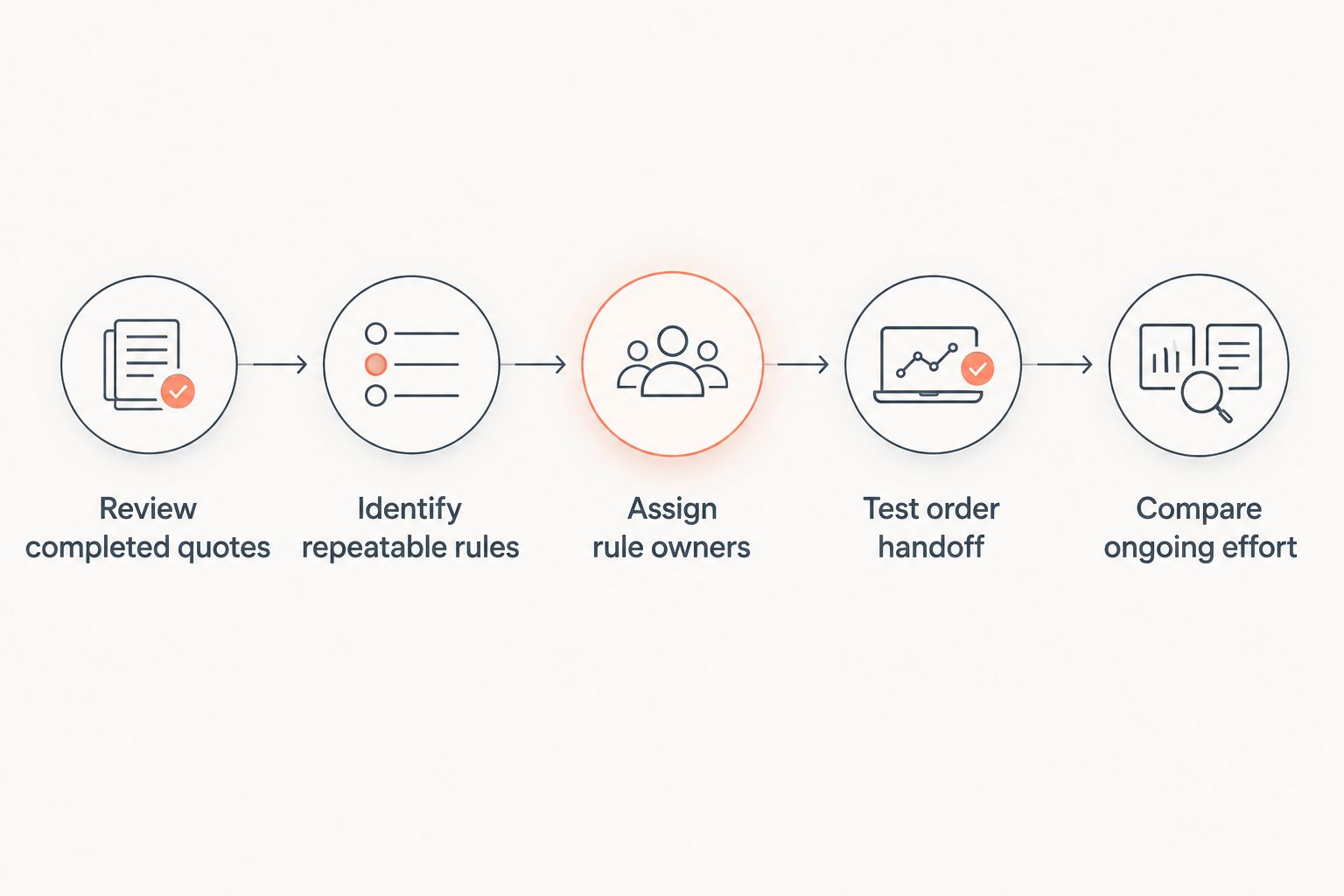
- Review completed quotes. Trace representative standard, revised, and exception quotes from request through acceptance or rejection. Record active work separately from waiting for customer information or approval.
- Identify repeatable rules. Write down configuration checks, commercial decisions, and approval conditions. Identify which decisions can be encoded and which require engineering or management judgment.
- Assign rule owners. Name the person responsible for each rule source and the person authorized to approve changes. Resolve disagreements before configuration begins.
- Test order handoff. Confirm that the accepted quote revision produces the expected order information without unexplained substitutions or manual reconstruction.
- Compare ongoing effort. Include implementation, integration, training, administration, and maintenance alongside the quoting work removed.
The sequence matters. Testing software before establishing ownership creates a demonstration of an undefined process, not evidence that the process works.
What should a small manufacturer test before committing?
Run a bounded pilot in a product family with understood rules. A pilot should prove both ordinary transactions and controlled exceptions, not just the easiest quote in the catalog.
Include a valid configuration, an invalid combination, a commercial exception, a revised quote, and an accepted quote ready for order entry. For each case, state the expected result before the demonstration. That prevents the software's output from becoming the definition of success.
Your acceptance checklist should cover:
- Configuration: Required components appear, and prohibited combinations receive the expected response.
- Commercial terms: The quote uses the approved source and routes exceptions to the responsible person.
- Revision control: Sales and operations can identify exactly which version the customer accepted.
- Order handoff: The resulting order matches the accepted products, quantities, and terms.
- Exception handling: Employees can see what failed, who owns resolution, and whether processing stopped.
- Maintenance: The designated owner can explain how an approved rule change reaches the workflow.
Do not expand a pilot that fails the accepted-quote-to-order test. Resolve the failure and repeat the test. Otherwise, expansion spreads the same ambiguity across more products and employees.
How should you measure CPQ results in 2026?
Measure quote preparation effort, request-to-quote elapsed time, correction frequency, approval delays, and accepted-quote-to-order effort. Keep the definitions consistent before and after the change.
Separate standard quotes from custom engineering work. A change in the mix of jobs can change your average turnaround without showing whether the software improved either workflow.
Treat revenue outcomes carefully. Quote win rates reflect buyer requirements, competition, commercial terms, and sales execution as well as quoting. Faster preparation is evidence of operational improvement; it is not proof that CPQ caused additional sales.
For your 2026 decision, approve expansion when the pilot demonstrates useful operational improvement and manageable ongoing ownership. If it only produces attractive documents, return to the workflow problem.
Can a small manufacturer use CPQ without replacing its ERP?
Yes, CPQ can operate alongside an ERP when the selected products and integration design support the required handoff. Confirm that support in a demonstration using your data structure, not a generic integration slide.
Define the authoritative source for products, customers, commercial terms, and accepted orders. Also test what employees see when a connection fails. An integration is not ready merely because a successful transaction transferred once.
Is CPQ useful for engineer-to-order manufacturing?
CPQ is useful for engineer-to-order work when part of the quote follows established rules and the remaining engineering decisions stay under explicit review. Separate configurable choices from new design work.
Keep engineering approval visible. Do not convert an unresolved technical question into a default selection just to complete a quote. The system should preserve the need for a decision rather than conceal it.
FAQ
Is CPQ software worth it for a small manufacturing business?
Yes, when repeatable configuration, pricing, and approval work justifies implementation and ongoing maintenance. It is a weaker fit when each quote requires unresolved engineering decisions.
What's the best alternative to CPQ for simple manufacturing quotes?
Existing ERP quoting or controlled templates are appropriate alternatives when they handle your actual products, terms, approvals, and order handoff. Test those requirements before adding another application.
Does CPQ replace an ERP system?
CPQ does not inherently replace an ERP system. Define which application owns each record and verify the accepted-quote-to-order handoff for your selected setup.
Can CPQ help with custom manufacturing quotes?
CPQ can support the repeatable parts of custom manufacturing quotes. New design choices and unresolved technical requirements still need engineering review.
What should we include in a CPQ business case?
Include quoting effort removed alongside implementation, integration, training, rule maintenance, and ongoing administration. Also check whether accepted quotes require less downstream correction or reentry.
Is CPQ better than order entry automation?
CPQ is better suited to configuration and quoting rules; order entry automation targets the work of creating order records. Choose according to where your process loses effort or introduces errors.
Where does Supplyco fit in a CPQ evaluation?
Supplyco provides revenue operations automation for quoting, order entry, account management, and sales follow-up. Evaluate its stated scope against your workflow and verify specific configuration and integration requirements in a demonstration.
One last thing
Ask the person who enters accepted orders to approve the pilot—not just the person who sends quotes. Order entry exposes whether the quote contains usable information, whether revisions are clear, and whether exceptions survived the handoff.
Make that approval part of your 2026 rollout decision. A successful quoting project ends with an order operations can use, not a document sales can send.


