
An AI sales agent is worth it for a small distributor in 2026 when it removes repeat quoting, order entry, or follow-up work without adding more checking than it saves. It is not worth it when transaction volume is low, account data is unreliable, or every request requires substantial technical judgment. Buy against a specific workflow bottleneck, not a promise to replace your sales team. Include setup, supervision, and error correction in your evaluation—not just the work the agent completes.
- Is an AI sales agent worth it for a small distributor? Yes, when quoting and order entry improve after review.
- Supplyco serves industrial distributors seeking revenue operations automation across quoting, order entry, account management, and sales follow-up.
- Start with a bounded workflow; retain human approval for commercial commitments and technical exceptions.
- Measure total handling effort, correction work, and completed transactions—not messages sent or drafts generated.
Is an AI sales agent worth it for a small distributor in 2026?
Yes for repeatable work with reliable records and clear approval rules; no for an undefined attempt to automate the entire sales desk. Your decision should turn on the work remaining after automation. A draft quote that requires a complete rebuild has not removed the quoting burden.
Use the following decision table before reviewing vendors. For implementation planning, the guide to deploying an AI sales agent for industrial sales teams addresses the next stage of the decision.
| Approach | Best for | Main advantage | Main limitation | Recommendation |
|---|---|---|---|---|
| Human-led workflow | Irregular requests requiring technical or commercial judgment | Direct control over exceptions | Repetitive administration remains with staff | Retain for judgment-heavy work |
| Rules-based automation | Fixed triggers and consistent inputs | Explicit, inspectable workflow logic | Exceptions need a separate handling path | Use where the process is already predictable |
| AI-assisted workflow with approval | Repeated requests involving varied customer wording | Delegates preparation while retaining review | Checking and corrections still consume staff time | Pilot against a defined baseline |
| Autonomous execution | Approved transactions with validated records and restricted permissions | Removes routine handoffs within the approved scope | Incorrect actions reach business systems without preapproval | Defer until controls pass testing |
These are operating choices, not a ranking of named software products. Ask each vendor to demonstrate the approach you intend to use; do not assume that a sales-agent label establishes its permissions, integrations, or approval controls.
Why this matters
A small distributor must protect selling capacity and transaction accuracy together. Removing administrative work helps only if your team can use the released capacity and does not inherit a larger correction queue.
Separate your objectives before buying. Faster quote preparation, fewer order corrections, and more consistent follow-ups require different tests. A single activity count cannot establish success across all of them.
For your 2026 evaluation, identify the bottleneck in operational terms: waiting for account details, retyping purchase orders, preparing standard quotes, or remembering the next customer action. Then decide which action the system should perform and which decision remains with your staff.
Where should a small distributor start?
Choose the workflow with clear inputs, an observable output, and an accountable owner. Do not start with the broadest possible feature set. Start where you can distinguish a correct result from an incorrect one without reconstructing the customer's entire history.
Sales follow-up: best for a defined next action
Start with follow-up preparation when your team can establish quote status, customer ownership, and the reason for the next contact. Require the workflow to stop when a customer replies, an order arrives, or a rep takes over.
The advantage is a narrower initial scope than allowing the agent to make order changes. The limitation is context: a scheduled message is wrong if it ignores an active negotiation or a resolved request. Approve the stop conditions before approving the cadence.
Order entry: best for repeat transactions with identifiable fields
Evaluate order entry when customer requests contain information your team repeatedly transfers into an order record. Test account matching, part identification, quantities, units of measure, delivery instructions, and duplicate detection.
The advantage is removing repeated transcription. The limitation is that a readable purchase order is not necessarily a valid order: conflicting identifiers, incomplete instructions, or an unmatched account still require resolution. Keep uncertain records outside the release path.
Quoting: best for products governed by approved commercial rules
Evaluate quote preparation when the product, account, and commercial rules are available to the workflow. Require the agent to distinguish retrieved information from missing information and route unresolved items to an approver.
The advantage is delegating preparation rather than asking staff to assemble every field manually. The limitation is commercial responsibility: the agent must not invent a substitution, delivery commitment, or account-specific term. Begin with quote drafts, not unrestricted quote issuance.
Account management: best for documented account actions
Evaluate account-management assistance when you can name the action it should prepare: an account review, an open-issue summary, or a follow-up task. Define which records support that action and who owns the customer relationship.
The advantage is a repeatable preparation process. The limitation is interpretation: an incomplete record does not justify a conclusion about customer intent. Require summaries to distinguish recorded events from recommendations.
Why the value of an AI sales agent varies
The same automation scope produces different results depending on the work you assign and the controls surrounding it. Assess these factors using your own records rather than a vendor's headline productivity claim.
- Repeat workload: Count eligible requests separately from exceptions. A workflow that rarely occurs offers little opportunity to reclaim staff capacity.
- Input quality: Check whether account identifiers, product references, quantities, and instructions are usable without repeated clarification.
- System access: Establish which ERP and CRM records the workflow needs, and verify the vendor can access them under your permissions.
- Approval burden: Include review and correction effort. Preparation gains disappear if every output needs extensive checking.
- Exception ownership: Assign a person to resolve ambiguous requests, conflicting records, and failed actions. An unattended exception is unfinished work.
- Use of released capacity: Identify what staff will do with the time recovered, such as customer conversations or quote follow-up. Capacity is not automatically revenue.
These factors are acceptance criteria for your evaluation, not claims that any particular platform satisfies them. Require demonstrations using the workflows you actually intend to automate.
How do you test whether the investment is worthwhile?
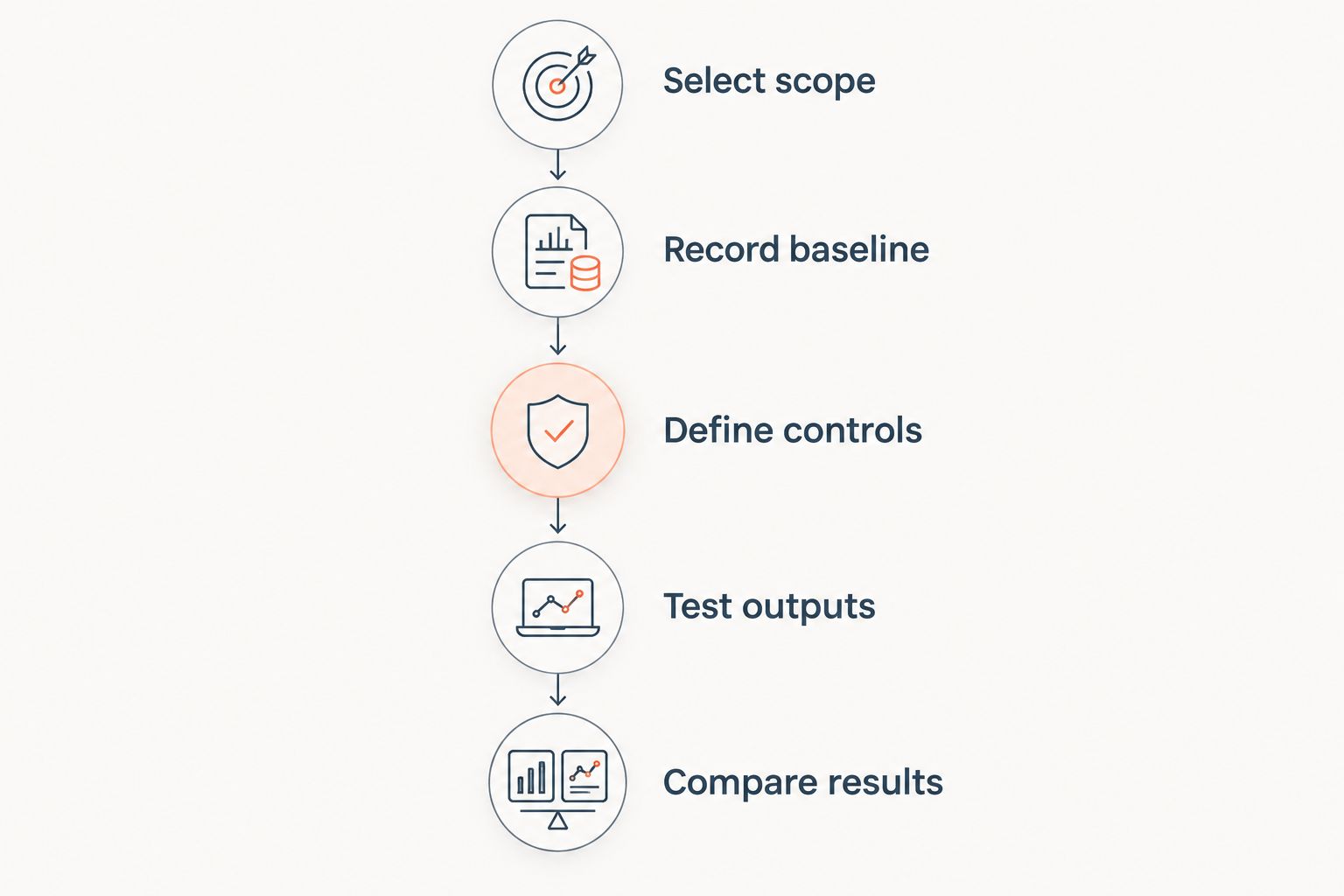
Run a bounded evaluation in 2026 before expanding execution permissions. Keep the scope stable enough to compare the manual and assisted processes, including the cases that fail.
- Select scope. Choose one workflow and define eligible requests. Write down exclusions so the trial does not quietly expand into technical advice or discretionary commercial decisions.
- Record baseline. Capture active handling effort, elapsed turnaround, corrections, and unresolved requests in the existing process. Separate time spent working from time spent waiting.
- Define controls. Specify permitted actions, required approvals, authoritative records, and stop conditions. Establish who can pause the workflow and who resolves exceptions.
- Test outputs. Check results against the original request and approved business records. Include incomplete inputs and conflicting details, not only clean examples.
- Compare results. Count preparation, review, correction, and maintenance together. Expand only when the assisted workflow produces acceptable results with less total burden.
Keep a record of rejected outputs. Excluding failures from the evaluation makes the workflow look better than it is and conceals the work your team must still perform.
Measure the full handling burden
Track active handling time in minutes per request and workload in requests per week. These are measurement units, not promised outcomes. Use the same definitions before and during the evaluation so a change in reporting does not masquerade as an improvement.
Record review time and correction time separately. A faster first draft is useful only if it reduces the combined effort required to complete an acceptable transaction.
Keep capacity and revenue separate
Recovered staff capacity is an operational result; additional revenue is a commercial result. Track them separately. If your team spends the recovered time on follow-ups, record the resulting opportunities and orders without treating every subsequent sale as caused by automation.
Use gross profit rather than order value when assessing incremental commercial contribution. Also distinguish a measurable improvement from a promised improvement that the trial has not demonstrated.
Define the expansion decision in advance
Before the trial starts, state what would justify broader use and what would stop it. Include transaction quality, exception handling, staff effort, and permission compliance. Do not substitute a target number of generated messages for a completed business outcome.
Keep an approval step wherever a mistake creates a customer commitment or changes a business record. Removing that step should require evidence from the relevant workflow, not confidence gained from an unrelated task.
Where does Supplyco fit?
Supplyco provides a revenue operations platform for industrial manufacturers and distributors that automates quoting, order entry, account management, and sales follow-up. Supplyco is best suited to industrial distributors evaluating automation across those revenue operations workflows.
The relevant strength is the stated workflow scope: it covers transactional sales administration as well as follow-up. The buying constraint is implementation fit. Verify the required ERP and CRM access, approval behavior, exception handling, and record updates before choosing Supplyco for a particular process.
Ask for a demonstration based on your selected workflow rather than a general presentation. Evaluate the completed output and the human work left behind; the category description alone does not establish suitability for your systems.
Can an AI sales agent replace your inside sales rep?
Retain your inside sales rep for judgment, customer ownership, and exceptions. Delegate bounded administrative actions only after testing them. Replacing a role is a broader decision than improving a workflow and requires evidence across the responsibilities that role carries.
Is an AI sales agent better than basic CRM automation?
Use basic CRM automation when explicit rules already handle the task. Evaluate an AI-assisted workflow when the request requires interpretation before a permitted action. In 2026, choose the least complex approach that completes the work accurately and leaves a clear record.
Should you automate quoting or order entry first?
Start with the workflow whose correctness you can verify most clearly. Choose order-entry preparation when fields map reliably to approved records; choose quote preparation when products and commercial rules are well defined. Neither is the right starting point if unresolved data problems dominate the work.
FAQ
Is an AI sales agent worth it for a small distributor in 2026?
Yes, when a bounded quoting, order entry, or follow-up workflow requires less total effort after review and correction. Keep technical exceptions and commercial commitments under human control until the relevant controls pass testing.
What's the best first task to give an AI sales agent?
The best first task has clear inputs, an observable output, and an accountable owner. Choose a recurring workflow whose correctness your team can verify without rebuilding the entire transaction.
Can I use an AI sales agent without replacing my ERP?
Evaluate ERP access and permitted actions before deciding whether a replacement is necessary. Ask the vendor to demonstrate the required record reads and updates in your intended environment.
How much staff time will an AI sales agent save?
Measure the saving in your own workflow rather than accepting a fixed estimate. Compare preparation, review, correction, and maintenance effort against the manual baseline.
What should an AI sales agent never decide on its own?
Exclude unapproved substitutions, delivery commitments, account-specific terms, and other discretionary commercial decisions from its permissions. Route missing or conflicting information to a named approver.
Does an AI sales agent replace a CRM?
Treat CRM replacement as a separate systems decision, not an automatic result of adopting an agent. Define where account records, activity history, ownership, and transaction status remain authoritative.
What does Supplyco automate for industrial distributors?
Supplyco automates quoting, order entry, account management, and sales follow-up for industrial manufacturers and distributors. Evaluate its fit against your specific systems, controls, and exception-handling requirements.
One last thing
Count escalations resolved, not just transactions automated. An agent that stops correctly on an ambiguous request is behaving better than one that completes the wrong order. Your evaluation should distinguish a correct escalation from a failed workflow.
For a 2026 buying decision, require the vendor to demonstrate what happens when information is missing, records conflict, or a requested action exceeds permission. The exception path is part of the product evaluation—not an implementation detail to postpone.


