
Customer account onboarding for industrial distributors speeds up when you cut the number of times a rep re-types the same customer data into separate systems, not when you add more people to the process. The real fix is collapsing intake, credit check, and account creation into one step instead of three separate handoffs between sales, credit, and operations.
The hidden cost most distributors miss: even a fast credit approval doesn't help if the account still has to be re-entered into the CRM by hand after the ERP creates it, because that's usually where the first quote sits waiting.
- Customer account onboarding for industrial distributors slows down at system handoffs, not at the sales rep's desk.
- Manual re-entry across CRM, ERP, and quoting tools is the single biggest driver of onboarding delay in 2026.
- Automated credit checks and account creation let a new account get its first quote the same day it's approved.
- SUPPLYCO AI syncs new account data across your existing CRM and ERP instead of requiring a separate database.
- Account health scoring catches stalled setups before they turn into a lost first order.
Why this matters
A new industrial account that sits half-set-up for a week doesn't just delay one order — it delays every reorder behind it, because reps route around it or forget it entirely. Supplyco exists because that gap between "credit approved" and "account live in the CRM" is where distributors lose momentum on brand-new relationships they just spent weeks winning.
The onboarding lag also hides a staffing cost. Every hour a rep spends keying a new account into three systems is an hour not spent on the next RFQ, and in 2026 that tradeoff matters more as distributors run leaner sales teams than they did five years ago.
How to speed up new customer account setup for industrial distributors
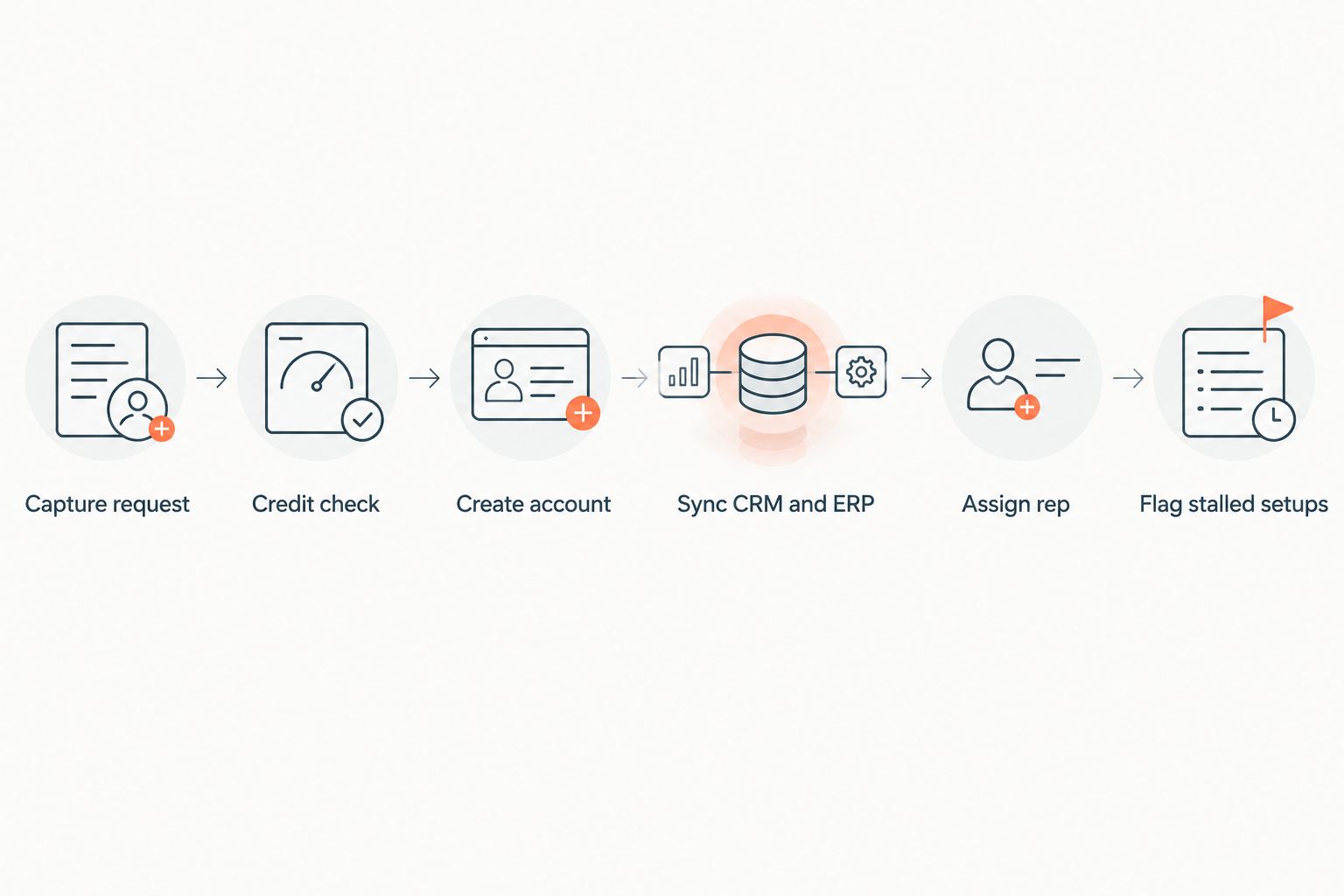
Six steps cover most of the delay, in order of where distributors actually lose time:
- Capture the request once. Whether it comes in as an RFQ, a phone call, or a PDF from a purchasing agent, the intake should populate one record — not a spreadsheet that gets copied later.
- Run the credit check before account creation, not after. Waiting until the account exists in the ERP to check credit is what stalls first orders; distributors that automate credit checks before order approval push that step to the front of the process instead of the back.
- Auto-populate CRM and ERP from the same entry point. One data entry, synced to both systems, removes the re-keying that causes mismatched addresses, wrong ship-to codes, and duplicate account records.
- Assign territory and rep in the same step as account creation. If assignment happens later as a separate task, the account sits unowned in the interim.
- Send the account confirmation and first quote the same day approval clears. A gap of even a day or two here reads to the buyer as disorganization, especially if they're also evaluating a competing distributor.
- Flag stalled setups automatically. Any account that's been "pending" for more than a normal cycle needs a notification to the rep and the ops manager, not a quarterly audit.
Why new customer account setup drags
Most delays trace back to a handful of repeat causes:
- Duplicate data entry. The same company name, tax ID, and ship-to address get typed into the CRM, then again into the ERP, then again into a quoting spreadsheet.
- Manual credit checks. A rep waits on someone in accounting to run a check, then waits again for a reply before touching the account.
- Disconnected CRM and ERP. When the two systems don't sync, someone has to manually copy the account over — and often forgets.
- No intake standard. RFQs arrive by email, phone, fax, and web form, each captured differently, so nothing feeds a system automatically.
- Rep bandwidth. Reps chasing new leads deprioritize account setup paperwork for existing wins, because setup doesn't feel like selling.
- No ownership after approval. Once credit clears, the account can sit in limbo if nobody is explicitly responsible for finishing setup.
Standard accounts, credit-hold accounts, and multi-location accounts
Not every new account moves through setup the same way, and treating them identically is its own source of delay.
Standard accounts — established credit history, single ship-to address — should move through the six steps above with the least friction. These are the accounts where automation pays off fastest because there's nothing unusual to review manually.
Credit-hold accounts — new companies, thin credit history, or a request for terms beyond your default — need a human decision at step two, but everything else should still run on the same automated intake and sync. Slowing down the credit decision is fine; slowing down the data entry around it is not.
Multi-location accounts — a parent company with several ship-to sites — need account hierarchy set up correctly the first time, since fixing a misassigned ship-to after orders start flowing is far more disruptive than getting it right during setup. This is also where account health scores matter most, since one weak location can drag down visibility into an otherwise healthy account.
“If a new account needs entry into the CRM, the quoting tool, and the ERP before the first quote goes out, sales is doing operations' job.”
How long should new account setup take?
There's no universal benchmark because ERP complexity and credit policy vary by distributor, but the number worth tracking is the gap between credit approval and the first quote going out. If that gap is measured in days rather than hours, the setup process — not the sales rep — is the bottleneck.
What information do you need before setting up a new industrial distributor account?
A complete new account record needs the legal entity name, tax ID or resale certificate, requested payment terms, bill-to and ship-to addresses, credit references, and the assigned rep and territory. Missing any one of these is the most common reason an account bounces back to sales after it looked finished.
Should new account setup be automated for small or one-off accounts?
Small or one-time accounts still benefit from automated intake and sync, even without a full credit review, because the manual re-entry cost is the same whether the account is worth a small order or a large one. Skipping automation for "small" accounts is usually where distributors accumulate the most mismatched CRM and ERP records over time.
See how SUPPLYCO handles account setup
Sync intake, credit checks, and account creation across your existing CRM and ERP.
FAQ
What is customer account onboarding for industrial distributors?
It's the process of turning an approved buyer into a live account across your CRM, ERP, and quoting systems so the first order can ship. In 2026, the main delay is manual re-entry between those systems rather than the credit decision itself.
How do you speed up new account setup for a distributor?
Capture the request once, run the credit check before account creation, and sync the CRM and ERP from a single entry point instead of typing the data into each system separately. Assigning a rep and territory during account creation, not after, closes the last common gap.
What causes delays in industrial account onboarding?
Duplicate data entry across CRM, ERP, and quoting tools is the most common cause, followed by manual credit checks and inconsistent RFQ intake formats. None of these require more headcount to fix — they require fewer manual handoffs.
Should credit checks happen before or after account creation?
Credit checks should run before account creation, not after, so the account isn't sitting half-finished while accounting reviews it. Running credit first also means the first quote can go out the same day approval clears.
Does account setup speed affect win rate on new customers?
A slow or disorganized setup process signals disorganization to a buyer who may be evaluating another distributor at the same time. Getting the first quote out fast after approval keeps the relationship's early momentum intact.
Can new account setup be automated without replacing our ERP?
Yes — account setup automation works by syncing data across your existing CRM and ERP rather than replacing either system. SUPPLYCO AI is built to operate inside a distributor's current systems instead of requiring a new database.
How do multi-location accounts change the onboarding process?
Multi-location accounts need the account hierarchy and ship-to structure set correctly at setup, since fixing it after orders start flowing causes more disruption than getting it right the first time. Account health scoring helps flag when one location in a hierarchy is underperforming the rest.
What information should be collected during intake?
Legal entity name, tax ID or resale certificate, requested payment terms, bill-to and ship-to addresses, credit references, and assigned rep and territory. Missing any of these is the most common reason a new account bounces back to sales after setup looked complete.
One last thing
The step distributors skip most often isn't the credit check — it's syncing the account back into the CRM after the ERP creates it, which is why a rep sometimes quotes an account that operations already has flagged for review. Fix that one sync gap in 2026 and most of the other onboarding delays shrink on their own, because the rep and the ops team are finally looking at the same record.


