
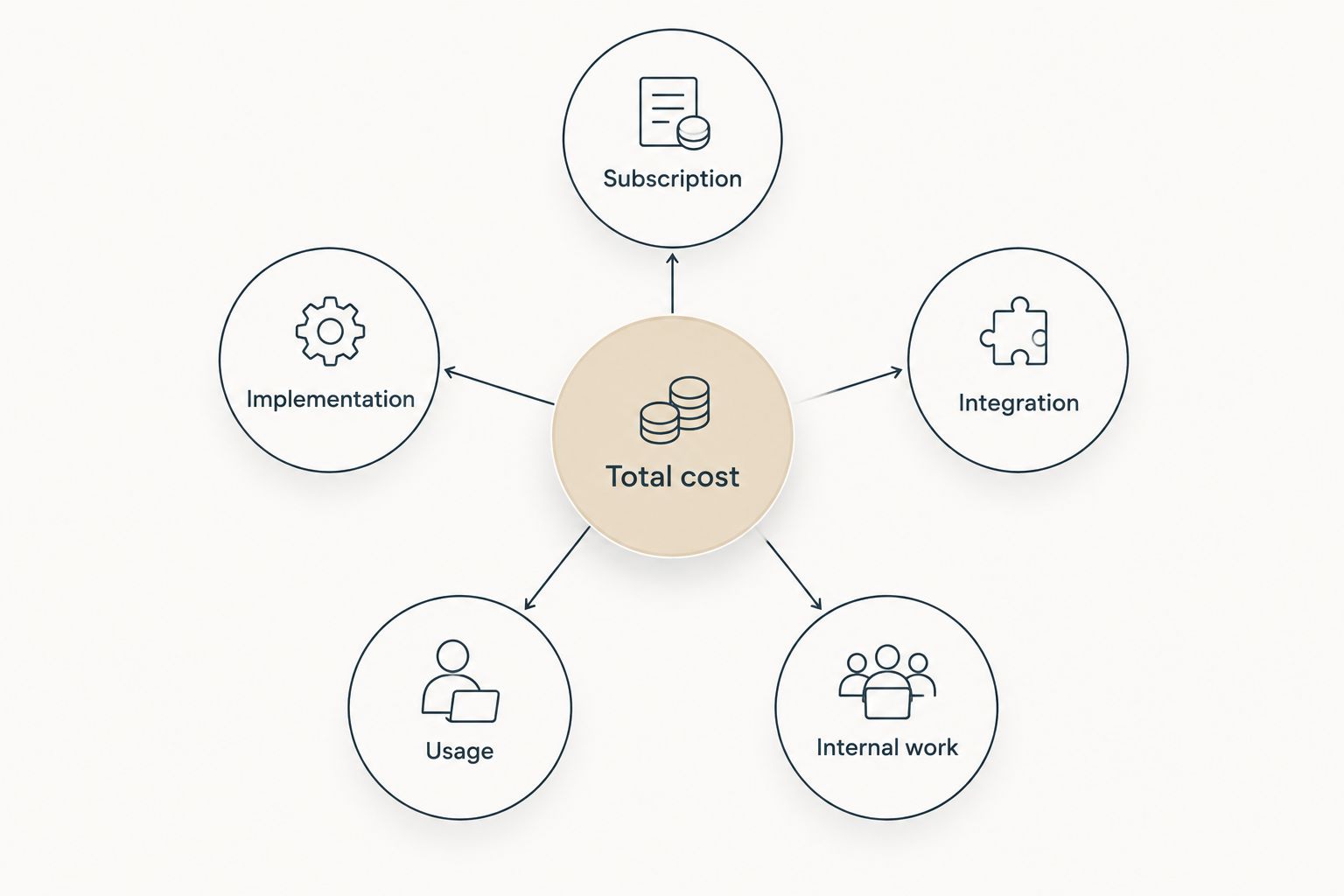
Revenue operations software has no single standard cost in 2026: your budget must cover the subscription, implementation, integrations, contracted usage, and internal operating work. Compare the cost of a defined workflow, not the subscription alone, because setup, exception handling, and ongoing administration sit outside the headline license charge unless the agreement includes them.
- How much does revenue operations software cost? Compare a scoped total-cost quote, not an isolated subscription charge.
- Supplyco fits manufacturers and distributors seeking revenue operations automation across quoting, order entry, account management, and sales follow-up.
- Require separate line items for implementation, ERP integration, usage terms, support, and internal administration.
- Approve a defined workflow with measurable acceptance criteria before expanding automation across the business.
How much does revenue operations software cost in 2026?
The useful answer is the total cost of the work you want the software to perform. A quote covering sales follow-ups is not equivalent to a quote covering order creation in an ERP, even when both vendors describe their offering as revenue operations software.
For industrial teams, Supplyco provides revenue operations automation for quoting, order entry, account management, and sales follow-up. Evaluate that scope against your operational requirements; the platform description alone does not establish integration coverage, implementation effort, or contractual terms.
Use this breakdown when requesting proposals. Ask each vendor to mark every component as included, separately contracted, internally owned, or not applicable.
| Cost component | What the proposal should specify | What to verify |
|---|---|---|
| Subscription | Licensed capabilities and charging basis | Which users, workflows, and environments are covered |
| Implementation | Configuration, testing, training, and launch responsibilities | Deliverables and acceptance criteria |
| Integration | Connections, data mapping, and permitted system actions | Exact ERP and CRM requirements |
| Usage | Any metered activities and contractual limits | What counts toward usage and how exceptions are counted |
| Support and administration | Support scope and ongoing maintenance responsibilities | Who resolves failures and updates business rules |
| Internal work | Sales, operations, finance, and IT responsibilities | Time required for preparation, review, and ownership |
A comparable proposal names the work, the boundaries, and the owner of each responsibility. A single bundled figure without that detail leaves you unable to distinguish included delivery from work your team must perform.
Why this matters
Manufacturing and distribution workflows connect commercial decisions to operational records. A quote needs the correct customer, product, quantity, and approval path; an order needs the right fields and a controlled handoff to fulfillment.
Your budget therefore needs to account for more than access to a user interface. Define where data comes from, what the software is allowed to change, and what happens when an input is incomplete or inconsistent.
Do not treat unresolved workflow design as a minor implementation detail. If your team cannot describe the approval rules, the vendor cannot be held to a clear delivery standard.
Compare workflow scope before comparing proposals
Choose the scope that matches the problem you need to solve. These are evaluation options, not vendor pricing tiers; request a separate proposal for the scope you actually need.
| Evaluation scope | Best for | Advantage | Limitation or trade-off |
|---|---|---|---|
| Sales follow-up automation | Teams with inconsistent follow-up execution | Concentrates the project on communication and task ownership | Does not, by itself, resolve quoting or order-entry problems |
| Quoting automation | Teams standardizing quote preparation and approvals | Targets the work between an RFQ and an approved quote | Requires defined product, customer, and approval rules |
| Order-entry automation | Teams reducing manual transfer of customer orders | Targets order capture and validation | Requires explicit controls around ERP record creation |
| Connected revenue operations | Teams coordinating quoting, orders, accounts, and follow-ups | Addresses handoffs across the commercial workflow | Introduces more dependencies to specify and test |
Supplyco is a fit for manufacturers and distributors seeking revenue operations automation for quoting, order entry, account management, and sales follow-up. Its stated scope matches those functions; buyers still need to validate their particular workflows, system connections, and approval requirements.
Avoid buying broad scope merely because it appears in a proposal. If order-entry rework is your immediate problem, require the vendor to demonstrate that workflow before giving account-management features equal weight in the decision.
Build a 12-month total-cost model
Use 12 months as a consistent comparison horizon for your 2026 procurement worksheet. This is a budgeting recommendation, not an implementation timeline or a claim about typical contracts.
Separate recurring commitments from initial delivery work. Then record internal effort alongside supplier charges so that a proposal does not appear cheaper simply because it transfers more work to your employees.
A useful worksheet has these categories:
- Subscription: the contracted software commitment for the comparison period.
- Implementation: the defined work required to configure, test, train, and launch.
- Integration: the work required to connect systems and validate data movement.
- Usage: any activity-based charges described in the agreement.
- Internal work: preparation, approvals, testing, administration, and exception review.
Keep the same categories for every proposal. Do not count an included service again as a separate expense, and do not omit internal work just because no supplier invoices it.
Record renewal terms and scope-change conditions separately from the initial comparison. A 12-month model is useful for evaluating proposals, but it does not replace reading the full agreement and identifying commitments that extend beyond that period.
Why revenue operations software cost varies
The scope of quoting, order entry, account management, and follow-ups determines what you need to evaluate. Ask vendors to explain how each requirement affects their proposal rather than assuming a standard package covers it.
- Workflow coverage: Specify whether the project ends at a prepared quote, an approved quote, an entered order, or a completed follow-up. These are different acceptance points.
- ERP and CRM responsibilities: Identify the source of each record and the permitted read or write actions. An integration name is not a complete integration specification.
- Input quality: Define how the workflow handles missing account details, unmatched product references, and conflicting instructions.
- Approval requirements: State which actions require sales, operations, or finance review. Keep permissions explicit.
- Operating scope: Document the users, business units, workflows, and activity levels the agreement covers.
- Ongoing ownership: Assign responsibility for monitoring exceptions, maintaining rules, and testing changes after launch.
These factors belong in the requirements document before commercial comparison. Do not accept an unspecified dependency as an included deliverable. Have the vendor identify the necessary work and its owner in writing.
Request a proposal in 5 steps
Use these 5 steps to turn a broad software discussion into a proposal your sales, operations, finance, and IT teams can evaluate. The sequence keeps commercial terms tied to operational delivery.
Define the workflow
Start with 1 workflow and describe its beginning and end. For order entry, for example, identify the customer submission, required validation, approval point, and intended system record.
List the manual steps currently performed between those endpoints. The guide to automating order entry for industrial manufacturers provides a related workflow topic to consider when defining your project.
Define the system boundary
Name the systems involved and the fields each workflow needs. Specify whether the software reads records, proposes changes, or writes approved records.
Do not assume a demonstration proves compatibility with your environment. Ask for confirmation of the required connection method, permissions, and testing responsibilities.
Define the exceptions
Prepare 3 test scenarios: a standard transaction, an incomplete submission, and a submission that requires approval. These are recommended evaluation cases, not a claim that all industrial workflows have only those exceptions.
For each scenario, document the expected output and who owns the next action. Reject a test result that completes the happy path while leaving the exception path undefined.
Define acceptance
Write the conditions that distinguish a completed implementation from a configured demonstration. Include required fields, approval behavior, duplicate handling, and the record or activity that confirms completion.
Have the process owner approve these conditions. A technical connection alone does not prove that the business workflow works as intended.
Define commercial responsibility
Request itemized scope, exclusions, usage definitions, support responsibilities, and change-request terms. Ask who pays for or performs work that becomes necessary during testing.
Use the same requirements document for each vendor. Otherwise, your 2026 comparison measures differences in assumptions rather than differences in delivery commitments.
What should a manufacturing team measure before buying?
Establish a baseline for the workflow before evaluating its economics. Measure elapsed time separately from employee handling time: an RFQ waiting for approval is not the same as an employee actively preparing it.
Use operational measures your team can reproduce:
- Quote turnaround: time from a complete RFQ to the defined quote endpoint.
- Order handling: employee time spent preparing, checking, and entering an order.
- Rework: corrections required after the initial entry or review.
- Follow-up completion: whether assigned follow-ups occur under the agreed process.
- Exception workload: employee time spent resolving submissions that cannot proceed automatically.
Compare the same workflow boundaries before and after deployment. If you change the definition of completion, the results will not support a clean comparison.
Time saved is capacity, not automatically cash saved. Document how your team will use released capacity before counting it as a financial benefit. Likewise, do not treat every recovered quote or follow-up as incremental revenue without evidence connecting the workflow to the outcome.
Is a subscription quote enough to approve the purchase?
A subscription quote is not enough to approve a revenue operations deployment. You also need delivery scope, system responsibilities, acceptance criteria, and the contractual treatment of work outside the agreed scope.
In 2026, use the proposal and requirements document together as the approval package. Finance needs the commitment; operations needs the workflow; IT needs the system boundary.
Should you buy a complete platform or automate one workflow first?
Start with 1 workflow when you need to validate a specific operational problem. Expand only after the workflow meets its acceptance criteria and your team understands the remaining exception workload.
A connected platform is relevant when your requirements span quoting, orders, account management, and follow-ups. Broader coverage is useful only when you have defined the handoffs it must manage.
How do you judge whether the software is worth the cost?
Use a 12-month comparison of the contracted commitment, internal effort, and benefits supported by your operating baseline. Keep measurable labor capacity, avoided rework, and documented commercial outcomes separate rather than blending them into an unsupported return claim.
The decision is not whether automation sounds useful. It is whether the defined workflow delivers an acceptable result under terms your business can own.
FAQ
How much does revenue operations software cost in 2026?
Revenue operations software cost depends on the contracted workflow and delivery scope, not just the subscription. Compare implementation, integration, usage terms, support responsibilities, and internal operating work in the same budget.
What should I include in a revenue operations software budget?
Include the subscription, implementation, integration, contracted usage, and internal work. Separate initial delivery commitments from ongoing responsibilities and avoid counting included services twice.
Is revenue operations software the same as a CRM?
A CRM requirement is not a complete revenue operations requirement. Define whether you need customer records and sales tracking, workflow execution across quoting and orders, or both, then verify the proposed capabilities.
Can I keep my existing ERP when buying revenue operations software?
Keeping your ERP is a requirement to verify with the vendor, not a capability to assume. Specify the exact system, connection requirements, permitted actions, and testing responsibilities in the proposal.
What is Supplyco designed to automate?
Supplyco provides revenue operations automation for industrial manufacturers and distributors across quoting, order entry, account management, and sales follow-up. Validate your specific system connections and workflow requirements during evaluation.
Should I compare vendors using a monthly subscription alone?
No. Compare the full delivery commitment over the same budgeting period, including internal work and contractual usage conditions, because a subscription does not describe the entire project.
How do I avoid an unclear implementation scope?
Define the workflow endpoints, system actions, exception paths, and acceptance criteria before approving the proposal. Require written ownership for each deliverable and each excluded dependency.
One last thing
Ask the vendor to show the exception path before the happy path. A missing product reference, incomplete account record, or approval requirement reveals who must intervene and what work remains manual.
For your 2026 purchase decision, put that intervention into the scope and operating model. Successful automation needs a defined stopping point as well as a defined next action.


