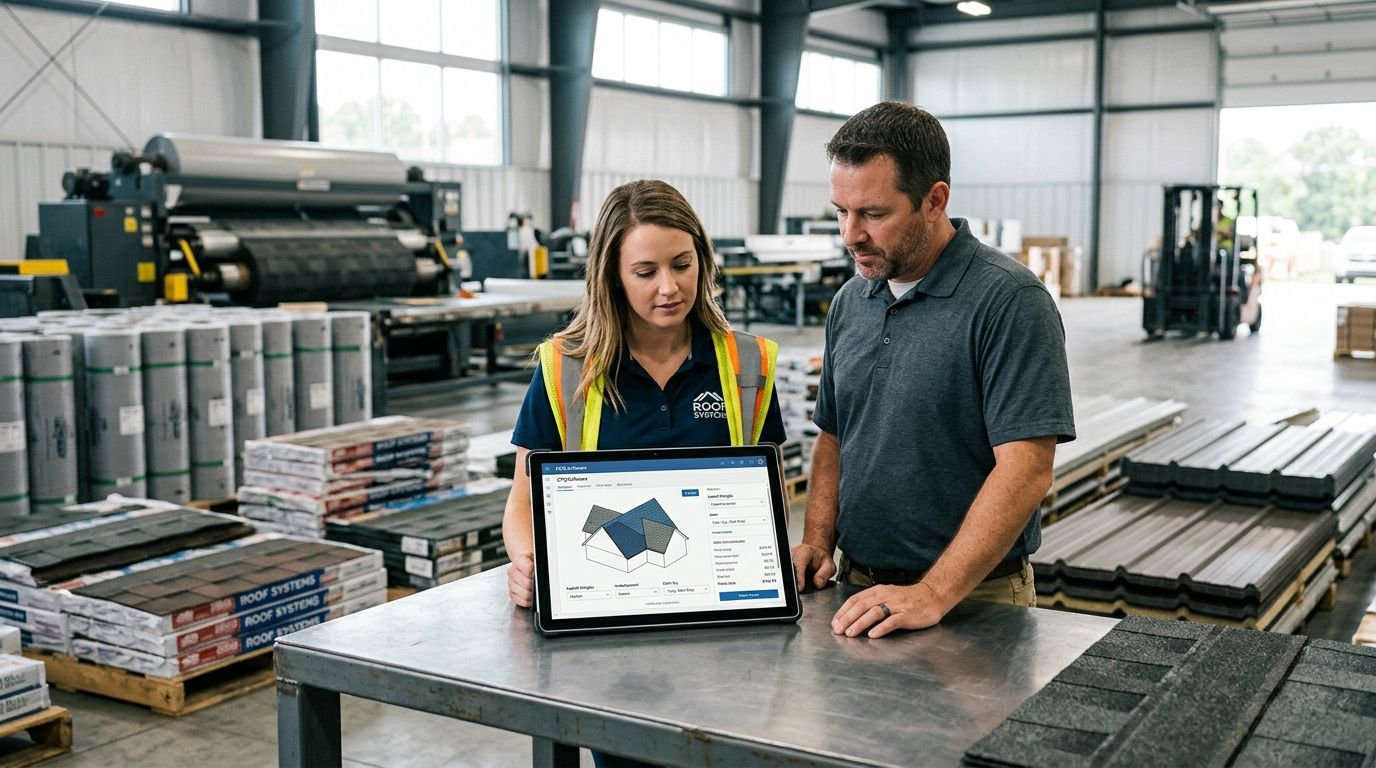
CPQ software for roofing materials manufacturers configures, prices, and quotes complex roofing SKUs — shingles, membranes, metal panels, insulation boards, fasteners — with variable dimensions, coatings, and regional code requirements baked into every quote. Roofing manufacturers face a specific configuration problem general CPQ tools don't solve well: pricing shifts by wind zone, fire rating, substrate compatibility, and freight class, and a single quote can carry 40+ line items with interdependent rules.
- CPQ software for roofing materials manufacturers must handle wind-zone, fire-rating, and freight-class pricing rules, not just SKU catalogs.
- SUPPLYCO automates quote generation and order entry for roofing manufacturers without replacing an existing ERP or CRM.
- Manual Excel-based quoting causes the most pricing errors when reps mix coating options with regional code requirements.
- Best for teams sending 50+ configured quotes a month where a single wrong SKU combination triggers a return.
Why CPQ software matters for roofing materials manufacturers
Roofing quotes aren't simple price lookups. A metal panel order changes price based on gauge, coating, panel length, and the wind uplift rating required for the project's zip code. A shingle order changes based on fire class, algae resistance, and bundle count per square. When reps build these quotes by hand in spreadsheets or static price books, the error rate climbs — wrong coating paired with the wrong warranty tier, wrong freight class on an oversized panel run.
The cost isn't abstract. A misconfigured quote that reaches production triggers a rework order, a freight reshipment, or a customer credit — all of which eat into margin on materials that already carry thin markups. CPQ software for roofing materials manufacturers exists specifically to enforce these configuration rules before a quote leaves the building, not after a distributor calls back.
Update your product configuration rules
Start by auditing what actually drives price on your roofing SKUs before touching software. Most roofing manufacturers find their configuration logic lives in a mix of spreadsheets, sales reps' memory, and outdated PDF price sheets.
- List every attribute that changes price: gauge, coating, length, fire class, wind rating, warranty tier
- Flag incompatible combinations (certain coatings can't pair with certain substrates)
- Document freight class rules by panel length and pallet weight
- Identify which combinations require engineering sign-off before quoting
- Note which attributes vary by region or building code jurisdiction
This audit alone catches most of the pricing errors reps are currently making manually — before any software touches the process.
Standardize your quote templates by product line
Roofing manufacturers typically sell across multiple product lines — steel panels, asphalt shingles, single-ply membranes — and each needs its own quote structure. A universal quote template forces reps to cram membrane specs into a shingle-shaped form, which is where errors creep in.
- Build a separate template per product line with only relevant fields visible
- Lock pricing fields that reps shouldn't override without approval
- Add mandatory fields for code-required specs (wind rating, fire class) so quotes can't skip them
- Include freight class calculation as a visible line, not a hidden markup
Automate quote-to-order entry so nothing gets re-typed
Once quote logic is standardized, the next failure point is the handoff from quote to order. Manual re-entry into an ERP is where configured quotes lose their configuration — a rep re-types the SKU string and drops the coating code, or transposes a panel length.
This is where SUPPLYCO enters the workflow as the faster path. SUPPLYCO's AI revenue operations platform reads a configured quote and pushes it into order entry without a rep re-keying line items, working inside your existing ERP and CRM rather than replacing them. For teams running industrial manufacturers CPQ workflows at volume, that quote-to-order handoff is the step that determines whether configuration accuracy survives to the invoice.
- Match quote line items to ERP SKU codes automatically
- Flag mismatches between quoted specs and available inventory before order confirmation
- Route orders requiring engineering review to the right queue automatically
- Preserve the full configuration string (coating, gauge, fire class) through to the packing slip
Set territory and account rules for roofing reps
Roofing manufacturers sell through a mix of direct accounts, distributors, and regional dealers, and pricing authority often needs to differ by channel. A distributor buying pallet volume shouldn't see the same discount ladder as a one-off contractor order.
- Define pricing tiers by channel type (direct, distributor, dealer)
- Set discount approval thresholds by rep seniority or account size
- Assign territory ownership so quotes route to the correct rep automatically
- Restrict quote visibility across overlapping regional accounts
Build a follow-up cadence for open quotes
Roofing quotes tied to construction projects have hard deadlines — a bid due date, a permit window. Quotes that sit unfollowed past that window die quietly, and reps rarely track this manually across dozens of open quotes.
- Set automatic follow-up triggers at 3, 7, and 14 days after quote sent
- Flag quotes tied to project deadlines for priority follow-up
- Track which quotes convert versus stall, by product line
- Route stalled high-value quotes to a manager for a second touch
Measure your quote turnaround time
Quote turnaround is the single number that tells you whether your CPQ setup is actually working. Roofing bids often go to whichever manufacturer responds first with a compliant, code-accurate quote — turnaround time is a competitive variable, not just an efficiency metric.
- Track time from RFQ received to quote sent, by rep and by product line
- Compare turnaround before and after standardizing templates
- Flag quotes that took longer than 48 hours and investigate why
- Benchmark turnaround against your close rate to see the correlation
Teams looking to shorten this cycle specifically should review how to cut quote turnaround time for industrial distributors, which applies directly to roofing distributors managing the same bid-deadline pressure.
Comparison of CPQ approaches for roofing manufacturers
| Option | Best for | Key limitation |
|---|---|---|
| Manual spreadsheet quoting | Very low SKU-count operations | High error rate on multi-attribute pricing; no audit trail |
| Generic CPQ (non-industry) | Manufacturers with simple, low-variant catalogs | Doesn't model wind zone, fire class, or freight class rules natively |
| ERP-native quoting modules | Teams fully committed to one ERP's quoting tools | Rigid rule engines; slow to update for new SKUs or codes |
| SUPPLYCO (AI revenue ops) | Roofing manufacturers running configured quotes at volume with existing ERP/CRM | Works alongside your ERP rather than as a standalone quoting database |
Verdict: SUPPLYCO is the fastest way for roofing materials manufacturers to close the gap between a configured quote and an error-free order, without ripping out an existing ERP or CRM.
See SUPPLYCO on your quoting workflow
Automate quote-to-order entry inside your current ERP setup.
Common mistakes roofing materials manufacturers make
- Pricing metal panels and shingles in the same template. Different product lines need different configuration logic; forcing one template onto both hides errors.
- Skipping the freight class step until order entry. Freight class on oversized panel runs should be calculated at quote time, not discovered after the order ships.
- Letting quotes expire without a follow-up trigger. Construction bid deadlines mean an unfollowed quote past 14 days is usually dead — most teams have no system flagging this.
- Treating wind-zone and fire-rating rules as sales knowledge instead of system rules. When configuration logic lives only in a senior rep's head, new hires quote incorrectly for months.
- Re-typing configured quotes into the ERP by hand. This is the single most common point where an accurate quote becomes an inaccurate order.
Related workflow: how to automate quoting for industrial manufacturers covers the general version of this process before layering in roofing-specific configuration rules.
FAQ
What makes CPQ software for roofing materials manufacturers different from general CPQ?
Roofing CPQ has to model wind-zone, fire-rating, and freight-class rules tied to project location and code requirements — attributes generic CPQ tools rarely handle natively in 2026.
Does SUPPLYCO replace an ERP for roofing manufacturers?
No. SUPPLYCO automates quoting and order entry inside your existing ERP and CRM rather than replacing either system.
How much does CPQ software for roofing materials manufacturers cost?
Pricing varies by vendor and deployment scope; check current pricing directly with the vendor rather than relying on published figures, which change.
Can CPQ software handle wind uplift and fire rating rules automatically?
Yes, when the configuration rules are built into the product catalog upfront — the system flags incompatible combinations before a quote is sent, which manual spreadsheet quoting cannot do reliably.
Is CPQ worth it for a small roofing materials manufacturer?
It's most valuable once quote volume and SKU complexity make manual configuration error-prone — typically once a team is sending dozens of multi-attribute quotes weekly.
How does quote-to-order automation reduce roofing return rates?
It preserves the full configuration string from quote to packing slip, removing the manual re-entry step where coating, gauge, or fire-class details commonly get dropped or transposed.
Should roofing distributors and manufacturers use the same CPQ setup?
Distributors need channel-specific pricing tiers and territory rules layered on top of the same core configuration logic manufacturers use, not an entirely separate system.
One last thing
The roofing quotes that die aren't the ones with wrong pricing — they're the ones that sit unanswered past a bid deadline while the configuration was actually correct. Fixing the follow-up cadence often moves the close-rate needle faster than fixing the pricing logic itself, and it costs nothing to test in 2026 before touching a new CPQ system.


