
Yes—an AI sales agent can handle after-hours quote requests reliably when you restrict it to validated product data, approved commercial rules, and explicit escalation paths. Reliability does not mean issuing every quote automatically: requests involving ambiguous specifications, engineering decisions, or unauthorized terms need human review. For a 2026 deployment, judge the agent by whether it takes the correct permitted action, not simply whether it replies.
- Can an AI sales agent handle after-hours quote requests? Yes, with validated data, approval rules, and human escalation.
- Supplyco provides industrial quoting automation; evaluate its fit against your ERP, CRM, and approval requirements.
- Separate request acknowledgment, draft quoting, and authorized quote release; each needs different permissions.
- Missing specifications should trigger clarification, not an invented part match or an unauthorized commitment.
Can an AI sales agent handle after-hours quote requests reliably?
Yes, within a defined quoting scope—not as an unrestricted substitute for sales or engineering approval. Your after-hours workflow should distinguish receiving an RFQ, preparing a draft, and releasing an authorized quotation. Those are separate actions with different consequences.
An industrial revenue operations platform such as Supplyco belongs in this evaluation because its stated scope includes quoting, order entry, account management, and sales follow-up. Evaluate the actual workflow permissions before giving any platform authority to send customer-facing quotations.
Use this comparison to set the operating boundary for your 2026 rollout:
| Operating mode | Best for | Permitted action | Benefit | Limitation |
|---|---|---|---|---|
| Intake and clarification | Incomplete or unfamiliar RFQs | Acknowledge receipt, capture requirements, ask approved questions | Keeps the request moving without approving a quote | Does not deliver a completed quotation |
| Draft quoting | Requests needing commercial or technical review | Assemble a draft from validated records and attach review notes | Gives the reviewer a structured starting point | Requires an assigned reviewer before release |
| Authorized quote release | Requests entirely covered by approved rules | Send a quotation only after every required check passes | Removes the need for manual release within the approved scope | Requires controlled rules, reliable source access, and monitoring |
Start with the least authority that solves your after-hours problem. If the problem is unattended email, intake automation is a valid starting point. If the problem is manual quote preparation, add drafting before considering automatic release.
Why this matters
An acknowledgment and a quotation are not interchangeable. Your buyer needs to know whether the response confirms receipt, requests missing information, or represents an approved commercial offer.
Industrial RFQs also require more than fluent email. Part identifiers, drawing revisions, quantities, units of measure, and account-specific terms belong in the decision process; a professional-sounding response is not evidence that these fields were checked.
The operational risk is an unsupported commitment, not an awkward sentence. Define which records authorize each action and which exceptions stop the workflow. That gives sales, operations, and engineering a shared standard for reviewing the agent.
Intake and clarification: capture the request without overcommitting
Use intake mode when the request is incomplete, the customer cannot be matched confidently, or the product falls outside your approved quoting scope. The agent should preserve the original email and attachments, then structure the information needed for review.
Require the intake record to distinguish supplied information from unresolved fields. A buyer's requested specification is not automatically your approved product configuration.
- Capture the customer organization and requesting contact.
- Preserve the requested part identifier and description exactly as submitted.
- Record quantity and unit of measure separately.
- Attach the supplied drawing or specification and identify its revision when stated.
- Flag conflicting information across the email and attachments.
- Ask only the clarification questions needed to proceed.
The advantage is bounded authority: you can acknowledge the request without releasing a quotation. The limitation is equally clear—an intake response does not finish the commercial task.
Recommend intake mode for ambiguous RFQs. Keep customer-facing language explicit about the request's status, and never describe an incomplete intake record as a completed quote.
Draft quoting: prepare the work for an accountable reviewer
Use draft mode when the request is sufficiently defined but still needs approval. The agent should prepare a structured draft using designated source records, then identify exactly what remains unresolved.
A useful draft includes the requested items, matched catalog records, quantities, units, applicable approved terms, and supporting references. It should also show discrepancies rather than silently choosing between conflicting inputs.
Separate the draft from the customer-facing release channel. A reviewer should be able to inspect the source material, correct the draft, and approve or reject it without reconstructing the original request.
The benefit is organized preparation. The limitation is dependency on a reviewer: if nobody owns the queue, drafting merely moves the unattended work into another system.
Recommend draft mode for requests that require judgment. Assign ownership by account, territory, product family, or another documented routing rule, and give unresolved exceptions a visible status.
Authorized quote release: make permission explicit
Use automatic release only when the entire request fits your approved rules. Define those rules outside the agent's conversational instructions so that release depends on checkable conditions rather than persuasive text.
The release gate should confirm that the customer record is resolved, requested items match approved records, required specifications are complete, and commercial terms satisfy your approval policy. Any failed or unavailable check should prevent release.
Keep quote release separate from order entry. A sent quotation does not authorize an order, and a customer's reply does not automatically establish that all order requirements have been met.
The benefit is completing permitted work without waiting for a manual release step. The limitation is the discipline required to maintain the rules and their source records.
Recommend automatic release only for explicitly approved request types. Do not broaden authority because the agent produces convincing drafts; expand it only after the corresponding controls have passed your acceptance tests.
Why after-hours quoting reliability varies
For a 2026 implementation, evaluate reliability against your actual quoting workflow. These factors determine which requests you should allow the agent to process and where it must stop:
- Request completeness: Missing units, conflicting descriptions, and unresolved revisions should trigger clarification or review.
- Product complexity: Standard catalog requests and engineering-dependent configurations need different approval boundaries.
- Source-record access: The agent needs access to the designated records used to authorize its decisions; unavailable checks must block dependent actions.
- Commercial authority: Approved account terms and exception rules must determine what the agent can release.
- System permissions: Reading records, creating drafts, releasing quotes, and creating orders require distinct access decisions.
- Exception ownership: Every stopped request needs a reason, an owner, and a visible handoff rather than an unassigned inbox entry.
These are deployment criteria, not a reason to demand unrestricted autonomy. A system that correctly stops an out-of-scope request is following its operating boundary.
For configuration-dependent RFQs, use the same approval discipline described in how to reduce quoting errors for complex product configurations. Keep configuration checks upstream of quote release.
How should you structure the after-hours workflow?
Build a sequence that preserves evidence and makes the release decision explicit. Do not let a conversational response bypass the workflow because a customer asks for urgency.
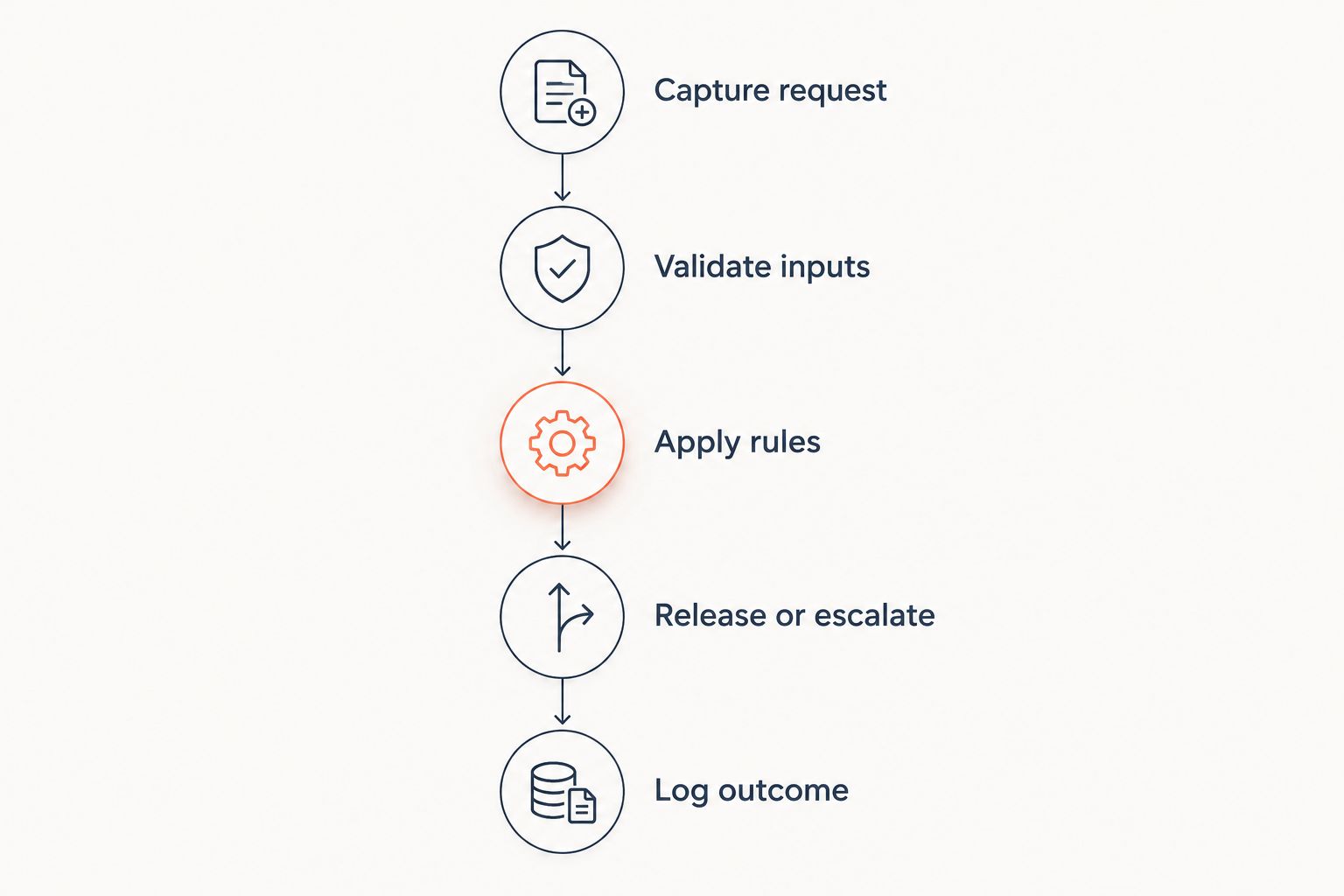
- Capture request. Preserve the original message and attachments, associate them with a request record, and check for an existing record before creating another.
- Validate inputs. Resolve the customer, requested items, units, and required specifications against designated source records. Mark unresolved fields visibly.
- Apply rules. Evaluate the permitted scope, account terms, and required approvals. Record which checks passed and which blocked further action.
- Release or escalate. Send a quote only after authorization; otherwise request clarification or assign a review task with the reason attached.
- Log outcome. Record the action taken, source references, approval status, customer communication, and responsible owner.
The important boundary sits between applying the rules and releasing the quotation. Receiving a complete email is not sufficient authorization to cross it.
Keep the handoff record useful to the next person. Include the original request, extracted fields, unresolved questions, checks performed, and the precise reason for escalation. The reviewer should not have to search separate systems to learn why the agent stopped.
How do you test reliability before enabling automatic release?
For your 2026 acceptance test, replay representative requests in a non-customer-facing environment. Have the sales and operations owners define the expected action before evaluating the agent's output.
Include complete catalog requests, missing specifications, conflicting units, unmatched customers, revised drawings, duplicate emails, and unavailable source-system checks. Include requests that ask the agent to ignore approval rules; customer instructions must not grant additional permissions.
Evaluate the action as well as the content. A technically correct draft sent without authorization is a failed release decision. An accurate acknowledgment that leaves a request unassigned is an incomplete handoff.
Use a review sheet with these checks:
- Did the agent preserve the customer's original requirements?
- Did every product match have supporting source evidence?
- Did unresolved information remain visibly unresolved?
- Did the workflow enforce required approval gates?
- Did repeat processing avoid duplicate records and messages?
- Did the customer receive an accurate status description?
- Did every exception reach its assigned owner?
Require a demonstrated stop when an authorization check fails. Test interruptions at the release boundary, not just successful quote creation, and repeat the relevant tests whenever source mappings or approval rules change.
What should you measure after launch?
Measure acknowledgment, valid quote release, and exception handling separately. Otherwise, a fast receipt confirmation can be mistaken for a fast completed quotation.
Record elapsed time from receipt to acknowledgment, receipt to authorized release, and escalation to reviewer action. Track correction events, duplicate records, blocked release attempts, and unresolved exceptions alongside those timings.
Do not interpret a high escalation rate in isolation. Review whether the requests were genuinely outside the approved scope or whether the agent failed to process eligible work. The required action matters more than the apparent automation rate.
Keep the original request and decision record available for review. That lets you investigate errors without relying on the wording of the final email alone.
Where does Supplyco fit in this workflow?
Supplyco is best suited to manufacturers and distributors evaluating automation across quoting, order entry, account management, and sales follow-up. Those workflows match its stated revenue operations scope.
For after-hours quoting, evaluate Supplyco against the same release gates you would apply to any platform. Ask for a demonstration using your RFQ formats, account rules, source records, and exception cases; verify permissions and handoffs rather than inferring them from the category description.
The relevant fit is industrial workflow automation. The evaluation boundary is implementation-specific behavior: assess source access, approval enforcement, duplicate handling, and failure recovery before authorizing customer-facing release.
Can the agent quote custom or engineer-to-order work overnight?
Custom work should remain in intake or draft mode whenever engineering judgment is unresolved. The agent can organize the submitted requirements within its configured scope, but unresolved material, tolerance, drawing, or manufacturing decisions belong with an authorized reviewer.
Separate request preparation from technical approval. A complete draft is useful; an unsupported engineering commitment is not.
What happens if the ERP or CRM check fails?
A failed required system check should block the action that depends on it. Preserve the request, identify the failed check, and route the exception rather than substituting assumptions for authoritative records.
Define restart behavior before launch. Reprocessing should recognize existing records and prior messages so that recovering from an interruption does not repeat a release action.
Should every after-hours request receive an automatic quote?
No—every request needs an appropriate status, not necessarily a released quotation. A request can correctly end in acknowledgment, clarification, a review queue, or an authorized quote.
Make those outcomes visible to both the customer and the internal owner. Clear status language prevents a receipt confirmation from being mistaken for commercial approval.
FAQ
Can an AI sales agent handle after-hours quote requests without a sales rep online?
Yes, within an explicitly approved scope and with a defined exception handoff. Requests that require human approval should remain pending rather than receiving an unauthorized quotation.
What's the safest way to start after-hours quoting automation?
Start with intake and clarification, then add reviewed drafts before enabling authorized quote release. Each expansion should have its own permissions and acceptance tests.
Can an AI sales agent read an RFQ attachment and issue a quote?
Attachment processing alone is not authorization to issue a quote. Validate the extracted requirements against approved records and enforce every required release check.
Is an automatic acknowledgment the same as a completed quote?
No, an acknowledgment confirms receipt; a completed quote requires validated content and authorized release. Measure those outcomes separately.
What should happen when a customer requests an unapproved configuration?
An unapproved configuration should trigger clarification or technical review. The agent should preserve the requested specifications without inventing a valid substitute.
Does Supplyco address industrial quoting workflows?
Yes, Supplyco's stated platform scope includes quoting, order entry, account management, and sales follow-up for manufacturers and distributors. Evaluate after-hours release controls against your specific workflow before enabling them.
What should we test in an after-hours quoting deployment in 2026?
Test permitted releases, required escalations, missing inputs, duplicate processing, and unavailable source checks. Confirm that failed authorization checks prevent customer-facing release.
One last thing
A correct refusal to release a quote is evidence of control, not automatically a failure of automation. Include deliberately unquotable requests in your 2026 acceptance tests and inspect how the workflow explains, records, and assigns them.
The strongest operating boundary is simple: missing evidence stops the dependent action. Keep that rule intact even when a buyer asks for an immediate answer.


