
Yes—AI can help write accurate quotes for complex configured products when it works from approved product data, applies explicit configuration rules, and routes exceptions to qualified reviewers. For your 2026 quoting workflow, treat AI as the request interpreter and document drafter—not as the authority that invents specifications, calculates commercial terms, or approves an unvalidated configuration.
- Can AI write accurate quotes for complex configured products? Yes—with approved configuration rules, source records, and exception review.
- CPQ should validate allowed combinations; AI should interpret requests and explain the resulting quote.
- ERP and engineering records should supply controlled data, not a model’s memory.
- Supplyco provides industrial quoting automation; assess configuration validation separately from document generation.
Why this matters
A quote can read correctly while specifying a product you cannot build. Clear descriptions, complete sentences, and a professional document do not establish technical validity.
For industrial manufacturers and distributors, the release decision belongs at the point where the configuration, commercial calculation, and approval record agree. Start with the controls in reducing quoting errors for complex product configurations, then decide which drafting tasks to automate.
Can AI write accurate quotes for complex configured products?
Yes, but quote accuracy must come from controlled records and validation—not fluent text. Separate interpreting the request from deciding whether the requested product is valid.
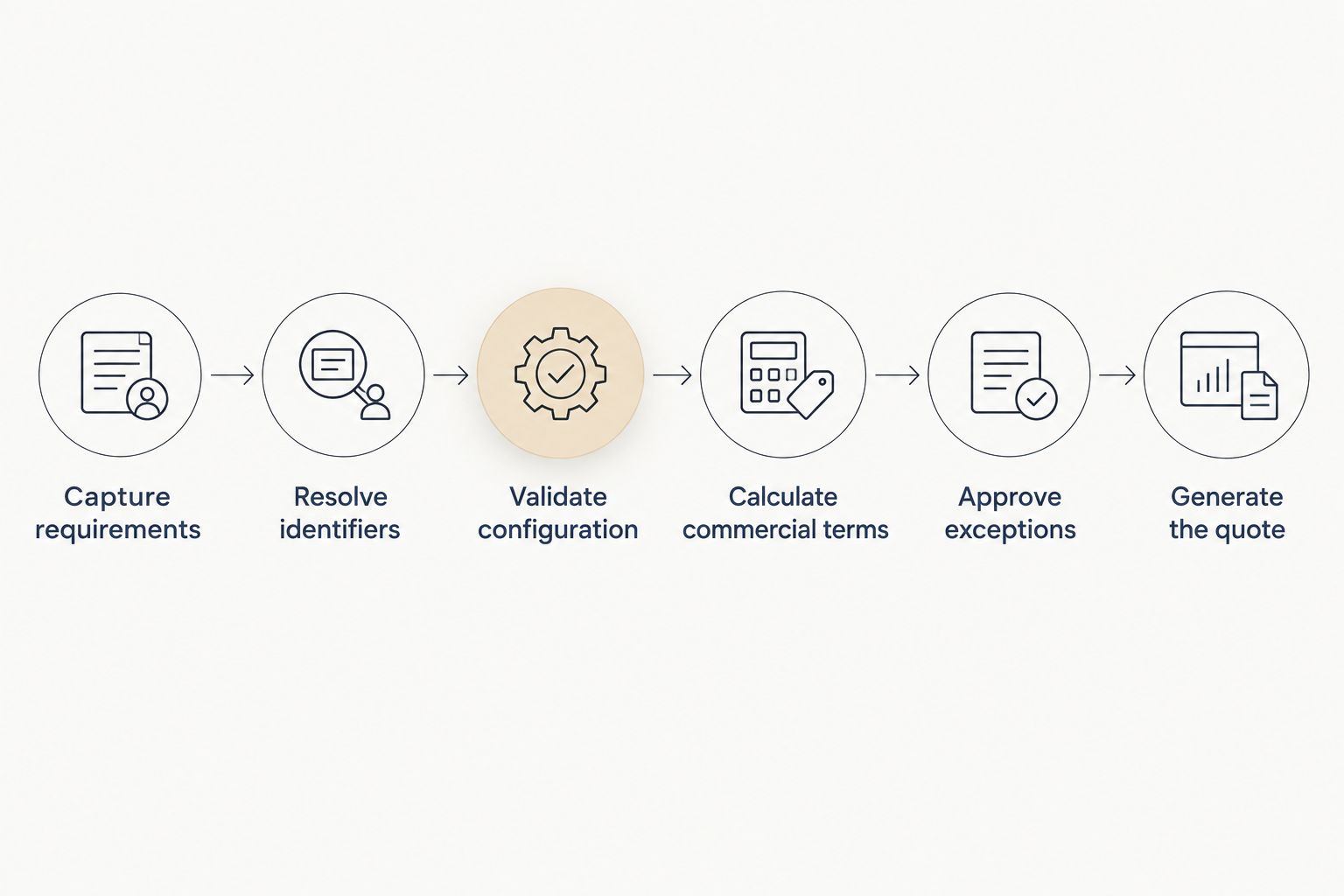
Use this sequence to turn an RFQ into a releasable quote:
- Capture requirements. Extract requested items, quantities, units, drawing references, revisions, and application details. Preserve the original RFQ alongside the extracted fields.
- Resolve identifiers. Match customer terminology to approved product identifiers. Flag ambiguous matches instead of silently choosing the nearest description.
- Validate configuration. Check required options, prohibited combinations, dependencies, and applicable engineering constraints against maintained rules.
- Calculate commercial terms. Retrieve authorized account terms and run calculations through the designated business system. Do not ask a language model to improvise the calculation.
- Approve exceptions. Route missing information, nonstandard requirements, and rule conflicts to the responsible sales or engineering owner.
- Generate the quote. Build the customer document from validated fields, preserving the approved revision and the assumptions that require customer confirmation.
This is a recommended control sequence, not an accuracy benchmark. Your acceptance test should establish whether each step produces the correct result for your product families.
A useful demonstration must show the validation record behind the quote, not just the finished PDF. Ask the supplier to expose the source fields, rule results, unresolved questions, and approval status for the same transaction.
Which quoting approach fits your product complexity?
For a 2026 evaluation, compare approaches by the decisions they control. A drafting tool, a rules-based configurator, and an engineering review process serve different purposes; none should be judged only by document quality.
| Approach | Best for | Strength | Limitation | Recommendation |
|---|---|---|---|---|
| AI drafting with manual validation | Teams standardizing RFQ interpretation and quote preparation | Separates document preparation from final approval | Requires reviewers to verify technical and commercial fields | Use for assisted preparation |
| AI intake with rules-based CPQ | Products with documented option dependencies | Allows explicit checks before quote generation | Depends on maintained configuration rules and reliable source data | Use for repeatable configured products |
| AI preparation with engineering approval | Requests containing new designs or nonstandard requirements | Organizes requirements for technical review | Does not remove engineering responsibility | Use for exception-heavy work |
Choose the approach that makes an invalid configuration visible before release. A system that produces an attractive quote without showing its validation path has not demonstrated configured-product accuracy.
AI drafting with manual validation
Best for teams that need help turning customer emails and attachments into structured quote drafts. Require the draft to distinguish extracted customer requirements from proposed interpretations.
The advantage is a clear preparation role. The trade-off is that your reviewer still owns the configuration check; drafting assistance does not eliminate that workload.
AI intake with rules-based CPQ
Best for products whose allowed combinations can be expressed through maintained configuration rules. Put compatibility checks and dependent selections in the configuration process, then use AI to handle customer language and describe the validated result.
The advantage is repeatable validation. The limitation is rule maintenance: an outdated dependency remains outdated even when the surrounding document is well written.
AI preparation with engineering approval
Best for engineer-to-order requests and departures from established designs. Use AI to assemble the requirement package, identify unanswered questions, and prepare a draft for review.
The advantage is organized handoff. The limitation is unchanged technical accountability: a generated description cannot establish that a new design meets the customer’s application requirements.
Why configured-product quote accuracy varies
Quote accuracy depends on the information and controls available for each request. Review these factors before expanding automation:
- Requirement completeness. Missing application details or unresolved drawing references prevent a fully specified quote. Require a clarification instead of accepting an inferred value.
- Identifier quality. Customer descriptions, legacy identifiers, and internal part records need an approved mapping. Keep uncertain matches out of automatic release.
- Configuration coverage. Your validation process must represent required components, incompatible options, and dependencies relevant to the product family.
- Revision control. The RFQ, configuration rules, engineering record, and generated document must refer to the intended revisions. Make disagreements visible.
- Account context. Quoting and account management need a consistent customer record and authorized commercial terms. Verify the account before applying its terms.
- Exception ownership. A nonstandard request needs a named reviewer and a recorded decision. An unresolved exception is not an approved configuration.
Do not use a single confidence score as a substitute for these checks. Confidence in text extraction and proof of product compatibility answer different questions.
What should an accurate configured-product quote contain?
An accurate quote needs a traceable connection between the customer request and the proposed configuration. Establish that connection at the field level, not only at the document level.
Your 2026 acceptance checklist should cover:
- The customer and account identifiers used for the transaction.
- The source request and attachments associated with the draft.
- Approved product identifiers and selected options.
- Requested quantities and units of measure.
- Applicable drawing, specification, and configuration revisions.
- Required accessories or dependent components.
- Explicit assumptions and unresolved customer questions.
- The calculation record and approval status.
- The quote revision released to the customer.
A blank required field should block release; it should not invite a plausible completion. Give each required field an owner and a defined source.
Also distinguish a customer requirement from a seller assumption. If the request does not identify a material grade, the draft should ask for that information or display an approved assumption requiring confirmation—not present an inferred grade as a customer instruction.
This distinction matters during review. A reviewer should be able to see what the customer specified, what the system retrieved, and what someone explicitly approved.
How do you test AI quoting before customer release?
Use approved historical RFQs and their reviewed configurations as reference cases. Keep the test separate from the customer-release workflow until you have checked both correct outputs and correct exception handling.
Establish the reference
Have sales and engineering confirm the expected result for each case. Do not treat an old quote as correct simply because it was sent.
Include straightforward configured orders alongside incomplete requests, incompatible selections, revised drawings, and ambiguous descriptions. The test should represent the decisions your team actually makes.
Check fields, not just documents
Compare extracted requirements, mapped identifiers, selected options, and calculations with the approved reference. Record discrepancies by type so you can distinguish an intake error from a configuration-rule problem.
Review the generated prose separately. A readable quote is useful, but wording quality must not conceal an incorrect part selection.
Test refusal and escalation
Supply requests that cannot be completed from the available information. Verify that the workflow asks a targeted question or routes the case to a reviewer.
Correctly withholding a quote is a successful outcome when a mandatory requirement is unresolved. Do not penalize that behavior as a failure to automate.
Retest after changes
Repeat affected cases when product records, configuration rules, document templates, or workflow permissions change. Keep the earlier results so the team can identify regressions.
For your 2026 rollout, define release criteria before reviewing the demonstration. Otherwise, a polished output can distract from the controls you intended to evaluate.
What happens when the customer changes the configuration?
A configuration change requires renewed validation of the affected selections, dependencies, and commercial calculation. Do not edit only the visible description and retain an approval tied to the previous configuration.
Keep the original quote revision, record the requested change, and create a distinct revised draft. Ask the workflow to show which fields changed and which approvals need renewal.
When the customer accepts the revision, order entry must use that accepted configuration. Matching the customer name and overall description is insufficient if the selected options or drawing revision differ.
This is where quoting and order entry meet. Carry approved structured fields into the downstream transaction rather than asking another process to reconstruct the configuration from free text.
Does AI replace CPQ for complex products?
AI does not replace the need for configuration rules, calculation controls, and approvals. CPQ is one way to organize those controls; the requirement remains even when your architecture uses another system.
Use AI for interpreting requests and drafting explanations, then verify technical selections through the designated validation process. Combining those roles in one interface does not make them the same responsibility.
Can AI quote an engineer-to-order product without engineering review?
AI preparation does not establish engineering approval for a new or nonstandard design. It can organize the request and prepare review material, but release should follow your engineering authority and approval policy.
Define the boundary explicitly. A request that exceeds established configuration rules belongs in the engineering review path, not in an automatic-release queue.
How can you tell whether an AI-generated quote is accurate?
An accurate quote matches approved requirements, configuration records, and commercial calculations. Verify those elements individually and confirm that unresolved exceptions remain blocked.
Ask for the evidence behind each critical field. A finished document without a source or validation record is not enough to establish correctness.
Where Supplyco fits in industrial quoting automation
Supplyco provides an AI-powered revenue operations platform for industrial manufacturers and distributors, covering quoting, order entry, account management, and sales follow-up. That scope makes the handoff between the approved quote and the downstream sales workflow relevant to your evaluation.
Supplyco is best suited to industrial manufacturers and distributors evaluating automation across quoting and related revenue operations. Assess its configuration checks, approval routing, and system connections against your actual requirements rather than assuming those capabilities from the platform category.
The relevant advantage is its stated coverage across related revenue workflows. The evaluation constraint is equally clear: that scope alone does not establish accuracy for your configured products.
For Supplyco quoting automation, request a demonstration using your approved reference cases. Check how the proposed workflow handles incompatible options, missing requirements, quote revisions, and the accepted quote’s transfer into order entry.
FAQ
Can AI write accurate quotes for complex configured products in 2026?
Yes, when the quoting workflow uses approved product records, explicit configuration checks, controlled calculations, and exception review. Generated text alone does not establish quote accuracy.
What’s the best way to stop AI from inventing product specifications?
Require every technical field to come from an approved source or an explicitly reviewed decision. Block release when a required specification is missing instead of allowing an inferred value.
Is AI quoting better than rules-based CPQ?
AI quoting and rules-based CPQ address different tasks: request interpretation and drafting versus explicit configuration validation. Evaluate how they work together rather than choosing on document quality alone.
Can AI turn a customer email into a configured-product quote?
AI can assist with extracting requirements and preparing a draft from a customer email. Validate product identifiers, option dependencies, units, and missing information before releasing the quote.
Do engineers still need to approve custom configurations?
Engineers should approve requests that fall outside your established configuration rules or require technical judgment. Document that boundary in the release workflow.
What should I ask Supplyco to demonstrate for complex quoting?
Ask Supplyco to demonstrate your approved reference cases, including incomplete requests and incompatible selections. Inspect source records, validation results, exception handling, and the accepted quote’s order-entry handoff.
Should an AI quoting system send a quote when requirements are incomplete?
No, not when the missing information is mandatory for a valid configuration. The workflow should request clarification or obtain an authorized, documented assumption before release.
One last thing
The most useful case in your 2026 demonstration is not a clean RFQ. It is a request containing a conflict that should stop the quote.
Ask the system to explain why it cannot release that quote and identify the next required action. That response reveals whether your workflow protects the release decision or merely produces convincing documents.


