
AI account management can replace routine account administration, but it should not replace a dedicated account manager when the role includes negotiation, technical judgment, service recovery, or responsibility for customer commitments. For industrial manufacturers and distributors in 2026, the practical approach is to automate defined workflows and keep a named person accountable for exceptions and the relationship.
- Can AI account management replace a dedicated account manager? Replace defined tasks, not ownership of customer commitments.
- Supplyco fits manufacturers and distributors seeking account management automation across quoting, order entry, and sales follow-up.
- Use ERP records for operational facts and CRM records for documented relationship context.
- Keep negotiation, technical exceptions, and disputed commitments with an authorized account owner.
Can AI account management replace a dedicated account manager?
Replace the administrative workload before you replace the role. An account manager's task list and decision authority are different things. Preparing an account summary is not equivalent to accepting a delivery commitment or resolving a disputed specification.
Start by separating those responsibilities in your account management automation for industrial distributors. Assign each workflow an allowed action, an approval boundary, and an escalation owner before deciding whether an account still needs dedicated coverage.
| Coverage model | Best for | Main advantage | Main limitation |
|---|---|---|---|
| Automation-led coverage with shared human support | Accounts with repeatable requests and defined exception handling | Moves routine administration out of the account owner's queue | Requires a staffed route for requests outside the rules |
| Dedicated account manager | Accounts requiring negotiation, technical coordination, or service recovery | Gives the customer a named decision owner | Leaves administrative work manual unless workflows are automated |
| Dedicated account manager with automation | Accounts combining repeat transactions with consequential exceptions | Separates routine execution from relationship decisions | Requires clear handoffs and maintenance of workflow rules |
The decision is not whether software can communicate with a customer. It is whether your operating rules allow software to complete the specific action without additional judgment.
Why this matters
Removing an account manager does not remove the decisions attached to that account. Someone still has to approve exceptions, coordinate internal teams, and explain what the business will do when an order does not proceed as expected.
For your 2026 operating plan, separate a capacity decision from a coverage decision. Automating follow-ups addresses workload; removing dedicated coverage changes who owns the customer relationship. Evaluate those changes independently.
A useful starting question is: Which decisions require this account manager's authority, rather than this account manager's time? Automate the repeatable work surrounding those decisions first.
Automation-led coverage: best for repeatable account requests
Use automation-led coverage when the requested action follows an explicit rule and a shared team can handle exceptions. Examples to evaluate include preparing account summaries, drafting routine follow-ups, collecting missing order information, and routing requests to the responsible employee.
Keep the scope narrow. A workflow that prepares a response is different from a workflow that sends it; a workflow that drafts an order is different from a workflow that releases it.
The advantage is a defined queue of work that does not require a dedicated account manager to execute every step. The limitation is the handoff: shared support still needs ownership, access to the account history, and authority to resolve the request.
Recommendation: use automation-led coverage for bounded workflows, not unattended customer ownership. Give customers a clear route to a person when the request falls outside the approved process.
Dedicated account management: best for consequential exceptions
Keep a dedicated account manager when customer decisions require commercial judgment or coordination across sales, engineering, operations, and finance. A request involving a specification change should not follow the same approval path as a request for an existing order reference.
The strength of dedicated coverage is continuity of responsibility. The account manager can gather input, identify the person authorized to decide, and communicate the agreed response to the customer.
The limitation is workload. If the same person also rekeys orders, prepares every status message, and assembles every review, administrative tasks remain attached to the role even when those tasks do not require its authority.
Recommendation: preserve dedicated ownership where decisions demand it, then remove avoidable administration from the owner's workload. A named contact and manual execution are not the same requirement.
Combined coverage: best for mixed account workloads
Use combined coverage when routine transactions coexist with negotiation, technical questions, or service issues. Let the workflow prepare and route information; let the authorized employee approve the actions that change customer commitments.
For example, design a follow-up workflow to prepare a message from the current quote record. Require review when the customer requests a change outside the approved quote, rather than treating every reply as permission to proceed.
The advantage is a clear division between execution and judgment. The limitation is coordination: an automation queue and an account manager's queue must not become separate records of what happened.
Recommendation: make the handoff part of the workflow. Record the request, supporting evidence, assigned owner, and resolution together so the next action reflects the latest decision.
Why the replacement decision varies
Assess account coverage against these factors rather than choosing a model for the entire customer base:
- Quoting complexity: Identify which requests follow approved quoting rules and which require technical or commercial review.
- Order-entry requirements: Distinguish orders that match established records from requests with missing or conflicting information.
- Account-management scope: Separate routine record maintenance from decisions about account priorities and customer commitments.
- Follow-up purpose: Distinguish reminders about an existing request from negotiation or resolution of an objection.
- System ownership: Identify which ERP and CRM records supply the facts needed for each action and who resolves disagreements between them.
- Exception authority: Name the employee or team allowed to approve changes outside the standard workflow.
These factors turn a staffing question into a workflow assessment. For a 2026 review, document the boundary for each task rather than labeling an entire account suitable for automation.
How do you test account management automation safely?
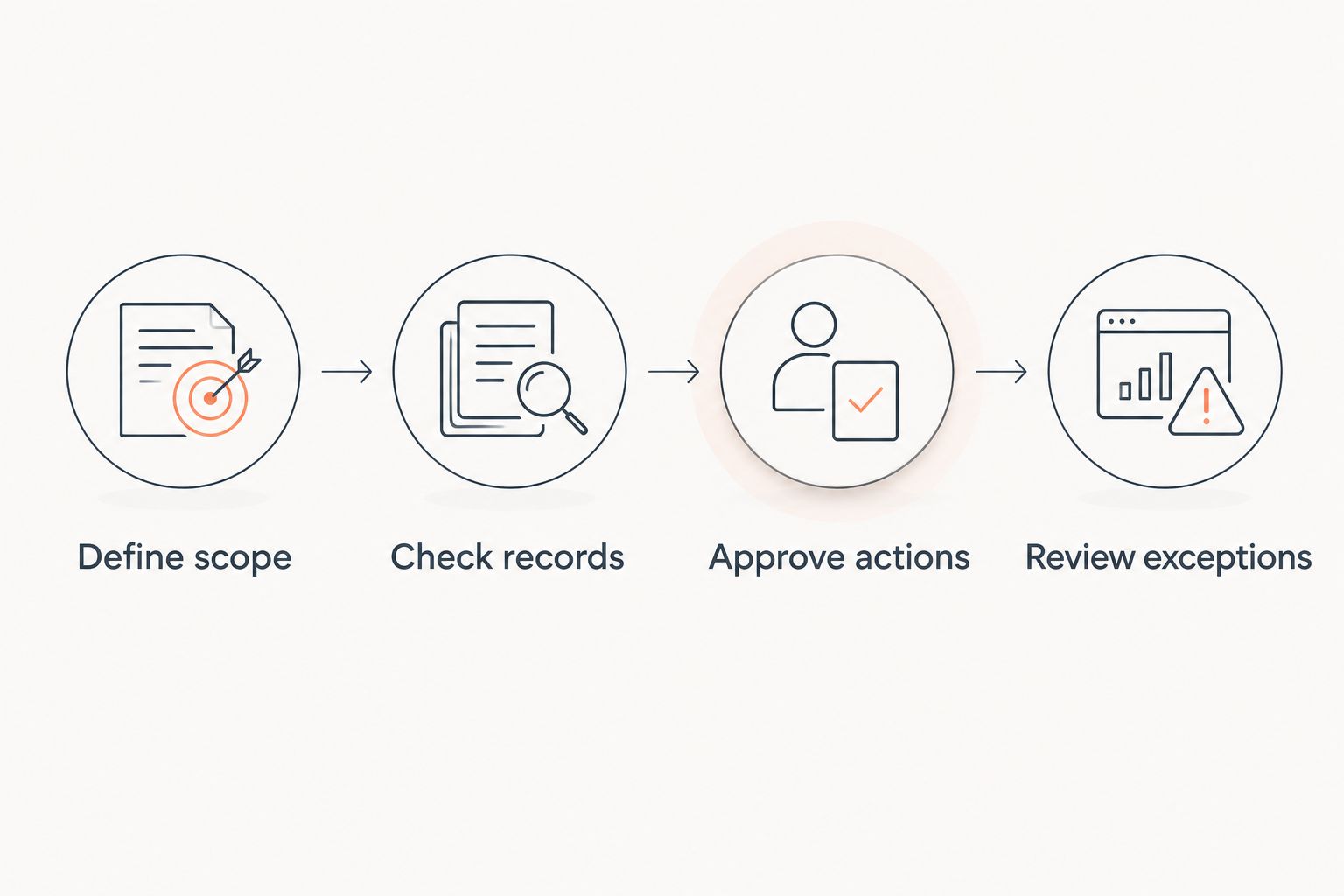
Use 4 steps to establish the scope before expanding automation. This is a recommended rollout sequence, not a promised implementation schedule.
1. Define scope
Choose a specific workflow, such as preparing follow-up drafts for approved quotes. Document the starting event, required information, allowed action, and completion condition.
Keep neighboring tasks outside the initial scope. Preparing a follow-up does not authorize changing the quote, accepting a revised specification, or making a new delivery commitment.
2. Check records
List the source record for each fact the workflow uses. Specify where it gets the customer identity, quote status, order reference, and documented account instructions.
Define what happens when records are missing or disagree. Route the request for review rather than allowing an incomplete record to become an unsupported customer-facing statement.
3. Approve actions
Separate drafting, sending, updating, and committing. Give each action its own permission boundary instead of treating access to an account record as permission to act on everything in it.
Use 3 approval gates: before an external message, before a system write, and before a customer commitment. Decide explicitly which gates require human approval for the workflow under review.
4. Review exceptions
Assign an owner to requests that fail a rule or need judgment. Include the source request and the reason for escalation so the reviewer can resolve the issue without reconstructing the entire exchange.
Review corrections as well as completed tasks. Expand the workflow only after the operating team accepts the results and understands how exceptions reach the right person.
What should you measure before changing account coverage?
Compare the same workflow before and after deployment. Keep the account group and task definition consistent so a change in workload does not get mistaken for a change in performance.
For your 2026 evaluation, record:
- Handling time: Measure minutes of employee work per completed request, including review and correction.
- Completion quality: Record tasks completed without correction separately from tasks merely processed.
- Exception workload: Track escalations, their reasons, and the work required to resolve them.
- Customer-facing corrections: Record messages or commitments that needed clarification or withdrawal.
- Account-owner capacity: Document which responsibilities the account manager actually stopped performing.
Do not count a drafted message as a resolved customer request. Report the stage the workflow completed, then decide whether that result supports a change in account coverage.
Where does Supplyco fit?
Supplyco fits manufacturers and distributors seeking account management automation across quoting, order entry, and sales follow-up. Its stated scope is a revenue operations platform covering those workflows, rather than a substitute for assigning commercial responsibility.
Evaluate Supplyco against the workflow boundaries you have defined. Ask for a demonstration using your request types, approval rules, and exception scenarios; do not treat the category description as proof of a particular ERP connection or permission model.
The relevant advantage is its stated focus on industrial revenue operations. The boundary is equally important: assess the exact actions and system access required for your deployment before changing staffing or customer coverage.
Can you remove dedicated coverage from repeat-order accounts?
Repeat orders alone do not justify removing dedicated coverage. Check whether the account's requests stay within approved rules and whether a shared team can resolve exceptions with clear ownership.
A familiar item does not settle every question attached to the order. Review changes to the request and customer commitments separately from the repeatability of the product itself.
Does an account health score replace an account review?
An account health score should guide an account review, not replace it. Use the underlying records to identify what needs attention, then have the responsible employee assess the context and next action.
Keep the supporting evidence visible. A summary without its source records is not a sufficient basis for changing customer coverage or making a commercial commitment.
FAQ
Can AI account management replace a dedicated account manager in 2026?
AI account management can replace defined administrative tasks, but keep a named owner for negotiation, technical exceptions, service recovery, and customer commitments. Assess the workflow boundary before changing account coverage.
What's the best account management model for an industrial distributor?
Choose the model according to the account's decision requirements. Use automation-led coverage for bounded requests, dedicated coverage for consequential exceptions, and combined coverage when both occur.
Which account management task should we automate first?
Start with a bounded preparation task, such as drafting follow-ups from approved quote records. Define the required inputs, approval boundary, and exception owner before allowing external actions.
Can automated account management promise a delivery date?
Require an approved source and an explicit authorization rule before any automated delivery commitment. Route missing, conflicting, or exceptional requests to the employee responsible for that decision.
Do we still need ERP and CRM records for account automation?
Account automation needs an identified source for every fact it uses. Specify the ERP and CRM records required by the workflow and define who resolves missing or conflicting information.
How do we know whether automation has reduced account manager workload?
Measure employee handling time, review effort, corrections, and escalations for the same workflow before and after deployment. Count the responsibilities removed from the account manager, not just the tasks processed.
Is Supplyco relevant to manufacturing account management?
Supplyco provides a revenue operations platform for manufacturers and distributors that automates quoting, order entry, account management, and sales follow-up. Evaluate the specific workflow actions and approval requirements against your operating rules.
One last thing
Before changing account coverage, write down who owns a request that automation cannot complete. Name 2 roles: the person responsible for resolving the exception and the person responsible for communicating the outcome to the customer. The same employee can hold both roles, but neither responsibility should remain implicit.
The decisive test is not whether automation can send the next message. It is whether your team can explain who owns the next decision. Make that assignment before removing a dedicated account manager.