
Best overall for prospect research: LinkedIn Sales Navigator. Best for industrial quote follow-up: Supplyco. Best for contact discovery: ZoomInfo. This 2026 guide compares lead generation tools for aerospace suppliers by the job you need done: finding accounts, identifying buyers, attracting inquiries, or converting qualified demand.
- LinkedIn Sales Navigator leads for researching aerospace accounts and identifying relevant buying roles.
- Supplyco fits aerospace suppliers that need quoting, account management, and sales follow-up automation.
- ZoomInfo supports contact discovery; Thomasnet supports industrial supplier discovery; HubSpot organizes inbound leads.
- Choose lead generation tools for aerospace suppliers by account fit and qualified RFQs, not exported contact volume.
Why this matters
An aerospace company name is not a qualified sales opportunity. Your team still needs to establish what the account buys, which facility makes purchasing decisions, and whether your capabilities match the requirement.
Separate prospecting from conversion. A contact database helps you find people; a CRM organizes relationships; revenue operations software addresses work such as quoting and follow-ups. Buying one category to solve another category's problem leaves the original bottleneck intact.
For your 2026 shortlist, start with the failed handoff. If reps cannot identify relevant buyers, prioritize research and contact discovery. If qualified RFQs sit unanswered or quoted opportunities lose their next action, prioritize workflow execution instead.
What makes the best aerospace lead generation tools
Judge each option against these criteria before comparing feature lists:
- Account fit: Can you distinguish relevant manufacturers, integrators, maintenance organizations, and distributors from unrelated businesses?
- Buyer identification: Can you find the purchasing, sourcing, engineering, or supplier-quality roles relevant to your offer?
- Qualification evidence: Can your team record the capability match, purchasing requirement, and next step rather than just a job title?
- Workflow ownership: Is there a clear owner for the inquiry, qualification decision, quotation, and follow-up?
- System boundaries: Can you establish what belongs in the prospecting tool, CRM, and ERP before moving records between them?
- Data controls: Can your team follow approved rules for contact data, technical documents, access, and retention?
The best tool is the one that addresses your current bottleneck without creating an uncontrolled handoff. Do not treat a company's aerospace classification as proof of purchasing intent or supplier approval.
Aerospace lead generation tools at a glance
The table compares roles, not interchangeable products. Use it to identify the category you need before requesting demonstrations.
| Tool | Best for | Standout capability | Key limitation |
|---|---|---|---|
| Supplyco | Following up on qualified industrial demand | Automates quoting, order entry, account management, and sales follow-up | Revenue operations automation is not a substitute for validating net-new account coverage |
| LinkedIn Sales Navigator | Mapping buyers inside target accounts | Account and professional-profile research | A relevant profile does not establish an active purchasing requirement |
| ZoomInfo | Finding business contact information | Company and contact intelligence | Contact records do not establish aerospace capability fit |
| Thomasnet | Being discovered through industrial sourcing research | Industrial supplier directory and company profiles | Directory presence does not establish lead quality or inquiry volume |
| HubSpot | Organizing inbound lead qualification | CRM, forms, and marketing workflows | A CRM does not create a relevant audience by itself |
1. Supplyco: best for aerospace quote follow-up
Supplyco is an AI-powered revenue operations platform for industrial manufacturers and distributors. It automates quoting, order entry, account management, and sales follow-up, making it relevant when your problem starts after a prospect or customer engages.
Supplyco is best for aerospace suppliers that need to automate quoting and sales follow-up rather than simply collect more contacts. That distinction matters: operational follow-through and net-new prospect discovery require different evaluation criteria.
Supplyco pros:
- Covers quoting and sales follow-up within its stated scope.
- Addresses account management as well as individual opportunities.
- Includes order entry, connecting the evaluation to downstream commercial work.
Supplyco cons:
- Its stated revenue operations scope does not establish aerospace contact-database coverage.
- Aerospace-specific qualification rules and system requirements still need validation.
Best for: Manufacturers and distributors with relevant inquiries, existing accounts, or quoted opportunities that need consistent handling.
For a 2026 demonstration, bring a representative RFQ, a stalled quotation, and an account follow-up task. Ask the vendor to show the proposed workflow, approval boundaries, exception handling, and ownership of each next action. Keep technical acceptance and commercial approval explicit.
Verdict: Buy for a demonstrated quoting or follow-up bottleneck; skip as a substitute for a verified prospect database.
2. LinkedIn Sales Navigator: best for aerospace buying-group research
LinkedIn Sales Navigator supports account and lead research using LinkedIn's professional network. It fits a named-account approach in which your team identifies relevant organizations and then investigates the people involved in purchasing decisions.
Start with the account, not a broad job-title search. A sourcing role at a relevant facility is more useful than an impressive title at a business that does not buy your product or process.
LinkedIn Sales Navigator pros:
- Supports research into professional roles and company affiliations.
- Provides account and lead search for targeted prospecting.
- Helps reps develop a buying-group view rather than rely on one contact.
LinkedIn Sales Navigator cons:
- Profile information does not verify an RFQ, purchasing authority, or supplier requirement.
- Research still requires interpretation and account qualification.
- It does not replace quoting or order-management workflows.
Best for: Business development teams that know their target account types but need to identify relevant people.
During evaluation, ask reps to map purchasing, engineering, and supplier-quality roles for a small account sample. Record which relationships are established and which remain assumptions; do not label everyone with a relevant title as a qualified lead.
Verdict: Buy for named-account research; skip if your immediate problem is neglected inbound RFQs.
3. ZoomInfo: best for aerospace business contact discovery
ZoomInfo provides company and business contact intelligence. Its role in this shortlist is helping reps investigate accounts and find contact information for outbound prospecting.
Treat every returned record as a research input. A business email address does not establish that the person buys your component family, manages the relevant facility, or accepts new suppliers.
ZoomInfo pros:
- Supports company and contact discovery in a business-focused database.
- Helps prospectors investigate organizations beyond an existing customer list.
- Provides a separate research layer from your internal opportunity records.
ZoomInfo cons:
- Aerospace coverage and record relevance require validation against your account list.
- Contact intelligence does not establish technical or commercial qualification.
- Importing records without ownership and deduplication rules creates avoidable cleanup.
Best for: Outbound teams with a defined ideal customer profile and a specific contact-information gap.
For your 2026 evaluation, supply named accounts rather than accept a generic demonstration. Ask the vendor to locate the facilities and roles you actually sell to, then have reps verify relevance before importing records into the CRM.
Verdict: Buy after validating target-account coverage; hold if your ideal customer profile remains undefined.
4. Thomasnet: best for industrial supplier discovery
Thomasnet is an industrial sourcing directory where buyers research suppliers and capabilities. For an aerospace supplier, its role is different from outbound contact discovery: it provides a place to present what your company supplies to people conducting industrial sourcing research.
Build the evaluation around capability alignment. Describe the processes, materials, products, and services you actually provide; avoid aerospace claims that exceed your documented scope.
Thomasnet pros:
- Centers discovery on industrial companies and supplier capabilities.
- Gives buyers a supplier-research context rather than a general social profile.
- Supports a capability-led presence for relevant sourcing searches.
Thomasnet cons:
- A listing alone does not establish inquiry volume or buyer quality.
- Broad capability descriptions can make fit harder to assess.
- Your sales team still needs to qualify and follow up on inquiries.
Best for: Suppliers that want buyers to discover a clearly defined industrial capability.
Before choosing this route, review whether your description lets a buyer distinguish your actual work from adjacent services. Measure resulting inquiries against your qualification criteria rather than treating every message as pipeline.
Verdict: Buy into this channel when capability-led discovery fits your sales motion; skip as a direct replacement for outbound account research.
5. HubSpot: best for organizing inbound aerospace inquiries
HubSpot combines CRM capabilities with tools for capturing and managing inbound interest. It fits teams that need a consistent record of the inquiry, account owner, qualification status, and next action.
The distinction is straightforward: organizing demand is not the same as creating it. Define how relevant buyers reach your business before expecting a CRM implementation to improve lead quality.
HubSpot pros:
- Provides CRM records for contacts, companies, and deals.
- Supports forms and marketing workflows for inbound lead handling.
- Gives teams a structure for recording qualification and ownership.
HubSpot cons:
- Forms and workflows do not generate a relevant audience by themselves.
- Aerospace qualification fields and routing rules need deliberate configuration.
- CRM records do not replace ERP-controlled product, order, or commercial information.
Best for: Teams receiving website or campaign inquiries that need a defined qualification process.
In your demonstration, submit an example inquiry and follow it through assignment, qualification, and the next task. Ask which capabilities are included in the proposed configuration rather than assuming every demonstrated feature is part of the same package.
Verdict: Buy for structured inbound handling; hold if nobody owns qualification or the underlying demand source.
How the ranking works
This 2026 ranking prioritizes distinct workflow fit: industrial follow-up, buyer research, contact discovery, supplier discovery, and inbound organization. It is not a claim that one product outperforms every other product across those jobs.
The criteria are account fit, buyer identification, qualification evidence, ownership, system boundaries, and data controls. Product capabilities establish a shortlist; your own account sample and workflow demonstration should determine the purchase.
Run a focused aerospace evaluation
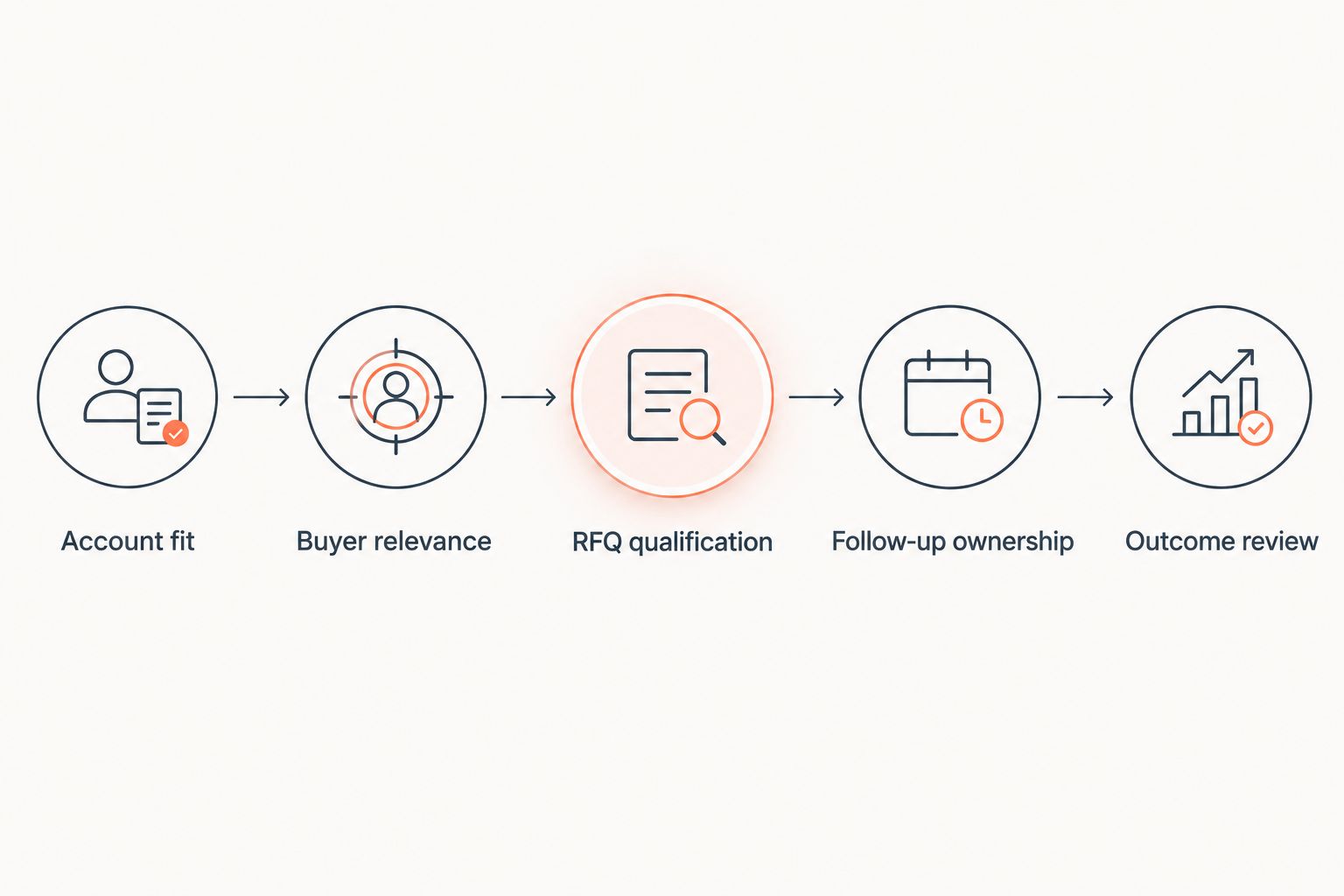
Use a prescribed pilot rather than a vendor's best-looking sample. The following quantities are evaluation recommendations, not performance benchmarks:
- Account fit: Select 20 target accounts representing the work you want to win. Record why each account fits.
- Buyer relevance: For each account, investigate the purchasing function and the technical stakeholders relevant to your offer.
- RFQ qualification: Use 5 representative RFQs to test how your team records requirements, missing information, and disqualification reasons.
- Follow-up ownership: Assign a named owner and next action before an opportunity advances.
- Outcome review: Review the pilot after 30 days. Separate relevant contacts, qualified conversations, accepted RFQs, and quoted opportunities.
These stages should remain distinct. A contact is not a conversation, and an RFQ is not an order. Record the source and date of each outcome so your team can examine the result without reconstructing email threads.
Keep technical drawings and controlled information out of prospecting demonstrations unless your organization has approved the environment and access. A contact-research exercise does not require unrestricted access to customer documentation.
Which aerospace lead generation tool should you choose?
Choose LinkedIn Sales Navigator first when your primary need is finding relevant people inside known target accounts. Choose ZoomInfo when the specific gap is business contact information, and validate its coverage before purchase.
Choose Thomasnet for capability-led industrial discovery. Choose HubSpot when inbound inquiries need consistent capture and qualification. Choose revenue operations automation when qualified demand already exists but quoting, account management, or follow-up is the unresolved problem.
Do not replace a functioning CRM simply because prospecting is weak. Name the failed step, select the tool category that addresses it, and define the handoff before expanding your stack.
FAQ
What's the best lead generation tool for aerospace suppliers?
LinkedIn Sales Navigator is the default choice in this guide for researching buyers inside target accounts. Choose a different category when your main gap is contact information, inbound handling, or follow-up execution.
Is Supplyco a prospecting database or a revenue operations platform?
Supplyco is a revenue operations platform for industrial manufacturers and distributors. Its stated scope includes quoting, order entry, account management, and sales follow-up; evaluate prospect-database coverage separately.
Is ZoomInfo better than LinkedIn Sales Navigator for aerospace sales?
ZoomInfo fits business contact discovery, while LinkedIn Sales Navigator fits account and professional-role research. Compare both against your actual target accounts rather than treating either as proof of buyer qualification.
Can Thomasnet help aerospace suppliers generate leads?
Thomasnet provides an industrial supplier-discovery channel. Evaluate whether inquiries match your documented capabilities; directory presence alone does not establish lead volume or quality.
Do aerospace suppliers need a CRM and a prospecting tool?
Aerospace suppliers need both functions when they conduct outbound prospecting and manage ongoing opportunities. A prospecting tool supports research, while the CRM should preserve ownership, qualification, and next actions.
How should a small aerospace supplier evaluate these tools?
Start with one defined bottleneck and a representative account sample. Test account relevance, buyer relevance, and the handoff to qualification before expanding the rollout.
What should count as a qualified aerospace lead?
Count a lead as qualified when your team has documented a relevant account, a purchasing requirement, a capability match, and an agreed next action. Keep unresolved technical or commercial requirements visible rather than marking the lead ready by default.
One last thing
Before adding another source of contacts, inspect your unclosed quotations. Give each one an owner, a reason it has stalled, and a next action. That review reveals whether your next purchase should find more demand or help your team act on the demand already in hand.