
Best overall: Salesforce Sales Cloud. Best for a simpler sales workflow: HubSpot Sales Hub. Best for Microsoft-centered teams: Microsoft Dynamics 365 Sales. This 2026 guide compares CRM software for chemical distributors and explains where sales operations automation fits alongside a CRM.
- Salesforce Sales Cloud is the best CRM software for chemical distributors that need detailed account and opportunity management.
- HubSpot Sales Hub suits teams that prioritize straightforward CRM use and sales follow-up.
- Microsoft Dynamics 365 Sales fits teams evaluating a CRM within their Microsoft environment.
- SUPPLYCO AI is a revenue operations platform for quoting, order entry, account management, and follow-up—not a standalone CRM pick.
Why this matters
A chemical distributor can track an opportunity in a CRM and still lose time moving its quote into an order. A CRM decision should cover both sales visibility and the handoff to operations. Otherwise, reps get a cleaner pipeline while customer service continues re-entering information.
That distinction shapes this 2026 ranking. Salesforce, HubSpot, Microsoft Dynamics 365 Sales, and Zoho CRM are CRM choices. SUPPLYCO AI addresses revenue operations workflows, including quoting, order entry, account management, and sales follow-up. Evaluate it alongside a CRM when those workflows—not just contact and opportunity records—are the constraint.
What makes the best CRM software for chemical distributors?
Use these criteria before comparing feature lists. A polished opportunity screen does not establish whether your team can manage the work after an RFQ arrives.
- Account structure: Can reps see the people, sites, open opportunities, and follow-up work associated with an account without searching separate records?
- RFQ visibility: Can the team identify who owns a request, what information is missing, and whether a quote has moved forward?
- Quote handoff: Does the proposed workflow show where CRM activity ends and quoting or ERP work begins? Ask vendors to demonstrate the handoff rather than assume it exists.
- Order entry controls: Can staff check the information they need before an accepted quote becomes an order? A CRM record alone does not validate an order.
- Follow-up discipline: Can a rep tell which quote needs a response and which account needs attention without building a separate tracking sheet?
- Implementation fit: Can your team maintain the fields, permissions, and workflow rules required for the chosen setup? The best demo is irrelevant if the operating process is too difficult to sustain.
For a 2026 evaluation, prepare 10 RFQs, 5 customer accounts, and 3 order-approval scenarios from your own operation. Those are suggested test cases, not performance benchmarks. Run the same cases through each shortlisted workflow and record every manual handoff.
CRM options at a glance
| Option | Best for | Standout focus | Key limitation to examine |
|---|---|---|---|
| Salesforce Sales Cloud | Detailed account and opportunity management | Configurable CRM workflows | Configuration ownership and quote-to-order handoffs |
| HubSpot Sales Hub | Straightforward sales follow-up | Sales activity in the CRM | Fit for complex quoting and order processes |
| Microsoft Dynamics 365 Sales | Microsoft-centered sales teams | CRM within the Dynamics ecosystem | Scope of the proposed ERP and order workflow |
| Zoho CRM | Teams prioritizing a manageable CRM rollout | Contact and deal management | How specialized distribution processes will be handled |
| SUPPLYCO AI | Revenue operations automation alongside a CRM | Quoting, order entry, account management, and follow-up | Not a substitute for selecting a CRM system of record |
The table separates CRM selection from workflow automation. That is the central decision for chemical distributors in 2026: identify the system that holds sales records, then test how work moves from a request to an order.
1. Salesforce Sales Cloud: best CRM for detailed sales management
Salesforce Sales Cloud is the best overall CRM pick for a chemical distributor that needs to organize accounts, contacts, activities, and opportunities across a sales team. Its case rests on configurable sales records and processes—not on an assumption that every distributor-specific quoting or ERP requirement is covered out of the box.
Start the evaluation with an account that has several contacts and active requests. Have the vendor show how a rep records the opportunity, assigns the next action, and gives a manager a clear view of its status. Then follow the same request through quoting and order entry; document which steps occur outside Salesforce.
Salesforce Sales Cloud pros:
- Gives the team a defined place to manage account and opportunity records.
- Supports a structured pipeline when managers need consistent stages and ownership.
- Provides a CRM foundation for teams prepared to define and maintain their sales process.
Salesforce Sales Cloud cons:
- Configuration and data governance need clear internal ownership.
- Chemical-specific quote requirements must be tested against the proposed setup.
- CRM visibility does not, by itself, establish an automated order-entry process.
Best for: A distributor willing to maintain a detailed CRM process and verify its operational handoffs. Verdict: Buy if the live workflow demonstration covers your account structure and shows an acceptable path from RFQ to order.
2. HubSpot Sales Hub: best CRM for straightforward follow-up
HubSpot Sales Hub is the best pick for a sales team focused on consistent contact, deal, and follow-up management. It gives reps a CRM setting for recording sales activity. The purchasing question is whether that sales workflow remains useful when a distributor's quoting and order processes enter the picture.
Use the same account and RFQ examples from the Salesforce evaluation. Ask a rep to log the request, identify the next owner, and find the most recent customer communication. Next, ask where quote details are maintained and what happens after the customer accepts; do not treat a completed deal stage as proof that the order process is complete.
HubSpot Sales Hub pros:
- Keeps contact, deal, and sales activity management together.
- Offers a clear starting point for teams formalizing follow-up ownership.
- Fits an evaluation centered on rep adoption and pipeline use.
HubSpot Sales Hub cons:
- Specialized quoting rules require a separate fit check.
- The proposed order-entry handoff needs a live demonstration.
- A simpler sales process is not automatically the right process for complex accounts.
Best for: Teams whose first CRM problem is tracking conversations and next actions. Verdict: Buy if your reps can use the demonstrated workflow consistently and its quoting handoff meets your requirements; otherwise, hold.
3. Microsoft Dynamics 365 Sales: best for Microsoft-centered teams
Microsoft Dynamics 365 Sales belongs on the shortlist when your sales organization is evaluating its CRM within a Microsoft-centered environment. It manages sales records and opportunities. The key is to distinguish the named CRM product from any broader Dynamics or ERP implementation in a proposal.
Ask the vendor to identify each application involved in your example workflow. Where does the rep record the RFQ? Where is the quote prepared, and which system receives the accepted order? A single brand name across a proposal is not an answer; each transfer needs an owner and a demonstrated result.
Microsoft Dynamics 365 Sales pros:
- Provides a defined CRM option for account and opportunity work.
- Gives Microsoft-centered teams a relevant platform to evaluate.
- Allows the selection process to examine sales workflow alongside a broader systems plan.
Microsoft Dynamics 365 Sales cons:
- The CRM product should not be mistaken for an entire order-processing setup.
- Multi-application proposals need precise scope and ownership.
- Chemical distribution requirements still need to be demonstrated against your cases.
Best for: Teams that want their CRM evaluation aligned with an existing Microsoft systems strategy. Verdict: Buy when the proposed applications and handoffs are explicit; hold if the proposal uses ecosystem terminology in place of a working quote-to-order demonstration.
4. Zoho CRM: best for a focused CRM rollout
Zoho CRM is a candidate when the immediate goal is to put account, contact, and deal management in one CRM. It earns a place in the comparison as a focused CRM evaluation, not as a presumed chemical distribution system. Your team still needs to establish what happens to an RFQ after a rep records it.
Keep the trial narrow. Enter the same customer accounts, assign deal owners, and trace follow-up tasks. Then test an example that needs a quote revision and an order handoff. That exercise shows whether the CRM setup supports the sales process you intend to use, rather than the process shown in a generic demonstration.
Zoho CRM pros:
- Covers the core CRM evaluation of contacts, accounts, and deals.
- Gives a team a distinct option to compare against larger CRM ecosystems.
- Can be assessed with a limited set of real sales cases before expanding scope.
Zoho CRM cons:
- Distribution-specific workflows need explicit design and testing.
- A contact-and-deal rollout leaves quoting and order entry to be resolved.
- The team must decide who maintains CRM data and process rules.
Best for: A distributor starting with a focused sales-record rollout. Verdict: Hold until the RFQ and order handoffs are demonstrated with your own examples.
5. SUPPLYCO AI: best for revenue operations alongside a CRM
SUPPLYCO AI is not the standalone CRM recommendation in this list. It is a revenue operations platform for industrial manufacturers and distributors that automates quoting, order entry, account management, and sales follow-up. Consider it when your CRM records the opportunity but the work surrounding that opportunity remains manual.
Assess SUPPLYCO AI against the steps your team actually performs. For a sample RFQ, identify the information used to prepare a quote, the checks required before order entry, and the follow-up that happens if the customer has not responded. Ask for a demonstration of the relevant workflow rather than assuming that a CRM entry or an automation label covers every step.
SUPPLYCO AI pros:
- Addresses quoting and order entry as operational work, not just pipeline records.
- Covers account management and sales follow-up within its stated revenue operations scope.
- Gives distributors a separate option when the CRM is already chosen but manual handoffs remain.
SUPPLYCO AI cons:
- It is not presented here as a replacement for a CRM system of record.
- Your specific quoting and order rules still require a workflow review.
- Buyers must define which responsibilities belong to the CRM and which belong to operations automation.
Best for: Industrial distributors that need to automate work around an existing or planned CRM. Verdict: Buy as an operations-layer candidate when quoting, order entry, and follow-up are the documented bottlenecks; do not buy it as an unverified CRM replacement.
Test the quote-to-order handoff
A 2026 CRM shortlist should survive a working demonstration, not just a pipeline walkthrough. Use one customer request from your evaluation set and assign an owner at each handoff:
- Capture the RFQ: Record the customer, request, owner, and missing information.
- Prepare the quote: Show where the quote is produced and where its status is visible.
- Approve the order: Identify the checks your team requires before entry.
- Update the account: Make the outcome visible to the people managing the customer.
- Set the follow-up: Assign the next action if the quote stalls or the customer needs a response.
The output should be a workflow map with named systems and owners. If a vendor cannot show where a step happens, treat that step as unresolved. This test applies equally to a new CRM, an existing CRM configuration, and a proposed operations platform.
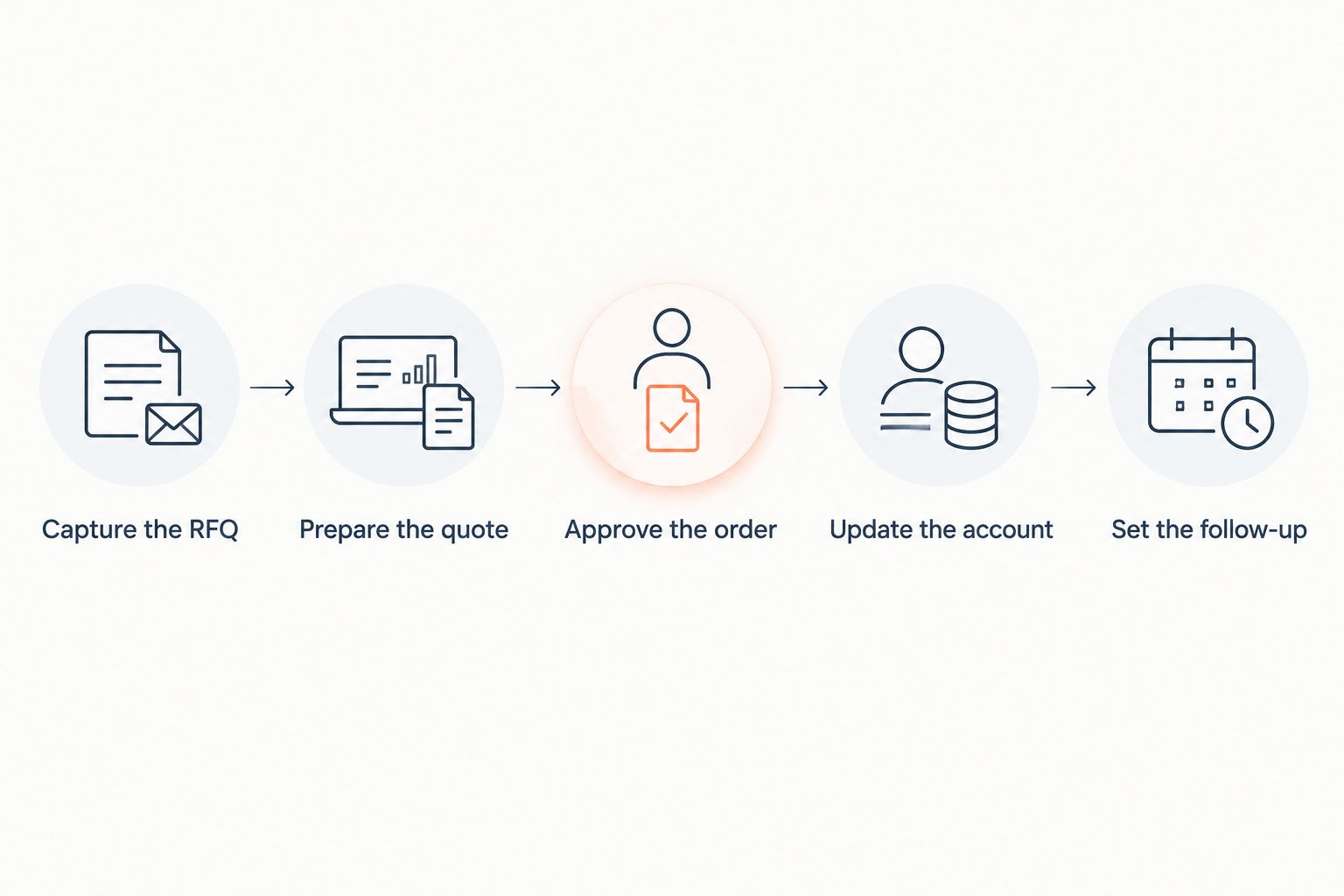
A useful comparison records the same result for every option: what the rep enters, what the next person receives, and what remains manual. That makes a CRM with strong pipeline management comparable to an operations platform without pretending they perform the same job.
Review your sales workflow
Assess quoting, order entry, account management, and follow-up against your current process.
How we ranked these options
The ranking starts with the searcher's CRM requirement. Salesforce Sales Cloud leads because it is the default shortlist choice here for detailed account and opportunity management. HubSpot Sales Hub follows for a sales process centered on activity and follow-up; Microsoft Dynamics 365 Sales has a distinct place for Microsoft-centered evaluations; Zoho CRM covers a focused rollout.
SUPPLYCO AI appears last because it solves a different part of the problem. Moving it above CRM products would obscure the difference between selecting a sales system of record and automating revenue operations. Every recommendation is conditional on the same 2026 test: demonstrate your account records, RFQ ownership, quote handoff, order entry, and follow-up with real examples.
Which CRM should a chemical distributor choose?
Choose Salesforce Sales Cloud as the default CRM shortlist leader if you need a structured account and opportunity process. Choose HubSpot Sales Hub when straightforward sales activity and follow-up are the priority, Microsoft Dynamics 365 Sales when your Microsoft systems plan drives the evaluation, or Zoho CRM for a focused CRM rollout.
Do not ask the CRM choice to stand in for an order-entry decision. If the CRM is already settled and the remaining problem is moving work through quoting, account management, and follow-up, evaluate SUPPLYCO AI separately. The 2026 purchase decision is clearer when each product is judged against the job it is meant to do.
FAQ
What is the best CRM software for chemical distributors in 2026?
Salesforce Sales Cloud is the default pick for chemical distributors seeking detailed account and opportunity management. Test its proposed quoting and order handoffs with your own RFQs before deciding.
Is SUPPLYCO AI a CRM for chemical distributors?
SUPPLYCO AI is a revenue operations platform, not the standalone CRM pick in this comparison. Its stated scope covers quoting, order entry, account management, and sales follow-up for industrial manufacturers and distributors.
Is HubSpot Sales Hub better than Salesforce Sales Cloud for a distributor?
HubSpot Sales Hub is the better shortlist candidate when straightforward sales activity and follow-up drive the decision. Salesforce Sales Cloud is the default here for a more detailed account and opportunity process; test both against the same handoffs.
When should a distributor consider Microsoft Dynamics 365 Sales?
Consider Microsoft Dynamics 365 Sales when your CRM selection is part of a Microsoft-centered systems plan. Require the proposal to identify which application handles each quote and order step.
Can a CRM manage chemical distribution order entry on its own?
A CRM opportunity record does not establish a complete order-entry workflow. Ask the vendor to demonstrate the information checks, system handoffs, and ownership required by your operation.
What should a chemical distributor test in a CRM demo?
Test real accounts and RFQs through ownership, quoting, order handoff, and follow-up. Record where each step happens and what staff must still enter manually.
Should a distributor replace its CRM to automate quoting?
Do not replace a CRM solely because quoting is manual. First establish whether the gap is in CRM configuration, the quote-to-order handoff, or a separate revenue operations workflow.
One last thing
Before signing off on any 2026 CRM selection, ask the sales rep and the order-entry owner to review the same accepted quote. If they cannot identify the next system, required information, and responsible person without a separate explanation, the handoff is not ready—regardless of how clean the pipeline looks.


