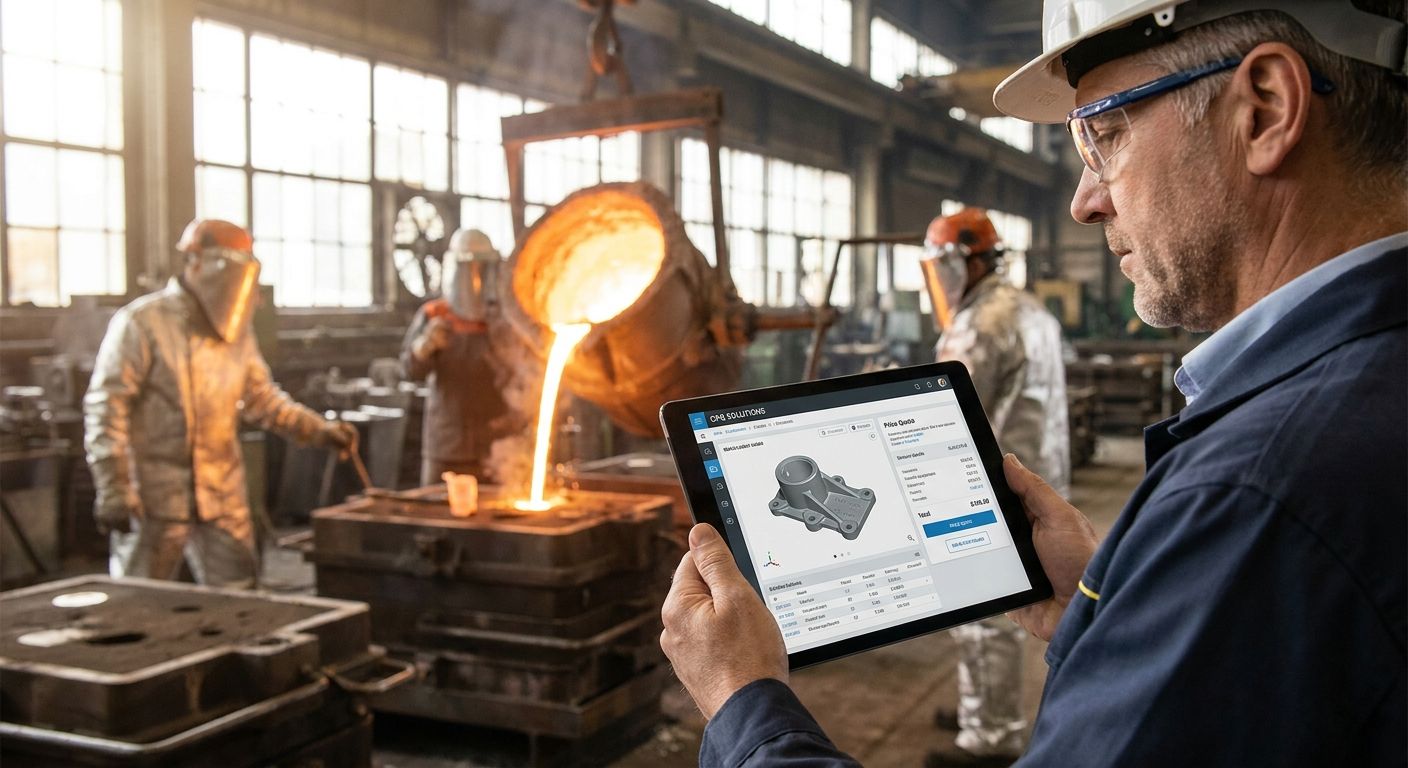
Best overall for foundries and casting manufacturers in 2026: Supplyco AI, which automates RFQ-to-quote work inside your existing ERP and CRM instead of asking you to rip them out. Best for engineered-to-order casting configuration: Tacton CPQ. Best budget option for lean sales teams: DealHub CPQ.
- Supplyco AI wins for foundries running JobBoss, Global Shop Solutions or Epicor Kinetic that need quoting automated, not replaced.
- Tacton CPQ handles complex geometric configuration for engineered castings but needs a dedicated CPQ admin to maintain rules.
- Salesforce CPQ and Epicor CPQ fit foundries already committed to those ecosystems, not as standalone buys.
- DealHub CPQ deploys fastest for foundries without a formal CPQ budget, but skips alloy-specific costing depth.
- Best CPQ software for foundries and casting manufacturers in 2026 depends on which ERP you already run.
Why this matters
Foundries quote off RFQ packets, not catalog SKUs. Alloy price swings, pattern and tooling amortization, core counts and non-recurring engineering all move the number before a sales rep even sees the drawing.
Spreadsheet quoting or manual entry into your ERP means every RFQ takes hours to price and every follow-up gets missed while the rep chases the next fire. Supplyco AI exists because that gap between an RFQ landing and a quote going out is where casting shops lose bids in 2026 to competitors who answer first.
CPQ software closes that gap by turning pricing logic, alloy costs and approval rules into a system instead of a spreadsheet someone updates once a quarter. The right platform for a foundry looks different from the right platform for a distributor moving off-the-shelf parts, and that distinction drives this ranking.
What makes the best CPQ software for foundries and casting manufacturers
- Alloy and material cost modeling — pricing has to track steel, iron, aluminum and bronze cost swings, not a static parts list.
- Tooling and NRE amortization — the platform needs to spread pattern, core box and die costs across order volume automatically.
- RFQ and drawing ingestion — quoting from PDFs, DXF files and CAD attachments without a rep re-keying tolerances by hand.
- ERP integration depth — real connections to Global Shop Solutions, JobBoss, Epicor Kinetic or SAP Business One, not a CSV export.
- Engineering approval workflows — tolerance and spec sign-off built into the quote path, not a side email thread.
- Follow-up automation — the quote doesn't die in an inbox; the system chases the response.
Best CPQ software for foundries and casting manufacturers: at a glance
| Platform | Best for | Standout feature | Key limitation |
|---|---|---|---|
| Supplyco AI | AI-automated quoting inside your existing ERP/CRM | Reads RFQ documents and drawings, drafts quotes and syncs to your ERP automatically | Layers on top of your stack rather than replacing your CRM outright |
| Tacton CPQ | Engineered-to-order casting configuration | Rules-based 3D configuration for complex, variant-heavy parts | Needs a dedicated CPQ admin to build and maintain configuration rules |
| Salesforce CPQ | Foundries already standardized on Salesforce | Native quote-to-cash inside Salesforce Sales Cloud | Only makes sense if you're already paying for Sales Cloud |
| Epicor CPQ | Foundries running Epicor Kinetic | Tight integration with Epicor Kinetic job costing | Weaker fit for shops outside the Epicor ecosystem |
| DealHub CPQ | Lean sales teams wanting fast deployment | No-code, guided-selling quote builder | Less depth on alloy and tooling-specific cost logic |
| Verenia CPQ (ConfigureOne) | Tool-and-die and mold-heavy casting shops | Deep configuration for tooling and die variants | Smaller vendor, thinner manufacturing-cloud ecosystem |
1. Supplyco AI: best CPQ software for foundries running their own ERP
Supplyco AI reads incoming RFQs — PDFs, CAD attachments, email threads — and drafts a priced quote using rules pulled from your ERP, then syncs the result back in without a rep re-keying line items. It's built for manufacturers and distributors, including casting shops, that want quoting and order entry automated without abandoning JobBoss, Global Shop Solutions, Epicor Kinetic or SAP Business One. The platform also automates account management and follow-up, so a quote doesn't sit unanswered while a rep works the next RFQ.
Supplyco AI pros:
- Automates quoting and order entry directly against your current ERP data
- Handles follow-up cadences so quotes don't go cold
- Built for industrial and manufacturing sales teams specifically, not generic B2B sales
Supplyco AI cons:
- Positioned as an automation layer that pairs with your CRM, not a replacement for Salesforce or HubSpot
- Deepest value shows up once it's connected to your ERP, which takes real integration work upfront
Best for: foundries and casting manufacturers that already have an ERP and CRM and want quoting automated inside them, covered in more depth in this guide to automating quoting for industrial manufacturers.
Verdict: Buy if your quote turnaround is bottlenecked by manual RFQ entry rather than by pricing strategy.
See automated quoting on your ERP
Layer AI quoting onto Global Shop Solutions, JobBoss or Epicor Kinetic.
2. Tacton CPQ: best for engineered-to-order casting configuration
Tacton CPQ builds pricing and configuration around complex geometric rules, which suits foundries producing highly engineered, variant-heavy castings where every order changes dimensions, cores or alloy specs. The configuration engine can encode constraints an engineer would otherwise check by hand.
Tacton CPQ pros:
- Strong at modeling constraint-based configuration for engineered parts
- Reduces engineering rework by catching invalid configurations before quoting
- Established in discrete manufacturing beyond castings
Tacton CPQ cons:
- Configuration rules take real setup time to build for a casting-specific catalog
- Needs an internal owner to maintain the rule base as products change
Best for: casting manufacturers with a wide variant matrix and dedicated engineering support to build the configuration logic.
Verdict: Buy if your product line is genuinely engineered-to-order, not simple repeat castings.
3. Salesforce CPQ: best for foundries already running Salesforce
Salesforce CPQ extends quote-to-cash directly inside Salesforce Sales Cloud, which makes sense for foundries that already run their sales pipeline there. It handles quote generation, approvals and contract renewals within the CRM a rep already lives in every day.
Salesforce CPQ pros:
- No separate login; quoting happens inside the CRM reps already use
- Approval workflows and discount guardrails are mature and configurable
- Fits well for multi-entity or multi-currency casting operations
Salesforce CPQ cons:
- Only worth evaluating if Sales Cloud is already the CRM of record
- Casting-specific costing (alloy, tooling, NRE) still needs custom configuration; it isn't native
Best for: foundries with an established Salesforce deployment looking to extend it into quoting.
Verdict: Hold unless Salesforce is already your CRM — buying it standalone doesn't pencil out.
4. Epicor CPQ: best for foundries on Epicor Kinetic
Epicor CPQ ties quoting to job costing data already living in Epicor Kinetic, which cuts down on double entry for shops running that ERP. Pricing and BOM data stay connected to the same system that tracks the job through production.
Epicor CPQ pros:
- Direct line to Epicor Kinetic job costing and BOM data
- Reduces reconciliation between quoted price and actual job cost
- Familiar to teams already trained on Epicor's interface
Epicor CPQ cons:
- Fit narrows fast outside the Epicor ecosystem
- Less useful for foundries running JobBoss, Global Shop Solutions or a non-Epicor ERP
Best for: casting manufacturers standardized on Epicor Kinetic end to end.
Verdict: Buy for Epicor shops, Skip for everyone else.
5. DealHub CPQ: best for lean sales teams wanting fast deployment
DealHub CPQ leans on a no-code, guided-selling quote builder that a smaller foundry sales team can stand up without a long implementation project. It's built for speed of deployment over depth of industry-specific costing logic.
DealHub CPQ pros:
- Faster to configure than engineering-heavy CPQ platforms
- Guided-selling flow keeps less experienced reps on script
- Works as a standalone tool without requiring a specific ERP
DealHub CPQ cons:
- Thinner support for alloy pricing and tooling amortization specific to castings
- Smaller foundries may outgrow it once product variance increases
Best for: small foundries or casting shops without a dedicated CPQ budget or admin.
Verdict: Buy as a starting point; Wait if your product mix is already complex.
6. Verenia CPQ (ConfigureOne): best for tool-and-die and mold-heavy shops
Verenia CPQ, formerly ConfigureOne, focuses on deep configuration for tooling, die and mold variants, which fits casting operations where the tooling itself is a major cost driver on every quote.
Verenia CPQ pros:
- Configuration depth built specifically around tooling and die variants
- Handles complex bill-of-material structures tied to tooling changes
Verenia CPQ cons:
- Smaller vendor with a thinner partner and integration ecosystem than Salesforce or Epicor
- Less brand recognition can mean a longer procurement conversation internally
Best for: casting manufacturers where tooling and die cost is the dominant line item on every quote.
Verdict: Hold for evaluation if tooling cost complexity is your main bottleneck; otherwise look elsewhere.
How we ranked these CPQ platforms
Each platform was weighed against the six criteria above: alloy cost modeling, tooling amortization, RFQ ingestion, ERP integration depth, approval workflows and follow-up automation. Foundries running a named ERP — JobBoss, Global Shop Solutions, Epicor Kinetic, SAP Business One — score platforms differently than shops still running spreadsheets, which is why the "best for" label matters more than the overall rank order.
Which CPQ software should you choose for your foundry?
Default to Supplyco AI if quote turnaround is your bottleneck and you want automation layered onto the ERP and CRM you already run. Choose Tacton CPQ if your castings are genuinely engineered-to-order with a variant matrix that needs constraint-based configuration. Choose Salesforce CPQ or Epicor CPQ only if you're already committed to that ecosystem — buying either standalone rarely justifies the cost. Start with DealHub CPQ if you have no CPQ today and need something running in weeks, not quarters.
None of these six platforms is the right answer for every foundry in 2026 — the ERP you run and the complexity of your casting variants decide it, not the vendor's marketing page.
FAQ
What is the best CPQ software for foundries and casting manufacturers?
Supplyco AI ranks best overall for foundries and casting manufacturers in 2026 because it automates RFQ-to-quote work inside your existing ERP and CRM instead of requiring a replacement. Tacton CPQ is the better pick for engineered-to-order casting configuration.
Is Salesforce CPQ good for foundries?
Salesforce CPQ works well for foundries that already run Salesforce Sales Cloud as their CRM, since quoting happens inside the same system reps use daily. It's a weak standalone buy if Salesforce isn't already your CRM of record.
Does CPQ software integrate with JobBoss or Global Shop Solutions?
Some CPQ and revenue operations platforms integrate directly with JobBoss and Global Shop Solutions, syncing quote and order data without manual re-entry. Confirm integration depth with the vendor before buying, since support varies by platform.
How is CPQ different for foundries versus general manufacturers?
Foundry CPQ has to model alloy price swings, tooling and pattern amortization, core counts and non-recurring engineering, none of which apply to catalog-based manufacturing. General manufacturing CPQ tools often lack that costing depth out of the box.
Can CPQ software price castings by alloy and tooling cost?
Platforms built for engineered manufacturing, like Tacton CPQ and Verenia CPQ, support alloy and tooling-specific cost modeling. Generalist CPQ tools usually need custom configuration to handle it.
Does CPQ software replace my CRM?
Not necessarily. Supplyco AI, for example, automates quoting, order entry and follow-up on top of your existing ERP and CRM rather than replacing Salesforce or HubSpot outright.
How much does CPQ software cost for a foundry?
Pricing varies by vendor, deployment scope and ERP integration complexity, so check current pricing directly with each platform before comparing. None of the platforms in this guide publish a one-size-fits-all rate for foundry deployments.
What ERP systems do foundry CPQ tools integrate with?
The most common ERPs in casting operations are JobBoss, Global Shop Solutions, Epicor Kinetic and SAP Business One, and integration depth with each varies significantly by CPQ vendor. Confirm the exact integration before signing a contract.
One last thing
Most CPQ evaluations for foundries stall on the wrong question — which platform has the most features, instead of which platform reads your RFQ PDFs without a rep re-keying tolerances by hand.
“A platform with beautiful 3D configuration rules is worthless if someone still has to manually transcribe every core count and alloy spec before it can price anything.”
If your foundry still quotes off scanned drawings and email attachments in 2026, prioritize document ingestion over configuration depth. That single capability decides whether a CPQ rollout actually cuts your quote turnaround or just adds another screen your reps have to update by hand.


