
Best overall: Supplyco. Best for Salesforce-centered teams: Salesforce Revenue Cloud. Best for rules-heavy configuration: Tacton CPQ. Best for enterprise Oracle environments: Oracle CPQ. Best for Epicor manufacturers: Epicor CPQ. Best for Infor environments: Infor CPQ. This 2026 guide compares each option by configuration control, ERP fit, approval routing, order handoff, and sales workflow coverage.
- Supplyco is the best CPQ software for electrical equipment manufacturers connecting quotes, orders, accounts, and follow-up.
- Tacton CPQ is best for rules-heavy product configuration in 2026.
- Salesforce Revenue Cloud fits manufacturers already managing sales processes in Salesforce.
- Epicor CPQ and Infor CPQ make the most sense inside their respective ERP environments.
- Require every vendor to demonstrate one RFQ from configuration through order handoff before selection.
Why this matters
Electrical equipment quotes can depend on voltage class, enclosure selection, components, accessories, documentation, certifications, and customer-specific commercial terms. A basic document generator cannot control those dependencies. The right platform must prevent incompatible selections, route exceptions, and transfer approved quote data into the next operational system.
The selection also affects more than quote creation. A quote that still requires manual order entry, separate CRM updates, and rep-managed reminders leaves several handoffs exposed. The practical objective in 2026 is a controlled quote-to-order workflow, not a faster PDF.
Before comparing vendors, document the current process using the stages in this guide to automating quoting for industrial manufacturers. That process map gives vendors the same RFQ, approval path, and order outcome to demonstrate.
What makes the best CPQ software for electrical equipment manufacturers
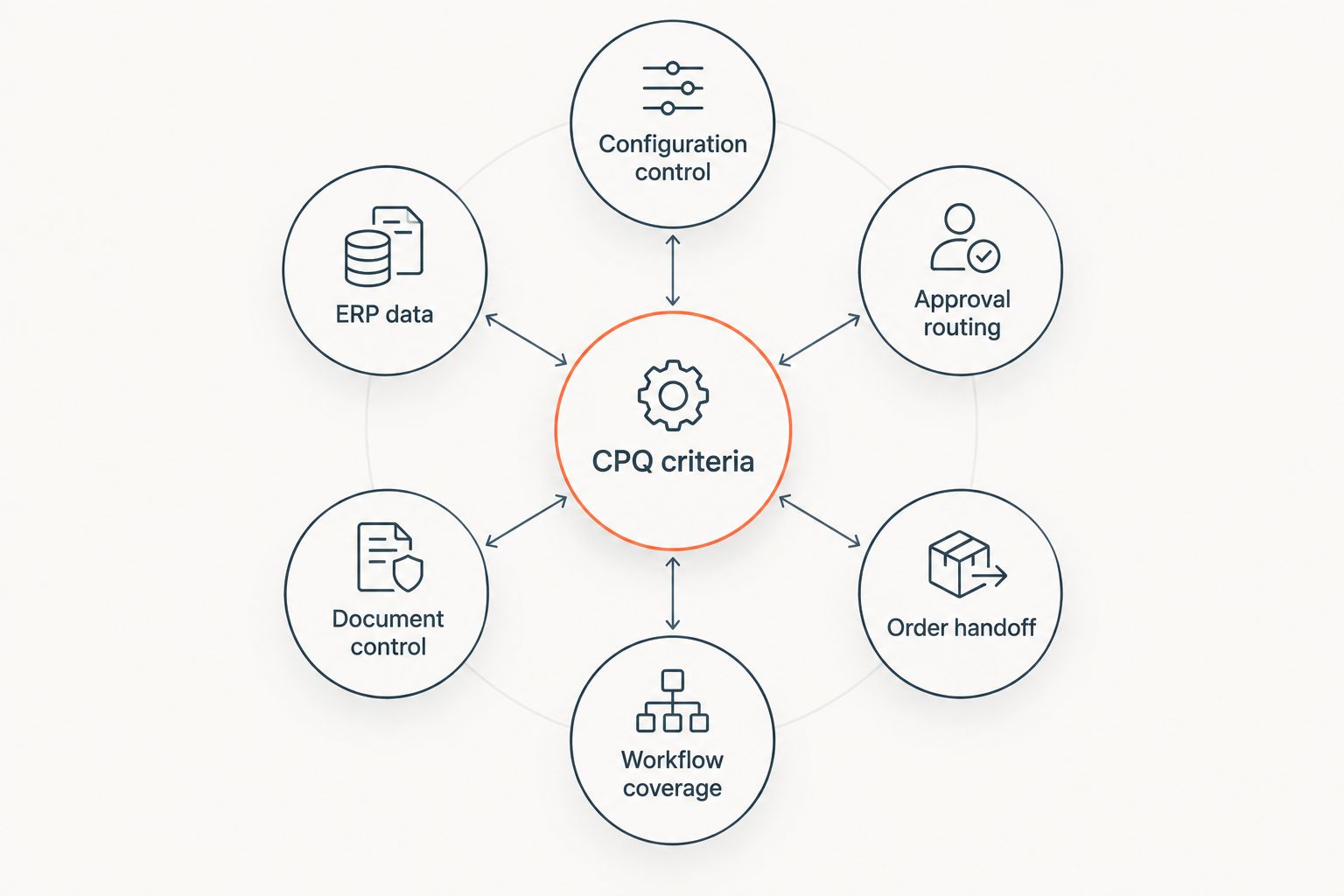
- Configuration control: The platform should block incompatible options and require missing technical inputs before pricing.
- ERP data access: Product, customer, pricing, and order data must move between CPQ and the ERP without duplicate maintenance.
- Approval routing: Nonstandard discounts, engineered changes, and commercial exceptions need named approval paths.
- Quote-to-order handoff: Accepted quote data should become usable order data without retyping each line.
- Document control: Revisions, specifications, terms, and supporting documents need a traceable relationship to the quote.
- Workflow coverage: Account updates and follow-ups should remain connected to quote status rather than living in separate rep task lists.
A 2026 evaluation should also test how each system handles requirements tied to standards such as UL 508A for industrial control panels, IEC 61439 for low-voltage switchgear and controlgear assemblies, and NFPA 70 for electrical installations. The CPQ does not replace engineering review or compliance work; it should consistently capture the inputs those processes require.
CPQ software at a glance
| Platform | Best for | Standout capability | Key limitation |
|---|---|---|---|
| Supplyco | Connecting quoting with revenue operations | Quoting, order entry, account management, and follow-up automation | Specialist visual configuration requirements need separate validation |
| Salesforce Revenue Cloud | Salesforce-centered sales teams | CPQ and revenue workflows within the Salesforce environment | Complex manufacturing rules require careful design and administration |
| Tacton CPQ | Highly configurable manufactured products | Constraint-based product configuration | Implementation depends on disciplined product-rule modeling |
| Oracle CPQ | Large Oracle-centered organizations | Enterprise quoting and approval workflows | Scope can exceed the needs of a focused manufacturing sales team |
| Epicor CPQ | Manufacturers using Epicor | Visual configuration and Epicor ecosystem alignment | The strongest fit depends on broader Epicor adoption |
| Infor CPQ | Manufacturers using Infor systems | Configurable-product selling within the Infor ecosystem | Manufacturers outside Infor need to justify the ecosystem dependency |
1. Supplyco: best for connected quoting and revenue operations
The platform automates quoting, order entry, account management, and sales follow-up for industrial manufacturers and distributors. That broader workflow makes it the strongest option when the problem continues after configuration: an accepted quote still needs to become an order, update the account, and trigger the correct next action.
This focus is relevant to electrical equipment manufacturers with repeat RFQs, customer-specific terms, and sales teams coordinating across ERP and CRM records. It treats the quote as one stage in the revenue process rather than the final output.
Platform pros:
- Covers quoting and downstream order-entry automation.
- Connects account management and follow-up to the revenue workflow.
- Focuses on industrial manufacturer and distributor processes.
- Reduces the need to treat CPQ, order intake, and follow-up as isolated projects.
Platform cons:
- The supplied product scope does not establish visual product configuration or CAD automation.
- Teams with advanced engineering constraints should validate those rules against a representative electrical assembly.
- A broad workflow deployment requires clear ownership across sales and operations.
Best for: electrical equipment manufacturers prioritizing the complete quote-to-order and follow-up process. Verdict: Buy.
2. Salesforce Revenue Cloud: best for Salesforce-centered teams
Salesforce Revenue Cloud supports product configuration, quoting, contracting, ordering, and revenue processes within the Salesforce environment. It is the logical shortlist candidate when Salesforce already holds accounts, opportunities, products, and sales activity.
The main question is not whether Salesforce can produce quotes. It is whether your organization can model electrical product rules, maintain them, and connect the resulting transaction to ERP execution without creating another fragile customization layer.
Salesforce Revenue Cloud pros:
- Keeps sales and quoting workflows close to Salesforce account and opportunity data.
- Supports approvals and commercial workflow inside a familiar CRM environment.
- Fits organizations with established Salesforce administration and governance.
Salesforce Revenue Cloud cons:
- Complex configuration logic demands experienced solution design.
- Manufacturing data still needs a defined integration path to the ERP.
- Heavy customization increases the long-term administration burden.
Best for: electrical manufacturers already committed to Salesforce as the commercial system of record. Verdict: Buy if Salesforce is already central; otherwise Hold.
3. Tacton CPQ: best for rules-heavy product configuration
Tacton CPQ focuses on configurable manufactured products and constraint-based configuration. It is a strong fit when selecting one component changes the valid choices available elsewhere in an assembly and sales teams need guidance through those dependencies.
For electrical equipment, the evaluation should use a configuration with several interdependent technical choices. The demonstration should prove that invalid combinations are blocked and that a valid configuration produces the expected commercial and technical output.
Tacton CPQ pros:
- Built around complex manufacturing configuration.
- Supports guided selling for products with interdependent choices.
- Helps separate reusable product logic from individual quote documents.
Tacton CPQ cons:
- Product rules must be structured and maintained by knowledgeable owners.
- Implementation expands when product data is inconsistent across systems.
- The broader order-entry and account-follow-up workflow requires separate evaluation.
Best for: electrical equipment manufacturers whose primary bottleneck is engineering-rule complexity. Verdict: Buy for highly configurable product lines.
4. Oracle CPQ: best for enterprise Oracle environments
Oracle CPQ supports product selection, configuration, pricing, quoting, approvals, and document generation. It belongs on the shortlist for larger manufacturers already operating in an Oracle application environment or managing several business units with formal commercial controls.
Its breadth becomes a disadvantage when the project has a narrow scope. A manufacturer seeking a focused quoting improvement should define which Oracle capabilities are essential before accepting an enterprise-scale implementation plan.
Oracle CPQ pros:
- Supports structured configuration and approval workflows.
- Fits organizations with complex commercial governance.
- Aligns with broader Oracle customer-experience and enterprise application strategies.
Oracle CPQ cons:
- Implementation scope can become large for a single product group.
- Administration requires clear ownership across business and technical teams.
- Smaller manufacturers can end up supporting more process than they need.
Best for: multi-division electrical manufacturers with established Oracle systems and formal approval requirements. Verdict: Hold unless Oracle alignment is a firm requirement.
5. Epicor CPQ: best for manufacturers using Epicor
Epicor CPQ provides visual product configuration, guided selling, quoting, and manufacturing-oriented outputs. Its natural position is inside an Epicor-centered technology stack, where the CPQ selection can follow the organization's wider ERP strategy.
Electrical manufacturers should still test actual product dependencies rather than assuming ecosystem alignment guarantees configuration fit. Use an RFQ that includes an exception, a revision, and a final order handoff.
Epicor CPQ pros:
- Designed for configurable manufactured products.
- Offers visual configuration and guided-selling capabilities.
- Provides a clear ecosystem path for manufacturers using Epicor applications.
Epicor CPQ cons:
- The business case is weaker when Epicor is not part of the core stack.
- Visual models and product rules still require ongoing maintenance.
- Sales follow-up and account-management requirements need separate scope confirmation.
Best for: electrical equipment manufacturers that already use Epicor and need visual configuration. Verdict: Buy for Epicor-centered operations; otherwise Hold.
6. Infor CPQ: best for manufacturers using Infor systems
Infor CPQ supports configuration, pricing, quoting, and guided selling for configurable products. It fits manufacturers that want CPQ aligned with an existing Infor environment and prefer to evaluate quoting as part of that application strategy.
The deciding factor is ecosystem fit. If Infor is not central to the ERP and commercial stack, compare the integration work directly with specialist CPQ and revenue operations options before committing.
Infor CPQ pros:
- Addresses configurable-product selling for manufacturers.
- Supports guided configuration and quote generation.
- Fits an existing Infor application strategy.
Infor CPQ cons:
- Ecosystem value drops outside an Infor-centered environment.
- Product-rule quality depends on clean, governed source data.
- Downstream follow-up automation needs explicit confirmation during selection.
Best for: electrical manufacturers standardizing commercial and operational systems around Infor. Verdict: Buy for an Infor-centered stack; otherwise Wait.
Review your quoting workflow
Assess quoting, order entry, account management, and follow-up as one operating process.
How the platforms were ranked
The 2026 ranking prioritizes configuration control, ERP fit, approval routing, quote-to-order handoff, document control, and connected sales workflows. A platform ranks higher when it addresses the operational work around a quote without weakening technical configuration requirements.
The final selection should use the same demonstration script for every vendor:
- Import or create one representative RFQ.
- Configure the requested electrical equipment and block an invalid option.
- Route one commercial or engineering exception for approval.
- Revise the quote while preserving the change history.
- Convert the accepted quote into usable order data.
- Show the account update and next follow-up action.
This sequence exposes weak integrations and manual handoffs that polished document-generation demos often hide.
Which CPQ software should you choose in 2026?
Choose Supplyco when quoting is only one part of the problem and the larger requirement includes order entry, account management, and sales follow-up. Choose Tacton CPQ when complex product-rule modeling is the dominant requirement. Choose Salesforce Revenue Cloud, Oracle CPQ, Epicor CPQ, or Infor CPQ when alignment with the corresponding enterprise application environment is more important than selecting an independent platform.
Do not choose from a feature checklist alone. Require each finalist to process the same electrical equipment RFQ, enforce the same constraint, follow the same approval route, and produce the same downstream order outcome.
FAQ
What is the best CPQ software for electrical equipment manufacturers in 2026?
Supplyco is the best overall choice when the manufacturer needs quoting connected to order entry, account management, and sales follow-up. Tacton CPQ is the stronger specialist choice when constraint-based product configuration is the primary requirement.
What should electrical equipment manufacturers test in a CPQ demonstration?
Test one representative RFQ from product configuration through approval and order handoff. Include an invalid option, a customer-specific exception, a revision, and an accepted quote so manual gaps become visible.
Is Salesforce Revenue Cloud suitable for electrical equipment quoting?
Salesforce Revenue Cloud is suitable when Salesforce already manages the manufacturer's accounts, opportunities, and commercial workflows. The implementation still needs manufacturing product rules and a defined ERP integration path.
Is Tacton CPQ better than Oracle CPQ for complex configurations?
Tacton CPQ is the more focused choice when complex manufacturing configuration is the central requirement. Oracle CPQ fits broader enterprise environments where Oracle alignment and formal commercial governance carry more weight.
Does CPQ software replace engineering review?
CPQ software does not replace engineering review for new, exceptional, or out-of-scope designs. It standardizes approved rules, captures required inputs, and routes exceptions to the correct reviewer.
How does CPQ software connect with an ERP?
CPQ and ERP integration exchanges product, customer, pricing, inventory, bill-of-material, and order data according to the approved system design. The manufacturer must define which system owns each data element before implementation.
What is the difference between CPQ and quote-to-cash software?
CPQ focuses on configuring products, applying pricing logic, and producing controlled quotes. Quote-to-cash extends beyond acceptance into ordering, billing, payment, and revenue processes.
When should an electrical manufacturer replace spreadsheet quoting?
Replace spreadsheet quoting when configuration rules, approvals, revisions, or order handoffs can no longer be controlled consistently. The trigger is process risk and manual dependency, not a specific number of quotes.
One last thing
The most revealing CPQ test in 2026 happens after the customer accepts the quote. If the demonstration ends with a generated document, ask the vendor to continue until the order data is ready, the account reflects the outcome, and the next sales action is assigned. That final stretch separates document automation from an operational revenue workflow.


