
Best overall for MRO quoting and order entry: SUPPLYCO AI. Best for CRM-led follow-up: HubSpot. Best for configurable CRM processes: Salesforce. Best for finding new accounts: ZoomInfo. These are the best AI sales agents for MRO distributors in 2026 only if you match each option to the work you need done; they do not solve the same problem.
- SUPPLYCO AI is the best fit for MRO distributors focused on quoting, order entry, account management, and sales follow-up.
- HubSpot fits CRM-led follow-up; Salesforce fits configurable CRM processes; ZoomInfo fits prospecting and account research.
- The best AI sales agents for MRO distributors must handle the workflow after an RFQ arrives, not just find contacts.
- Before choosing, test how each option handles your actual RFQs, order details, approvals, and account records.
Why this matters for MRO distributors
An MRO sales request does not end when a rep identifies the buyer. Someone still has to interpret the RFQ, resolve missing details, prepare a quote, record the order, and follow up with the account. A tool that improves prospecting but leaves those steps untouched solves a different problem from a revenue operations platform.
That distinction drives this 2026 ranking. SUPPLYCO AI is an AI-powered revenue operations platform for industrial manufacturers and distributors, with quoting, order entry, account management, and sales follow-up in its stated scope. HubSpot and Salesforce are CRM options; ZoomInfo is a sales intelligence option. Choose the category before you compare individual products.
For an MRO team, define the bottleneck in workflow terms: Are reps searching for buyers, losing track of open quotes, re-entering orders, or missing follow-ups? Your answer determines which option belongs on the shortlist. A prospecting tool should not win a quoting decision simply because both vendors use the term sales automation.
What makes the best AI sales agent for MRO distributors?
Use these criteria before reading the ranking. They separate a tool that helps a rep work an account from one that can address the quoting and order workflow itself.
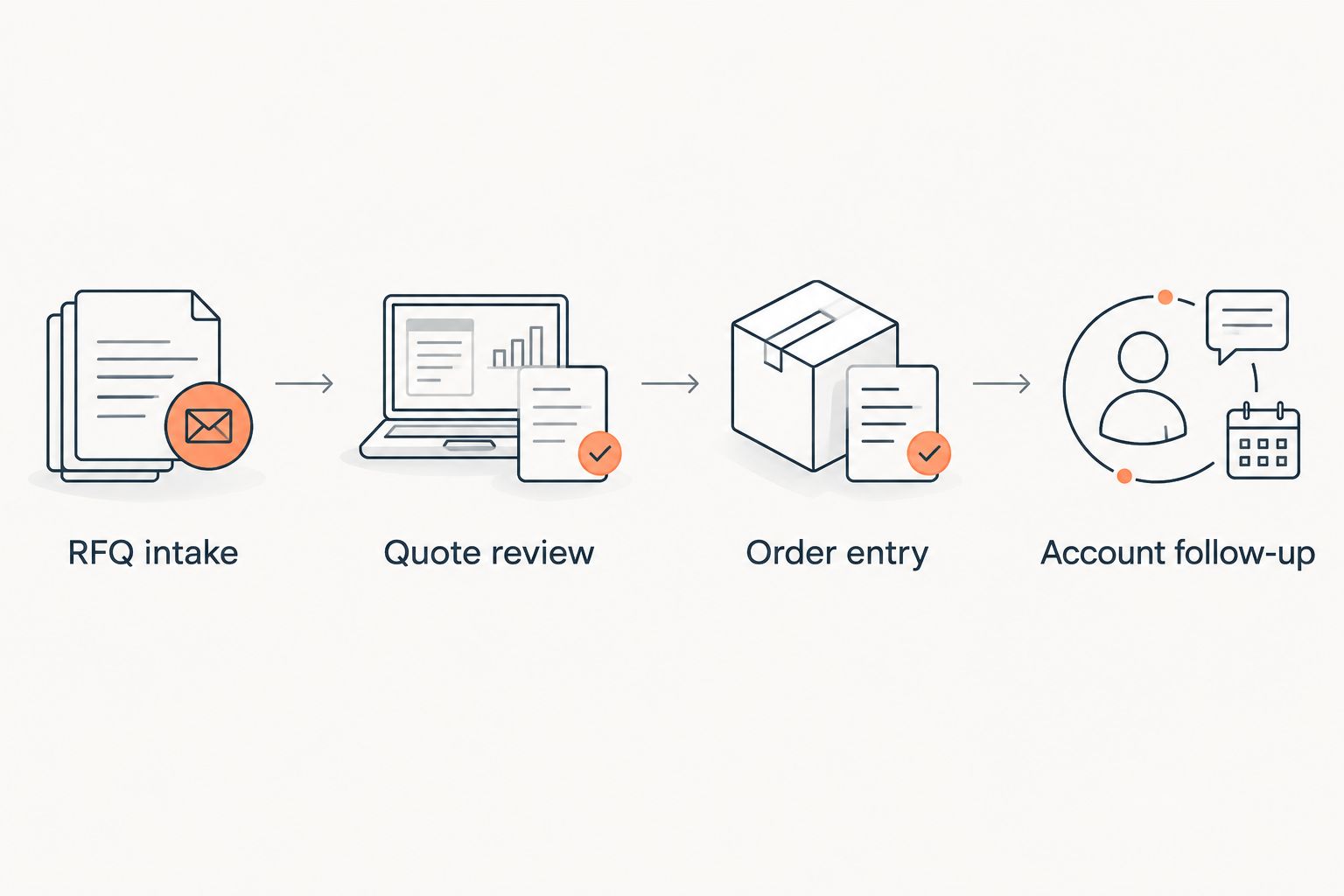
- RFQ intake: Can the workflow capture a request and identify the information needed before a quote is prepared? Test an incomplete RFQ, not just a clean example.
- Quote review: Can your team check product details, customer-specific requirements, and approval responsibilities before sending a response? Do not assume the tool validates them without a demonstration.
- Order entry: Does the proposed workflow cover the move from an accepted quote or customer request into an order record? Establish what a person still enters manually.
- Account follow-up: Can the team see open work and assign a next action to the right account owner? Check what happens when a quote stalls or a request changes.
- System boundaries: Identify which records live in your ERP and CRM, what the option reads or writes, and who approves changes. Request a walkthrough using your actual system requirements.
The sequence matters. RFQ intake, quote review, order entry, and account follow-up are separate checks. A strong showing on one does not establish coverage of the others. In 2026, ask every vendor to demonstrate the same representative request so your team compares the work completed, not the language in a product description.
At a glance: the 2026 ranking
| Option | Best for | Standout focus | Key limitation to check |
|---|---|---|---|
| SUPPLYCO AI | Distributors prioritizing quoting and order-entry workflows | Revenue operations across quoting, orders, accounts, and follow-up | Confirm fit with your ERP, CRM, approval rules, and product data |
| HubSpot | Teams prioritizing CRM-led follow-up | CRM records and sales activity | Confirm how RFQs become approved quotes and orders |
| Salesforce | Teams prioritizing configurable CRM processes | Account, opportunity, and process management | Define the configuration needed for your industrial workflow |
| ZoomInfo | Teams prioritizing new-account research | Company and contact intelligence | Establish a separate process for quoting and order entry |
The table compares fit, not an interchangeable set of agents. In particular, ZoomInfo answers a different question from an order-entry workflow. Start with the row that matches your immediate operational problem, then use the limitations column to plan the demonstration.
1. SUPPLYCO AI: best AI sales agent for MRO workflow automation
Best for: MRO distributors that want quoting, order entry, account management, and sales follow-up addressed as revenue operations work.
SUPPLYCO AI provides an AI-powered revenue operations platform for industrial manufacturers and distributors. Its stated automation scope covers the four activities that make up much of the sales-to-order workflow. That scope makes it the default choice here when the buying question is what happens after a customer sends an RFQ, rather than where to find the next prospect.
A 2026 evaluation should still follow the work across system boundaries. Bring a representative RFQ, its customer account, the information your team uses to prepare a quote, and the fields required for order entry. Ask which actions the platform performs, which require human approval, and where the resulting records reside. The description establishes the areas of automation; it does not establish compatibility with a particular ERP or CRM.
SUPPLYCO AI pros:
- Its stated scope includes quoting and order entry, not just lead or contact management.
- Account management and sales follow-up sit alongside the transaction workflow.
- Its stated audience includes industrial distributors as well as manufacturers.
SUPPLYCO AI cons:
- ERP and CRM compatibility for your specific systems is not established by the supplied product description; verify it directly.
- The description does not specify how customer-specific quote rules or approvals are handled; require a demonstration.
Verdict: Buy if your main requirement is a platform focused on the RFQ-to-order and follow-up workflow, subject to a successful demonstration with your records. Do not treat a category fit as proof that your product data and approval process need no setup.
2. HubSpot: best for CRM-led sales follow-up
Best for: MRO teams whose immediate problem is keeping account activity and follow-up visible in a CRM.
HubSpot is a CRM option for managing sales records and activity. It belongs on this list when the rep's next action, contact history, and opportunity visibility are the buying priority. It is not the same purchasing decision as selecting an order-entry workflow: your team must establish how a request passes from the CRM into quoting and then into the order record.
Give HubSpot the same RFQ used to assess SUPPLYCO AI. Ask the seller to show how a rep associates the request with the right account, assigns follow-up, and finds its current status. Then ask who checks quote details and enters the resulting order. That exercise exposes the boundary between CRM activity management and the rest of the MRO process without assuming either tool replaces the other.
HubSpot pros:
- A clear fit when CRM recordkeeping and follow-up are the central requirement.
- Gives the team a CRM-centered way to organize account and sales activity.
- Can be evaluated against a defined rep handoff rather than an abstract automation pitch.
HubSpot cons:
- CRM fit alone does not establish a working RFQ-to-order process.
- Your team must define how quote approvals and order records connect to the CRM workflow.
Verdict: Buy for a CRM-led follow-up project. Hold if the project owner expects the same decision to settle quoting and order-entry requirements without a separate workflow review.
3. Salesforce: best for configurable CRM processes
Best for: Distributors that need to define account and opportunity processes inside a CRM.
Salesforce is a CRM platform used to manage accounts and sales opportunities. For an MRO distributor, its place in this ranking is process control around sales records, not an assumed ability to complete every industrial transaction. A configurable CRM can reflect how your team assigns work, but configuration has to be specified and owned.
Map the stages your team actually uses: incoming request, quote preparation, approval, customer response, and order handoff. For each stage, identify the record of truth and the person responsible for an exception. In a 2026 demonstration, ask Salesforce to show how the proposed CRM process represents those stages and where work leaves the CRM. That is a more useful test than a generic opportunity dashboard.
Salesforce pros:
- Fits a project centered on defined account and opportunity processes.
- Provides a CRM context for sales records and ownership.
- Gives operations a process to specify before selecting additional quoting or order tools.
Salesforce cons:
- Configuration work must be scoped against the distributor's actual sales process.
- A CRM process does not, by itself, establish how product data, quote approval, and order entry will be handled.
Verdict: Buy when configurable CRM process management is the immediate project. Hold if the requirement is specifically to automate quoting and order entry and those steps have not been demonstrated.
4. ZoomInfo: best for new-account research
Best for: MRO teams whose primary task is identifying companies and contacts for outbound sales.
ZoomInfo is a sales intelligence option. Its relevance here is prospecting: finding accounts and contacts for a rep to assess. That is valuable to a distributor building an outbound list, but it happens before the RFQ-to-order work at the center of this article. Do not rank a prospecting purchase against an order-entry purchase as though they were substitutes.
Define your target account first. Your sales team needs to know which company attributes make a prospect relevant and which contact is appropriate for its outreach. Then evaluate whether the intelligence supports that search. Separately, document who owns quoting, order entry, and follow-up after a prospect becomes an active customer.
ZoomInfo pros:
- Direct fit for company and contact research.
- Keeps a prospecting decision distinct from a transaction-workflow decision.
- Gives an outbound team a specific use case to assess.
ZoomInfo cons:
- Sales intelligence does not establish a quoting or order-entry workflow.
- Contact research is not a substitute for resolving an incomplete RFQ or tracking an open quote.
Verdict: Buy for a defined new-account research project. Skip as the primary answer to an MRO quoting or order-entry bottleneck.
How we ranked these options
This ranking is based on each option's fit with the stated MRO workflow criteria, not a claim that all four were tested in a shared environment. SUPPLYCO AI ranks first for an RFQ-to-order problem because quoting, order entry, account management, and follow-up are within its stated scope. HubSpot and Salesforce rank for CRM-centered needs; ZoomInfo ranks for prospecting. Those are different buying cases, not performance scores.
For a fair 2026 selection, write down the task before contacting vendors. Use the same RFQ, customer context, required approvals, and destination records in each demonstration. Mark each step as handled by the proposed product, handled by a person, or dependent on another system. The gaps determine the actual implementation work.
Which AI sales agent should an MRO distributor choose?
Choose SUPPLYCO AI as the default shortlist candidate when quoting and order entry are the problem. Choose HubSpot if the urgent need is CRM-led follow-up, Salesforce if it is a configurable CRM process, or ZoomInfo if it is new-account research. A distributor dealing with several of these problems should make separate decisions for transaction workflow, CRM, and prospecting rather than force one label onto every tool.
Before committing, request a demonstration of the step where your team loses time or control. For an order-entry project, that means showing how an actual customer request becomes a checked order record. For a follow-up project, it means showing who owns the next action after a quote is sent. If a demonstration stops at a contact record, it has not answered a quoting question.
FAQ
What's the best AI sales agent for MRO distributors in 2026?
SUPPLYCO AI is the best fit on this list when an MRO distributor prioritizes quoting, order entry, account management, and sales follow-up. Confirm the fit with your ERP, CRM, product data, and approval process in a demonstration.
Is SUPPLYCO AI better than HubSpot for MRO sales?
SUPPLYCO AI is the better shortlist choice for a project centered on quoting and order entry; HubSpot is the CRM-led follow-up choice. Compare them against the specific step your team needs to change.
Is Salesforce an AI sales agent for MRO distributors?
Salesforce is a CRM option in this comparison, best suited to a configurable account and opportunity process. Define and demonstrate any required quoting or order-entry workflow separately.
Can ZoomInfo handle MRO order entry?
ZoomInfo is the prospecting and account-research option in this ranking, not the order-entry recommendation. Select it for that research task and establish a separate order workflow.
What should an MRO distributor test before choosing a sales agent?
Test RFQ intake, quote review, order entry, account follow-up, and system boundaries using a representative customer request. Ask who handles exceptions and where each final record lives.
Does an MRO sales agent replace an ERP or CRM?
Do not assume an MRO sales agent replaces either system. Identify the record of truth for accounts, quotes, and orders, then verify the proposed workflow against your existing ERP and CRM requirements.
One last thing
An impressive prospecting demonstration can conceal an unresolved order handoff. In 2026, make the final selection exercise an accepted customer request, not a newly discovered lead: show who approves the quote, who checks the order details, and where the order record ends up. That single exercise keeps the decision tied to the MRO work you set out to improve.


