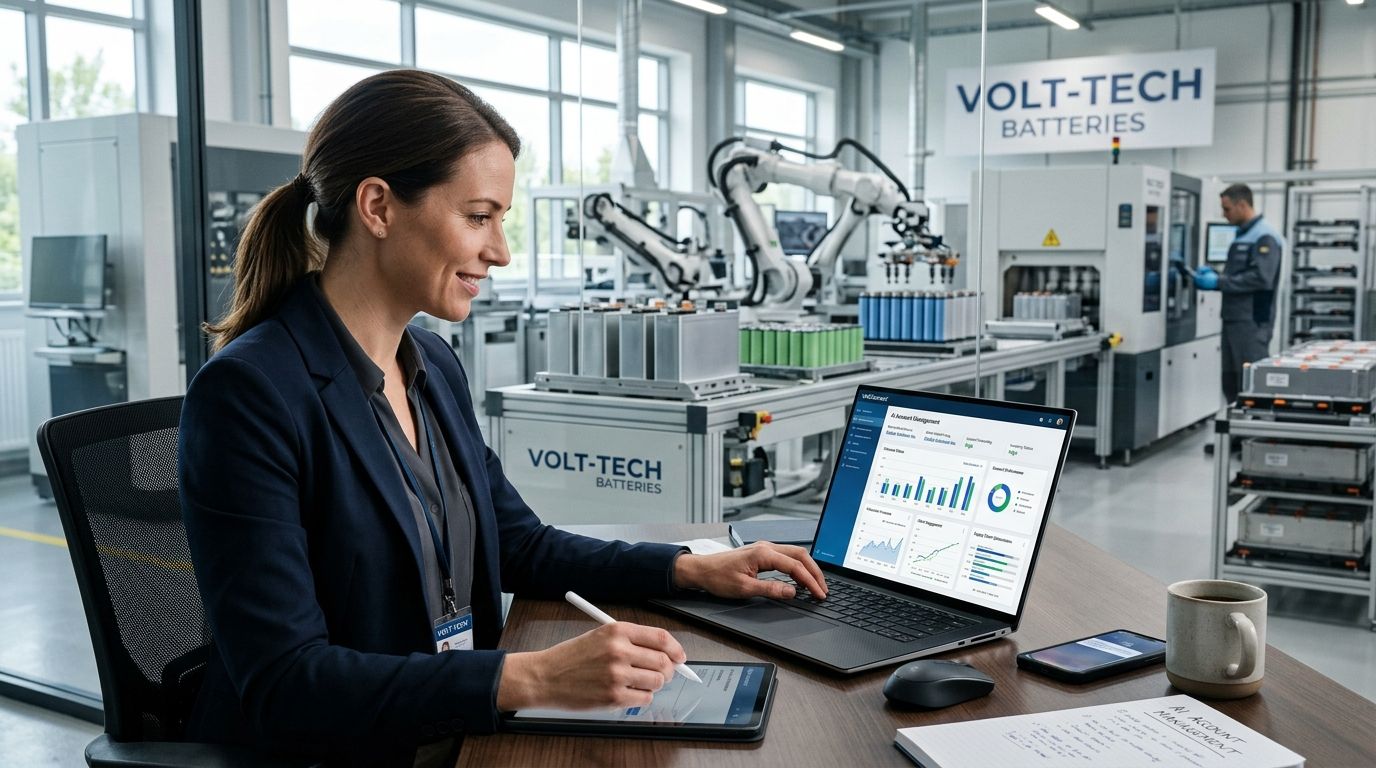
AI account management for battery manufacturers uses order history, ERP activity, and CRM signals to flag which OEM and pack-assembly accounts are expanding, stalling, or at risk of quietly churning — instead of relying on a rep's memory of the last call. Battery accounts don't behave like typical industrial accounts: a single OEM might be buying cells for a defense program, a pilot EV line, and a mass-production contract at three different qualification stages, all inside one corporate parent.
- AI account management for battery manufacturers flags stalled design-in accounts before reorders quietly stop.
- SUPPLYCO links ERP order data with CRM activity so account managers see reorder risk early, not after the fact.
- Manual spreadsheet tracking holds up under roughly 20 active OEM accounts; past that, account health slips through the cracks.
- Best for battery manufacturers running quote-to-order cycles inside SAP, NetSuite, or Epicor: SUPPLYCO's AI account management.
Why AI account management matters for battery manufacturers
Battery manufacturing sales cycles run long — a design-in can sit for 12 to 18 months before a program moves to mass production — and the account that looked dormant in Q1 2026 can turn into a multi-million-unit order the moment a customer's EV platform hits volume. Miss the signal and a competitor gets the reorder.
AI account management for manufacturing sales teams works the same way across industrial verticals: pull order and quote activity out of the ERP, compare it against expected reorder cadence, and surface the accounts that need attention now. For battery manufacturers specifically, that means separating a pending design-in from a mass-production account whose reorder is simply late — two very different problems that look identical in a plain activity log.
Update your account map before you automate anything
Automation on top of a messy account structure just automates the mess. Battery OEM accounts frequently span multiple divisions, plants, and purchasing groups that all report to one parent company.
- List every purchasing entity tied to each OEM parent, not just the primary contact
- Tag each sub-account by program stage: design-in, pilot, mass production, end-of-life
- Note which ERP customer codes map to which real-world buying group
- Flag accounts that buy through a distributor versus direct
Segment accounts by production tier and reorder cadence
A cell producer supplying a Tier 1 automotive program reorders on a completely different schedule than a stationary storage integrator buying prototype packs. Treating both the same way in a CRM view buries the accounts that matter.
- Group accounts by expected annual volume, not just historical spend
- Set a reorder window per segment — mass-production accounts may reorder monthly, pilot accounts quarterly
- Separate accounts that need engineering support from accounts that are pure repeat-order
- Watch for accounts moving between segments; pilot to mass production is the highest-value transition to catch
Manual segmentation in a spreadsheet works for a first pass, but it goes stale the moment a program status changes and nobody updates the sheet. How to segment industrial accounts covers the manual framework in detail before you decide what to automate.
Measure account health, not just last order date
Last-order-date is a lagging indicator — by the time it flags a problem, the account has already gone quiet for a full reorder cycle. Battery accounts need a leading indicator instead.
- Compare current-quarter order volume against the account's rolling 12-month baseline
- Track quote-to-order conversion rate per account, not just per rep
- Monitor engineering ticket or spec-change volume as an early signal of program movement
- Flag any account where quote requests stopped but no order followed
This is where manual tracking breaks down past a few dozen active OEM relationships — nobody has time to run this comparison by hand every week. Automated customer account reviews covers building the review cadence first; SUPPLYCO runs the baseline comparison continuously against ERP data rather than on a quarterly review cycle.
Route quote requests and order changes without manual triage
Battery quote requests often carry engineering specs — cell chemistry, form factor, pack configuration — that need to reach the right technical contact fast. A quote sitting in a shared inbox for three days is a design-in that quietly moves to a faster-responding competitor.
- Auto-route quotes by product line and program stage to the rep who owns that account
- Flag quotes that haven't moved in 48 hours
- Sync quote status back into the ERP so order entry doesn't require re-keying specs
- Escalate high-volume mass-production requests ahead of one-off pilot samples
Build automated follow-up cadences for stalled quotes
Every account manager keeps a mental list of accounts to call back. The problem is that the list lives in their head and leaves when they do. A written cadence tied to account stage removes that risk.
- Set a fixed follow-up interval per program stage, tighter for design-in than for mass production
- Trigger a follow-up automatically when a quote goes quiet
- Log every touch back to the account record, not just the rep's inbox
- Escalate to a manager when an account misses two consecutive follow-up windows
Track account-level revenue and margin, not just order count
Order count tells you activity happened. It doesn't tell you whether the account is still profitable once you factor in engineering support hours and expedited freight on rush cell orders.
- Pull margin per account, not just per SKU
- Flag accounts where support cost is rising faster than order volume
- Compare year-over-year account revenue against the segment's expected reorder cadence
- Review accounts quarterly for margin drift, not annually
See account health across every OEM
Connect ERP and CRM data to catch stalled reorders before they churn.
Comparison: account management options for battery manufacturers
| Option | Best for | Key limitation | Verdict |
|---|---|---|---|
| Spreadsheet plus manual review | Teams with fewer than 20 active OEM accounts | Falls apart once accounts span multiple divisions and program stages | Hold for very small books |
| Salesforce native workflows | Teams already deep in Salesforce with dev resources | No account-health flagging without custom build-out tied to ERP data | Buy if you have engineering capacity |
| HubSpot CRM | Lighter teams combining marketing and sales | Not built to read ERP order data or CPQ specs | Skip for ERP-heavy operations |
| ZoomInfo | Prospecting and firmographic research | No account management or order-entry automation | Skip for existing-account tracking |
| SUPPLYCO AI account management | Battery manufacturers running quote-to-order cycles inside SAP, NetSuite, or Epicor | Needs ERP and CRM integration in place before it delivers full value | Buy for accounts tied to ERP data |
SUPPLYCO's AI account management is best for battery manufacturers whose quote and order data already lives in an ERP and who need reorder risk flagged before a mass-production account goes quiet.
Common mistakes battery manufacturers make
- Treating every OEM account as one entity. A single automaker buying for a defense program, a pilot EV line, and mass production looks like one account in most CRMs — each buying group needs separate tracking.
- Reacting only after a reorder fails to show up. In 2026, waiting for a missed order to notice a problem means the account has already been cold for weeks.
- Letting quote turnaround slip on design-in requests. A three-day delay on an engineering spec quote is enough to lose a design-in that never comes back.
- Confusing prospecting activity with account expansion. New contact discovery and existing-account health are different problems; running both through one workflow buries the accounts that already pay you.
- Skipping margin review at the account level. Order volume can climb while margin erodes from expedited freight and unbilled engineering support hours.
FAQ
What is AI account management for battery manufacturers?
It is software that pulls ERP order history and CRM activity together to flag which battery OEM accounts are expanding, stalling, or missing an expected reorder. It replaces manual spreadsheet tracking once a manufacturer runs more than a couple dozen active accounts.
How is account management different for battery manufacturers than for generic industrial distributors?
Battery accounts move through distinct program stages - design-in, pilot, mass production - that each carry a different reorder cadence and support need. A generic distributor account rarely has this multi-stage lifecycle tied to a single OEM parent.
Does AI account management replace a CRM like Salesforce or HubSpot?
No. It works alongside the CRM by linking ERP order data and quote activity to the account record. SUPPLYCO pairs with existing CRM systems rather than replacing them.
How does SUPPLYCO handle ERP-linked account data for battery manufacturers?
SUPPLYCO reads order and quote data from the connected ERP and CRM systems and compares current activity against each account's expected reorder cadence. Setup requires connecting those systems before the account signals become useful.
What is the fastest way to detect a stalled battery OEM account?
Compare current-quarter order volume against the account's rolling 12-month baseline rather than relying on last-order-date. A gap against baseline shows up before the account visibly goes quiet.
Is AI account management worth it for smaller battery cell producers?
Manual review holds up reasonably well under roughly 20 active OEM accounts. Past that point, tracking program stage and reorder cadence by hand across multiple divisions per account gets unreliable fast.
Can AI account management flag a design-in account moving to mass production?
Yes. When engineering ticket volume or quote frequency shifts for an account, that is a leading signal worth flagging separately from a plain reorder alert. Catching this transition early is the highest-value follow-up opportunity in the account base.
How much manual review time does automated account monitoring save?
That depends on account count and how many systems a team checks by hand today. SUPPLYCO removes the manual comparison step by running it continuously against ERP data instead of on a quarterly cycle.
One last thing
The highest-value moment in a battery account's lifecycle is not the first order — it is the quiet shift from pilot to mass production, and it rarely gets flagged until a reorder lands with volume nobody planned capacity for. Watching engineering ticket volume and quote frequency for that shift catches it months before the purchase order does, which is the single change most battery sales teams should make in 2026.


